

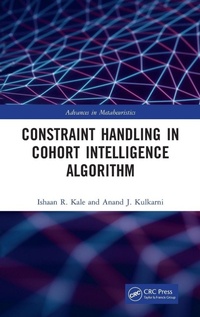
Constraint Handling in Cohort Intelligence Algorithm
1st Edition
Published on 27. December 2021
Book
Hardback
200 pages
978-1-032-15075-8 (ISBN)
Description
Mechanical Engineering domain problems are generally complex, consisting of different design variables and constraints. These problems may not be solved using gradient-based optimization techniques. The stochastic nature-inspired optimization techniques have been proposed in this book to efficiently handle the complex problems. The nature-inspired algorithms are classified as bio-inspired, swarm, and physics/chemical-based algorithms.
Socio-inspired is one of the subdomains of bio-inspired algorithms, and Cohort Intelligence (CI) models the social tendencies of learning candidates with an inherent goal to achieve the best possible position. In this book, CI is investigated by solving ten discrete variable truss structural problems, eleven mixed variable design engineering problems, seventeen linear and nonlinear constrained test problems and two real-world applications from manufacturing domain. Static Penalty Function (SPF) is also adopted to handle the linear and nonlinear constraints, and limitations in CI and SPF approaches are examined.
Constraint Handling in Cohort Intelligence Algorithm is a valuable reference to practitioners working in the industry as well as to students and researchers in the area of optimization methods.
Socio-inspired is one of the subdomains of bio-inspired algorithms, and Cohort Intelligence (CI) models the social tendencies of learning candidates with an inherent goal to achieve the best possible position. In this book, CI is investigated by solving ten discrete variable truss structural problems, eleven mixed variable design engineering problems, seventeen linear and nonlinear constrained test problems and two real-world applications from manufacturing domain. Static Penalty Function (SPF) is also adopted to handle the linear and nonlinear constraints, and limitations in CI and SPF approaches are examined.
Constraint Handling in Cohort Intelligence Algorithm is a valuable reference to practitioners working in the industry as well as to students and researchers in the area of optimization methods.
More details
Series
Language
English
Place of publication
London
United Kingdom
Publishing group
Taylor & Francis Ltd
Target group
College/higher education
Academic, Postgraduate, Professional, and Undergraduate Advanced
Illustrations
75 s/w Abbildungen, 75 s/w Zeichnungen, 64 s/w Tabellen
64 Tables, black and white; 75 Line drawings, black and white; 75 Illustrations, black and white
Dimensions
Height: 240 mm
Width: 161 mm
Thickness: 16 mm
Weight
482 gr
ISBN-13
978-1-032-15075-8 (9781032150758)
Copyright in bibliographic data and cover images is held by Nielsen Book Services Limited or by the publishers or by their respective licensors: all rights reserved.
Schweitzer Classification
Other editions
Additional editions
Ishaan R. Kale | Anand J. Kulkarni
Constraint Handling in Cohort Intelligence Algorithm
Book
10/2024
1st Edition
CRC Press
€68.10
Shipment within 10-20 days
Ishaan R. Kale | Anand J. Kulkarni
Constraint Handling in Cohort Intelligence Algorithm
E-Book
12/2021
1st Edition
CRC Press
€61.99
Available for download
Ishaan R. Kale | Anand J. Kulkarni
Constraint Handling in Cohort Intelligence Algorithm
E-Book
12/2021
1st Edition
CRC Press
€61.99
Available for download
Persons
Ishaan R. Kale is a researcher for the Optimization and Agent Technology Research (OAT Research) Lab.
Anand J. Kulkarni is an Associate Professor at the Institute of Artificial Intelligence, MIT World Peace University, India.
Anand J. Kulkarni is an Associate Professor at the Institute of Artificial Intelligence, MIT World Peace University, India.
Content
Chapter 1: Introduction to Metaheuristic Algorithms
Chapter 2: Literature Survey on Nature Inspired Optimisation Methodologies and Constraint Handling
Chapter 3: Cohort Intelligence (CI) Using the Static Penalty Function (SPF) Approach
Chapter 4: Constraint Handling Using the Self-Adaptive Penalty Function (SAPF) Approach
Chapter 5: Hybridization of Cohort Intelligence with Colliding Bodies Optimisation
Chapter 6: Validation of CI-SPF, CI-SAPF and CI-SAPF-CBO for Solving Discrete/Integer and Mixed Variable Problems
Chapter 7: Solution to Real-World Applications
Chapter 8: Conclusions and Recommendations
Appendix: Problem Statements for the Truss Structure, Design Engineering, Linear and Nonlinear Programming and Manufacturing Problems
Index
Chapter 2: Literature Survey on Nature Inspired Optimisation Methodologies and Constraint Handling
Chapter 3: Cohort Intelligence (CI) Using the Static Penalty Function (SPF) Approach
Chapter 4: Constraint Handling Using the Self-Adaptive Penalty Function (SAPF) Approach
Chapter 5: Hybridization of Cohort Intelligence with Colliding Bodies Optimisation
Chapter 6: Validation of CI-SPF, CI-SAPF and CI-SAPF-CBO for Solving Discrete/Integer and Mixed Variable Problems
Chapter 7: Solution to Real-World Applications
Chapter 8: Conclusions and Recommendations
Appendix: Problem Statements for the Truss Structure, Design Engineering, Linear and Nonlinear Programming and Manufacturing Problems
Index