

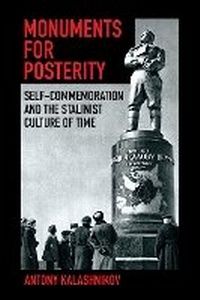
Monuments for Posterity
Self-Commemoration and the Stalinist Culture of Time
Published on 15. April 2023
Book
Hardback
216 pages
978-1-5017-6863-7 (ISBN)
Description
Monuments for Posterity challenges the common assumption that Stalinist monuments were constructed with an immediate, propagandistic function, arguing instead that they were designed to memorialize the present for an imagined posterity. In this respect, even while pursuing its monument-building program with a singular ruthlessness and on an unprecedented scale, the Stalinist regime was broadly in step with transnational monument-building trends of the era and their undergirding cultural dynamics.
By integrating approaches from cultural history, art criticism, and memory studies, along with previously unexplored archival material, Antony Kalashnikov examines the origin and implementation of the Stalinist monument-building program from the perspective of its goal to "immortalize the memory" of the era. He analyzes how this objective affected the design and composition of Stalinist monuments, what cultural factors prompted the sudden and powerful yearning to be remembered, and most importantly, what the culture of self-commemoration revealed about changing outlooks on the future-both in the Soviet Union and beyond its borders.
Monuments for Posterity shifts the perspective from monuments' political-ideological content to the desire to be remembered and prompts a much-needed reconsideration of the supposed uniqueness of both Stalinist aesthetics and the temporal culture that they expressed. Many Stalinist monuments still stand prominently in postsocialist cityscapes and remain the subject of continual heated political controversy. Kalashnikov makes manifest monuments' intentional attempts to seduce us-the "posterity" for whom they were built.
By integrating approaches from cultural history, art criticism, and memory studies, along with previously unexplored archival material, Antony Kalashnikov examines the origin and implementation of the Stalinist monument-building program from the perspective of its goal to "immortalize the memory" of the era. He analyzes how this objective affected the design and composition of Stalinist monuments, what cultural factors prompted the sudden and powerful yearning to be remembered, and most importantly, what the culture of self-commemoration revealed about changing outlooks on the future-both in the Soviet Union and beyond its borders.
Monuments for Posterity shifts the perspective from monuments' political-ideological content to the desire to be remembered and prompts a much-needed reconsideration of the supposed uniqueness of both Stalinist aesthetics and the temporal culture that they expressed. Many Stalinist monuments still stand prominently in postsocialist cityscapes and remain the subject of continual heated political controversy. Kalashnikov makes manifest monuments' intentional attempts to seduce us-the "posterity" for whom they were built.
Reviews / Votes
In his thorough historical exploration of memorials and magnificent edifices in Stalin's Soviet Union, Kalashnikov argues that the frenzy of monument building and grand architectural projects was driven less by propaganda and more by the regime's desire to immortalize itself for future generations.(Foreign Affairs)
More details
Language
English
Place of publication
Ithaca
United States
Product notice
Paper over boards
Illustrations
15 b&w halftones - 15 Halftones, black and white
Dimensions
Height: 229 mm
Width: 152 mm
Thickness: 22 mm
Weight
907 gr
ISBN-13
978-1-5017-6863-7 (9781501768637)
Copyright in bibliographic data and cover images is held by Nielsen Book Services Limited or by the publishers or by their respective licensors: all rights reserved.
Schweitzer Classification
Other editions
Additional editions
E-Book
04/2023
Cornell University Press
€22.49
Available for download
Person
Antony Kalashnikov is Postdoctoral Fellow in History at the University of Waterloo.
Content
Introduction: Beyond totalitarian monuments
1. Stalinist monuments in context
2. Historicist aesthetics: developing an enduring architecture
3. Synthetic composition: anticipating posterity's gaze
4. The (un)contested politics of Stalinist monument building
5. The cultural foundations of Stalinistmonument building
6. Self-commemoration and the interwar culture of time
Epilogue: Posterity's Monuments
1. Stalinist monuments in context
2. Historicist aesthetics: developing an enduring architecture
3. Synthetic composition: anticipating posterity's gaze
4. The (un)contested politics of Stalinist monument building
5. The cultural foundations of Stalinistmonument building
6. Self-commemoration and the interwar culture of time
Epilogue: Posterity's Monuments