

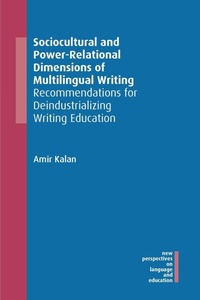
Sociocultural and Power-Relational Dimensions of Multilingual Writing
Recommendations for Deindustrializing Writing Education
Published on 14. May 2021
Book
Paperback/Softback
240 pages
978-1-78892-670-6 (ISBN)
Description
This book examines the writing practices of three adult multilingual writers through the prism of their writing in English as an additional language. It illustrates some of the social, cultural and political contexts of the writers' literacy activities and discusses how these impact their literate and intellectual lives. It reflects on the para- and meta-textual dimensions of writing because organic writing practices are almost always performed within sociocultural and power-relational contexts. In our highly compartmentalized educational structures, writing education has been severed from those organic components, focusing mainly on writing stylistics. This book proposes creating space for organic writing practices in our everyday writing pedagogies, and argues for a writing pedagogy that acknowledges the complex interactions of social, emotional and identity-related layers of writing.
Reviews / Votes
Amir Kalan's participatory ethnographic research with three adult multilingual English writers reveals how monolingual language ideologies, formalist pedagogies, and industrialized assessment practices have kept Anglo-Americentric educational institutions oblivious to the richness and complexity of immigrants' cultural and discursive experience. Kalan's exemplary case studies show how this experience might be tapped as an intellectual catalyst, with writing re-figured as an emergent activity of hermeneutic design, semiotic dexterity, and rhetorical consciousness of language-power relations. * John Trimbur, Emerson College, USA * Kalan has written one of those rare scholarly texts in education which is theoretically rich while simultaneously offering concrete suggestions for practice and policy. Through eminently lucid and engaging prose, this book provides textured portraits of how multilingual writers draw upon their rich transnational cultural repertoires to navigate their social worlds. In doing so, it also prefigures a cosmopolitanism that is not naive to issues of power and inequity during this period of resurgent xenophobia. A hopeful gem of a book. * Gerald Campano, University of Pennsylvania, USA *More details
Series
Language
English
Place of publication
Bristol
United Kingdom
Target group
College/higher education
Dimensions
Height: 234 mm
Width: 156 mm
Thickness: 13 mm
Weight
363 gr
ISBN-13
978-1-78892-670-6 (9781788926706)
DOI
10.21832/KALAN7802
Copyright in bibliographic data and cover images is held by Nielsen Book Services Limited or by the publishers or by their respective licensors: all rights reserved.
Schweitzer Classification
Other editions
Additional editions
Amir Kalan
Sociocultural and Power-Relational Dimensions of Multilingual Writing
Recommendations for Deindustrializing Writing Education
E-Book
05/2021
Multilingual Matters
€24.49
Available for download
Amir Kalan
Sociocultural and Power-Relational Dimensions of Multilingual Writing
Recommendations for Deindustrializing Writing Education
Book
05/2021
Multilingual Matters
€170.70
Shipment within 3-4 weeks
Person
Amir Kalan is Assistant Professor in the Department of Integrated Studies in Education (DISE) at McGill University, Canada. He is the author of Who's Afraid of Multilingual Education? (Multilingual Matters, 2016). He is interested in critical literacy, multiliteracies, second language writing, intercultural rhetoric, multilingual text generation, and multimodal and digital writing.
Content
Acknowledgments
1. Introduction
2. Conceptual and Empirical Background
3. Making Sense of Histories and Literate Legacies
4. Literacy and Writing Discourses
5. Writing as a Power Differential
6. Written Texts as Organic Outgrowth of Complex Linguistic and Cultural Repertoires
7. Social and Institutional Lived Experiences
8. Mechanics and Practicalities
9. Implications, Recommendations, and Potential Further Directions
References
1. Introduction
2. Conceptual and Empirical Background
3. Making Sense of Histories and Literate Legacies
4. Literacy and Writing Discourses
5. Writing as a Power Differential
6. Written Texts as Organic Outgrowth of Complex Linguistic and Cultural Repertoires
7. Social and Institutional Lived Experiences
8. Mechanics and Practicalities
9. Implications, Recommendations, and Potential Further Directions
References