

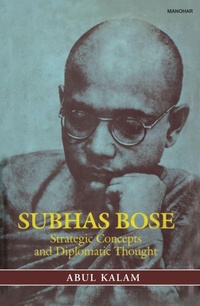
Subhas Bose
Strategic Concepts and Diplomatic Thought
Published on 20. November 2024
Book
Hardback
178 pages
978-81-7304-219-5 (ISBN)
Description
The book focuses on the contributions of Subhas Chandra Bose as a revolutionary politician and on his diplomatic undertakings. It places in perspective his strategic blueprint or framework of action for the liberation of India. It examines his concepts on international relations in an era when in many parts of the world the notion of nation-state and that of inter-state relations were being formulated.
It advances the view that, Bose was perhaps the only nationalist leader who demonstrated a great deal of understanding of the dynamics of strategy and tactics involved in India's liberation struggle. He displayed great skill in international diplomacy despite the constraints and limitations imposed by the existing frame of national liberation struggle and the colonial surroundings of the time. It is suggested that it was Bose who could have delivered India from colonial bondage and might have saved the subcontinent from the vicious circle of conflict and disharmony, disintegration and fragmentation.
Bose's views on regional subsystem and international system as a whole have also been projected to suggest that he was far ahead of his time. The strategic framework of Bose and his diplomatic thought as well as his legacy of action may perhaps still serve as the basis for forging and reinforcing a peaceful evolution of co-operative system in South Asia.
It advances the view that, Bose was perhaps the only nationalist leader who demonstrated a great deal of understanding of the dynamics of strategy and tactics involved in India's liberation struggle. He displayed great skill in international diplomacy despite the constraints and limitations imposed by the existing frame of national liberation struggle and the colonial surroundings of the time. It is suggested that it was Bose who could have delivered India from colonial bondage and might have saved the subcontinent from the vicious circle of conflict and disharmony, disintegration and fragmentation.
Bose's views on regional subsystem and international system as a whole have also been projected to suggest that he was far ahead of his time. The strategic framework of Bose and his diplomatic thought as well as his legacy of action may perhaps still serve as the basis for forging and reinforcing a peaceful evolution of co-operative system in South Asia.
More details
Language
English
Place of publication
New Delhi
India
Target group
College/higher education
Professional and scholarly
Product notice
sewn/stitched
Cloth over boards
Illustrations
16 b&w illutrations
Dimensions
Height: 230 mm
Width: 150 mm
Weight
550 gr
ISBN-13
978-81-7304-219-5 (9788173042195)
Copyright in bibliographic data and cover images is held by Nielsen Book Services Limited or by the publishers or by their respective licensors: all rights reserved.
Schweitzer Classification
Person
Abul Kalam is Professor of International Relations, University of Dhaka. He had his education and research experiences at Dhaka, Carleton, Berkeley, Liverpool, Oxford and Urbana Champaign. He has authored Japan and South Asia: Subsystemic Linkages and the Developing Relationships; edited Bangladesh: Internal Dynamics and External Linkages.
Content
Foreword
Preface
Chapter 1 Introduction
Chapter 2 Subhas Bose's Life and His Time
Chapter 3 Strategic Concepts Philosophy of Struggle
Chapter 4 Diplomatic Thought and Pursuits
Chapter 5 Conclusion Bose in Retrospect and Prospect
Chapter 6: Postscript Bose and the Common Legacy of Bengal
Appendices
Bibliography
Index
Preface
Chapter 1 Introduction
Chapter 2 Subhas Bose's Life and His Time
Chapter 3 Strategic Concepts Philosophy of Struggle
Chapter 4 Diplomatic Thought and Pursuits
Chapter 5 Conclusion Bose in Retrospect and Prospect
Chapter 6: Postscript Bose and the Common Legacy of Bengal
Appendices
Bibliography
Index