

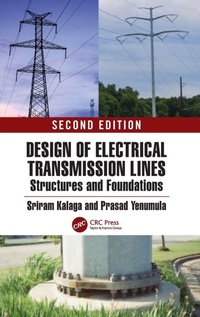
Design of Electrical Transmission Lines, Structures, and Foundations
2nd Edition
Will be published approx. on 29. July 2026
Book
Hardback
500 pages
978-1-032-88187-4 (ISBN)
Description
This book covers line modeling, structural and foundation systems used in highvoltage transmission lines, conductors, insulators, hardware, and component assembly. In most developing countries, the term "transmission structures" usually means lattice steel towers. The term actually includes a vast range of structural systems and configurations of various materials such as wood, steel, concrete, and composites.This book discusses those systems along with associated topics such as structure functions and configurations, load cases for design, analysis techniques, line, structure and foundation modeling, design deliverables, and latest advances in the field. In the foundations section, theories related to direct embedment, drilled shafts, spread foundations, vibratory caissons, micropiles, and anchors are discussed in detail. Regulatory changes related to climate change are added in this edition along with a special chapter on complex design situations.
Key Features:
Covers transmission and distribution lines
Explores modeling, analysis and design
Includes sections about structural and foundation systems
Featuring worked out design problems, the book is aimed at students, practicing engineers, researchers and academics. It contains beneficial information for those involved in the design and maintenance of transmission line structures and foundations. For those in academia, it will be an adequate text-book / design guide for graduate-level courses on the topic. Engineers and managers at utilities and electrical corporations will find the book a useful reference at work.
Key Features:
Covers transmission and distribution lines
Explores modeling, analysis and design
Includes sections about structural and foundation systems
Featuring worked out design problems, the book is aimed at students, practicing engineers, researchers and academics. It contains beneficial information for those involved in the design and maintenance of transmission line structures and foundations. For those in academia, it will be an adequate text-book / design guide for graduate-level courses on the topic. Engineers and managers at utilities and electrical corporations will find the book a useful reference at work.
More details
Edition
2nd edition
Language
English
Place of publication
London
United Kingdom
Publishing group
Taylor & Francis Ltd
Target group
College/higher education
Postgraduate
Illustrations
22 s/w Photographien bzw. Rasterbilder, 176 s/w Zeichnungen, 124 s/w Tabellen, 198 s/w Abbildungen
124 Tables, black and white; 176 Line drawings, black and white; 22 Halftones, black and white; 198 Illustrations, black and white
Dimensions
Height: 234 mm
Width: 156 mm
Weight
453 gr
ISBN-13
978-1-032-88187-4 (9781032881874)
Copyright in bibliographic data and cover images is held by Nielsen Book Services Limited or by the publishers or by their respective licensors: all rights reserved.
Schweitzer Classification
Other editions
Previous edition
Book
12/2016
1st Edition
CRC Press
€244.90
Shipment within 10-20 days
Persons
Dr. Sriram Kalaga is currently a Senior Engineer in the Transmission Line Division of Ulteig Engineers. He holds bachelors, masters and doctoral degrees in Civil engineering with a specialization in Structural Engineering and Mechanics. He has published more than 35 research papers in various journals and conferences. His research background included finite element methods, buckling of beam-columns, nonlinearities, low-cost composites and reliability-based approaches. He has been involved in transmission line design in the USA for 16 years while his overall experience as a Civil Engineer spans over 36 years. As a consulting engineer, he developed various in-house design manuals and technical specifications related to transmission structures.
Siriam conducts regular seminars on transmission line design and also participates in teaching workshops on transmission structural design. He is currently a guest editor for an International Civil Engineering Journal and has advised graduate students on their theses. In addition to being a member of ASCE, AISC and ACI, he is currently serving on the ASCE-FRP Blue Ribbon Committee on composite transmission structures. He is a licensed professional engineer in several states in the USA.
Dr. Prasad Yenumula is currently a Principal Engineer from the Transmission Line Engineering System Standards of Duke Energy. He earned his bachelor's, master's and doctoral degrees in Civil engineering along with an MBA degree with a specialization in Global Management. With a post-doctoral fellowship in engineering, he published more than 50 research papers in various journals and conferences. He worked as a line design engineer, line standards engineer and lines asset manager in the US & Canada for over 20 years. Prasad was responsible for managing and leading a number of line projects and special assignments, along with developing various technical standards & specifications. He is a professor (adjunct) with Gonzaga University, Washington and contributes to the development and teaching of the on-line transmission & distribution engineering Master's program, and teaches business students at the University of Phoenix. His training classes are in the areas of line design, standards and line design software.
Prasad is currently the Chair of line design task force of the Electric Power Research Institute (EPRI) and Vice-Chair of CEATI (Center for Energy Advancement through Technological Innovation) International's TODEM interest group.
Siriam conducts regular seminars on transmission line design and also participates in teaching workshops on transmission structural design. He is currently a guest editor for an International Civil Engineering Journal and has advised graduate students on their theses. In addition to being a member of ASCE, AISC and ACI, he is currently serving on the ASCE-FRP Blue Ribbon Committee on composite transmission structures. He is a licensed professional engineer in several states in the USA.
Dr. Prasad Yenumula is currently a Principal Engineer from the Transmission Line Engineering System Standards of Duke Energy. He earned his bachelor's, master's and doctoral degrees in Civil engineering along with an MBA degree with a specialization in Global Management. With a post-doctoral fellowship in engineering, he published more than 50 research papers in various journals and conferences. He worked as a line design engineer, line standards engineer and lines asset manager in the US & Canada for over 20 years. Prasad was responsible for managing and leading a number of line projects and special assignments, along with developing various technical standards & specifications. He is a professor (adjunct) with Gonzaga University, Washington and contributes to the development and teaching of the on-line transmission & distribution engineering Master's program, and teaches business students at the University of Phoenix. His training classes are in the areas of line design, standards and line design software.
Prasad is currently the Chair of line design task force of the Electric Power Research Institute (EPRI) and Vice-Chair of CEATI (Center for Energy Advancement through Technological Innovation) International's TODEM interest group.
Content
1. Introduction. 2. General Design Criteria. 3. Structural Analysis and Design. 4. Foundation Design. 5. Design Deliverables. 6. Advanced Topics. 7. Line Modeling 8. Case Studies. Appendix 1: Analysis and Design of a Transmission Line. Appendix 2: Wood Pole Data. Appendix 3: Steel Pole Data. Appendix 4: Concrete Pole Data. Appendix 5: Pole Deflection Limitations. Appendix 6: Conductor Data. Appendix 7: Shield Wire Data. Appendix 8: Optical Ground Wire Data. Appendix 9: Guy Wire Data. Appendix 10: Guy Anchor Data. Appendix 11: Insulator Data. Appendix 12: Soil Classification. Appendix 13: ASTM and Other Standards. Appendix 14: Composite Pole Data. Appendix 15: Design Checks by Other Codes. Appendix 16: Ampacity Data of Conductors (Amperes).