

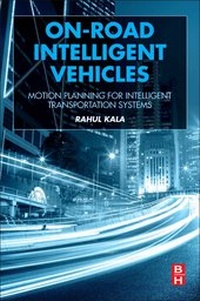
On-Road Intelligent Vehicles
Motion Planning for Intelligent Transportation Systems
Published on 27. April 2016
Book
Paperback/Softback
536 pages
978-0-12-803729-4 (ISBN)
Description
On-Road Intelligent Vehicles: Motion Planning for Intelligent Transportation Systems deals with the technology of autonomous vehicles, with a special focus on the navigation and planning aspects, presenting the information in three parts. Part One deals with the use of different sensors to perceive the environment, thereafter mapping the multi-domain senses to make a map of the operational scenario, including topics such as proximity sensors which give distances to obstacles, vision cameras, and computer vision techniques that may be used to pre-process the image, extract relevant features, and use classification techniques like neural networks and support vector machines for the identification of roads, lanes, vehicles, obstacles, traffic lights, signs, and pedestrians.
With a detailed insight into the technology behind the vehicle, Part Two of the book focuses on the problem of motion planning. Numerous planning techniques are discussed and adapted to work for multi-vehicle traffic scenarios, including the use of sampling based approaches comprised of Genetic Algorithm and Rapidly-exploring Random Trees and Graph search based approaches, including a hierarchical decomposition of the algorithm and heuristic selection of nodes for limited exploration, Reactive Planning based approaches, including Fuzzy based planning, Potential Field based planning, and Elastic Strip and logic based planning.
Part Three of the book covers the macroscopic concepts related to Intelligent Transportation Systems with a discussion of various topics and concepts related to transportation systems, including a description of traffic flow, the basic theory behind transportation systems, and generation of shock waves.
With a detailed insight into the technology behind the vehicle, Part Two of the book focuses on the problem of motion planning. Numerous planning techniques are discussed and adapted to work for multi-vehicle traffic scenarios, including the use of sampling based approaches comprised of Genetic Algorithm and Rapidly-exploring Random Trees and Graph search based approaches, including a hierarchical decomposition of the algorithm and heuristic selection of nodes for limited exploration, Reactive Planning based approaches, including Fuzzy based planning, Potential Field based planning, and Elastic Strip and logic based planning.
Part Three of the book covers the macroscopic concepts related to Intelligent Transportation Systems with a discussion of various topics and concepts related to transportation systems, including a description of traffic flow, the basic theory behind transportation systems, and generation of shock waves.
More details
Language
English
Place of publication
Woburn
United States
Publishing group
Elsevier - Health Sciences Division
Target group
Professional and scholarly
Dimensions
Height: 229 mm
Width: 152 mm
Weight
840 gr
ISBN-13
978-0-12-803729-4 (9780128037294)
Copyright in bibliographic data and cover images is held by Nielsen Book Services Limited or by the publishers or by their respective licensors: all rights reserved.
Schweitzer Classification
Other editions
Additional editions
E-Book
04/2016
Butterworth-Heinemann
€78.95
Available for download
Person
Rahul Kala is an assistant professor at the Centre of Intelligent Robotics, Indian Institute of Information Technology, Allahabad, India, where he received his B.Tech. and M.Tech. degrees in information technology. He received his Ph.D. degree in cybernetics from the University of Reading, UK in 2013. Dr. Kala has authored four books, 100 scientific papers, and is an active reviewer of leading journals of the domain. He has received numerous scholarships and grants from the Government of India, and is a recipient of the Best PhD Dissertation award from the IEEE Intelligent Transportation Systems Society.
Content
Part I: Autonomous Vehicles
1. Introduction
2. Basics of Autonomous Vehicles
3. Perception in Autonomous Vehicles
4. Advanced Driver Assistance Systems
Part II: Deliberative Motion Planning of Autonomous Vehicles
5. Introduction to Planning
6. Optimization Based Planning
7. Sampling Based Planning
8. Graph Search based Hierarchical Planning
9. Using Heuristics in Graph Search based Planning
Part III: (Near-)Reactive Motion Planning of Autonomous Vehicles
10. Fuzzy Based Planning
11. Potential Based Planning
12. Logic Based Planning
Part IV: Intelligent Transportation Systems
13. Basics of Intelligent Transportation System
14. Intelligent Transportation Systems with Diverse Vehicles
15. Reaching Destination before Deadline with Intelligent Transportation Systems
16. Conclusions
Appendix A: Resources from the Author
1. Introduction
2. Basics of Autonomous Vehicles
3. Perception in Autonomous Vehicles
4. Advanced Driver Assistance Systems
Part II: Deliberative Motion Planning of Autonomous Vehicles
5. Introduction to Planning
6. Optimization Based Planning
7. Sampling Based Planning
8. Graph Search based Hierarchical Planning
9. Using Heuristics in Graph Search based Planning
Part III: (Near-)Reactive Motion Planning of Autonomous Vehicles
10. Fuzzy Based Planning
11. Potential Based Planning
12. Logic Based Planning
Part IV: Intelligent Transportation Systems
13. Basics of Intelligent Transportation System
14. Intelligent Transportation Systems with Diverse Vehicles
15. Reaching Destination before Deadline with Intelligent Transportation Systems
16. Conclusions
Appendix A: Resources from the Author