

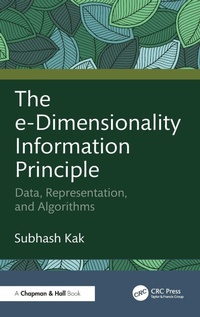
The e-Dimensionality Information Principle
Information, Representation, and Algorithms
1st Edition
Will be published approx. on 8. April 2026
Book
Hardback
288 pages
978-1-041-22430-3 (ISBN)
Description
This book stems from a concept that, from an information-theoretic and computational perspective, e-dimensionality represents optimal information representation. Drawing on the principle that nature consistently chooses optimal solutions, this book demonstrates that noninteger dimensionality provides a unifying framework for understanding diverse phenomena across physics, biology, engineering, and data science. The work explores how optimal information representation naturally leads to scale-invariance and self-similarity-characteristics observed throughout natural systems from fractals and genetic structures to evolutionary processes and neural networks.
Key Features:
* Reveals why three-way logic is superior to binary logic in natural systems and provides an information-theoretic rationale for the power laws frequently encountered across scientific applications
* Explains fundamental biological mysteries including the non-uniform groupings of codons in the genetic code (ranging from 1 to 6 per amino acid) and offers novel insights into chromatin geometry and evolutionary dynamics
* Addresses the reproducibility crisis in biomedical research by proposing new significance testing approaches based on noninteger dimensionality that move beyond traditional binary hypothesis testing methods
Written for researchers and graduate students in electrical engineering, computer science, physics, and biology, this work serves as both an advanced textbook for senior-level and graduate courses and a research resource providing fresh perspectives on longstanding problems across multiple disciplines.
Key Features:
* Reveals why three-way logic is superior to binary logic in natural systems and provides an information-theoretic rationale for the power laws frequently encountered across scientific applications
* Explains fundamental biological mysteries including the non-uniform groupings of codons in the genetic code (ranging from 1 to 6 per amino acid) and offers novel insights into chromatin geometry and evolutionary dynamics
* Addresses the reproducibility crisis in biomedical research by proposing new significance testing approaches based on noninteger dimensionality that move beyond traditional binary hypothesis testing methods
Written for researchers and graduate students in electrical engineering, computer science, physics, and biology, this work serves as both an advanced textbook for senior-level and graduate courses and a research resource providing fresh perspectives on longstanding problems across multiple disciplines.
More details
Language
English
Place of publication
London
United Kingdom
Publishing group
Taylor & Francis Ltd
Target group
College/higher education
Postgraduate
Illustrations
22 s/w Tabellen, 40 farbige Zeichnungen, 45 s/w Zeichnungen, 22 Farbfotos bzw. farbige Rasterbilder, 62 farbige Abbildungen, 45 s/w Abbildungen
22 Tables, black and white; 40 Line drawings, color; 45 Line drawings, black and white; 22 Halftones, color; 62 Illustrations, color; 45 Illustrations, black and white
Dimensions
Height: 240 mm
Width: 161 mm
Thickness: 16 mm
Weight
487 gr
ISBN-13
978-1-041-22430-3 (9781041224303)
Copyright in bibliographic data and cover images is held by Nielsen Book Services Limited or by the publishers or by their respective licensors: all rights reserved.
Schweitzer Classification
Other editions
Additional editions
E-Book
04/2026
1st Edition
Chapman and Hall
€152.99
Available for download
E-Book
04/2026
1st Edition
Chapman and Hall
€152.99
Available for download
Person
Subhash Kak is Regents Professor at Oklahoma State University in Stillwater and a Distinguished Academic Scholar at Chapman University. He has held academic appointments at Imperial College, London, Louisiana State University, and Curtin University, Perth. He has authored several books, of which the most recent one is The Age of Artificial Intelligence. Since 2018, he has been a member of the Indian Prime Minister's Science, Technology, and Innovation Advisory Council.
Content
1. Information and optimal representation. 2. The intrinsic dimensionality of data. 3. Fractals with optimal information dimension. 4. Self-similarity, maximum entropy principle, and the genetic code. 5. Information optimality and the geometry of chromatin. 6. Autonomous cognitive agents in a neural network. 7. Evolutionary stages in the universe. 8. Nonlocal noise and self-decoherence. 9. Significance testing in natural and biological systems. 10. Epilogue.