

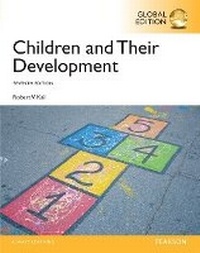
MyLab Psychology with Pearson eText for Children and their Development, Global Edition
7th Edition
Published on 16. June 2015
Book
Mixed media product
978-1-292-07387-3 (ISBN)
More details
Edition
7th edition
Language
English
Place of publication
Harlow
United Kingdom
Target group
College/higher education
Professional and scholarly
ISBN-13
978-1-292-07387-3 (9781292073873)
Copyright in bibliographic data and cover images is held by Nielsen Book Services Limited or by the publishers or by their respective licensors: all rights reserved.
Schweitzer Classification
Person
Robert V. Kail is Distinguished Professor of Psychological Sciences at Purdue University. His undergraduate degree is from Ohio Wesleyan University, and his Ph.D. is from the University of Michigan. Kail is editor of Child Development Perspectives and the editor emeritus of Psychological Science. He received the McCandless Young Scientist Award from the American Psychological Association, was named the Distinguished Sesquicentennial Alumnus in Psychology by Ohio Wesleyan University, and is a fellow of the Association for Psychological Science. He has also written Scientific Writing for Psychology: Lessons in Clarity and Style.
Content
1. The Science of Child Development
2. Genetic Bases of Child Development
3. Prenatal Development, Birth, and the Newborn
4. Growth and Health
5. Perceptual and Motor Development
6. Theories of Cognitive Development
7. Cognitive Processes and Academic Skills
8. Intelligence and Individual Differences in Cognition
9. Language and Communication
10. Emotional Development
11. Understanding Self and Others
12. Moral Understanding and Behavior
13. Gender and Development
14. Family Relationships
15. Influences Beyond the Family
2. Genetic Bases of Child Development
3. Prenatal Development, Birth, and the Newborn
4. Growth and Health
5. Perceptual and Motor Development
6. Theories of Cognitive Development
7. Cognitive Processes and Academic Skills
8. Intelligence and Individual Differences in Cognition
9. Language and Communication
10. Emotional Development
11. Understanding Self and Others
12. Moral Understanding and Behavior
13. Gender and Development
14. Family Relationships
15. Influences Beyond the Family