

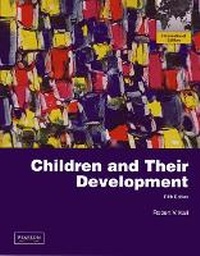
Children and Their Development
International Edition
5th Edition
Published on 24. February 2009
Book
Paperback/Softback
576 pages
978-0-205-68906-4 (ISBN)
Description
For Child Development courses in Psychology, Education, Human Development, Child and Family Studies, and Early Childhood Education.
Research Made Relevant
Written by a well-known and respected researcher in the field of child development, this TOPICALLY organized text uses unique and effective pedagogy as the framework of the entire text. Designed to demonstrate how research translates into practice with accessible writing, a modular format, and application-based features such as: Focus on Research, Cultural Influences, Spotlight on Theories, Improving Children's Lives, and Child and Development and Family Policy.
Want to learn more about MyVirtualChild? Visit www.mydevelopmentlab.com and click on the `watch this video' link to learn about MyVirtualChild.
MyDevelpmentLab with MyVirtualChild is available at www.mydevelopmentlab.com.
Research Made Relevant
Written by a well-known and respected researcher in the field of child development, this TOPICALLY organized text uses unique and effective pedagogy as the framework of the entire text. Designed to demonstrate how research translates into practice with accessible writing, a modular format, and application-based features such as: Focus on Research, Cultural Influences, Spotlight on Theories, Improving Children's Lives, and Child and Development and Family Policy.
Want to learn more about MyVirtualChild? Visit www.mydevelopmentlab.com and click on the `watch this video' link to learn about MyVirtualChild.
MyDevelpmentLab with MyVirtualChild is available at www.mydevelopmentlab.com.
More details
Edition
5th edition
Language
English
Place of publication
United States
Publishing group
Pearson Education (US)
Target group
College/higher education
Dimensions
Height: 216 mm
Width: 276 mm
Thickness: 22 mm
Weight
1164 gr
ISBN-13
978-0-205-68906-4 (9780205689064)
Copyright in bibliographic data and cover images is held by Nielsen Book Services Limited or by the publishers or by their respective licensors: all rights reserved.
Schweitzer Classification
Other editions
New editions
Book
08/2011
6th Edition
Pearson
€194.59
Article exhausted; check for reprint
Previous edition
Book
09/2008
4th Edition
Pearson
€59.71
Article exhausted; check for reprint
Person
Robert V. Kail is Professor of Psychological Sciences at Purdue University. His undergraduate degree is from Ohio Wesleyan University and his Ph.D. is from the University of Michigan. Kail is editor of Psychological Science. He received the McCandless Young Scientist Award from the American Psychological Association, was named the Distinguished Sesquicentennial Alumnus in Psychology by Ohio Wesleyan University, and is a fellow of the Association for Psychological Science. His research focuses on cognitive development during childhood and adolescence. Away from the office, he enjoys photography and working out. His web site is: http://www2.psych.purdue.edu/~rk/home.html.
Content
1. The Science of Child Development.
2. Genetic Bases of Child Development.
3. Prenatal Development, Birth and the Newborn.
4. Growth and Health.
5. Perceptual and Motor Development.
6. Theories of Cognitive Development.
7. Cognitive Processes and Academic Skills.
8. Intelligence and Individual Differences in Cognition
9. Language and Communication.
10. Emotional Development.
11. Understanding Self and Others.
12. Moral Understanding and Behavior.
13. Gender and Development.
14. Family Relationships.
15. Influences Beyond the Family.
2. Genetic Bases of Child Development.
3. Prenatal Development, Birth and the Newborn.
4. Growth and Health.
5. Perceptual and Motor Development.
6. Theories of Cognitive Development.
7. Cognitive Processes and Academic Skills.
8. Intelligence and Individual Differences in Cognition
9. Language and Communication.
10. Emotional Development.
11. Understanding Self and Others.
12. Moral Understanding and Behavior.
13. Gender and Development.
14. Family Relationships.
15. Influences Beyond the Family.