

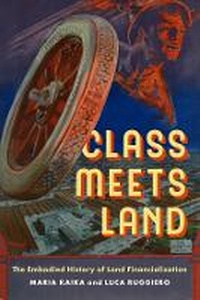
Class Meets Land
The Embodied History of Land Financialization
1st Edition
Published on 5. November 2024
Book
Hardback
218 pages
978-0-520-41007-7 (ISBN)
Description
Class Meets Land reveals something seemingly counterintuitive: that nineteenth-century class struggles over land are deeply implicated in the transition to twenty-first-century financial capitalism. Challenging our understanding of land financialization as a recent phenomenon propelled by high finance, Maria Kaika and Luca Ruggiero foreground 150 years of class struggle over land as a catalyst for assembling the global financial constellation. Narrating the close-knit histories of industrial land, industrial elites, and the working class, the authors offer a novel understanding of land financialization as a "lived" process: the outcome of a relentless, socially embodied historical unfolding, in which shifts in land's material, economic, and symbolic roles impact both local everyday lives and global capital flows.
Reviews / Votes
"Stylistically logical. . . . A convincing case for approaching financialization in its specific historical context and from the perspective of local class struggles." * Marx and Philosophy Review of Books *More details
Series
Edition
First Edition
Language
English
Place of publication
Berkerley
United States
Target group
Professional and scholarly
Product notice
Cloth over boards
Dimensions
Height: 229 mm
Width: 152 mm
Thickness: 15 mm
Weight
499 gr
ISBN-13
978-0-520-41007-7 (9780520410077)
Copyright in bibliographic data and cover images is held by Nielsen Book Services Limited or by the publishers or by their respective licensors: all rights reserved.
Schweitzer Classification
Other editions
Additional editions
E-Book
11/2024
1st Edition
Naval Institute Press
€28.99
Available for download
Persons
Maria Kaika is a planner, urban geographer, and architect. She is Director of the Centre for Urban Studies at the University of Amsterdam. Her books include Turning Up the Heat: Urban Political Ecology for a Climate Emergency, The Political Ecology of Austerity, In the Nature of Cities, and City of Flows.
Luca Ruggiero is Professor of Economic and Political Geography in the Department of Political and Social Sciences at the University of Catania, Italy. His books include Tardo industrialismo: Energia, ambiente e nuovi immaginari di sviluppo in Sicilia, La dipendenza energetica dell'Unione Europea: Strategie geopolitiche e scenari innovativi, and Temi di geografia economica.
Luca Ruggiero is Professor of Economic and Political Geography in the Department of Political and Social Sciences at the University of Catania, Italy. His books include Tardo industrialismo: Energia, ambiente e nuovi immaginari di sviluppo in Sicilia, La dipendenza energetica dell'Unione Europea: Strategie geopolitiche e scenari innovativi, and Temi di geografia economica.
Content
Contents
List of Illustrations
Acknowledgments: The Academic Manuscript as a Collective "Labor of Love"
Introduction: A Timeful Analysis of Class Struggle as a Force of Spatial Production
PART I. CITY OF INDUSTRY: LAND AS THE MEANS TO FORGE A NEW ANTHROPOLOGICAL TYPE OF WORKING
MEN AND WOMEN (1880-1939)
1. Class Meets Land: Turning Flexible Peasantry into Disciplined Industrial Labor (1880-1922)
2. Land as Catalyst for Forging Class Consciousness (1922-1939)
PART II. CITY OF WORKERS: LAND AS SPACE FOR COMMONING AND RADICAL POLITICAL ACTION
(1939-EARLY 1970s)
3. Land as Citadel of Workers' Anti-Fascist Resistance (1939-1945)
4. "Italy's Stalingrad" and the "Years of Lead": Radicalizing Social Claims over
Industrial Land (1945-Early 1970s)
PART III. CITY OF TECHNOLOGY: LAND REVANCHISM AS A MEANS OF TRANSITIONING TO HIGH-TECH
CAPITALISM (EARLY 1970s-early 1990s)
5. Land Revanchism and the Unmaking of the Working Class (Early 1970s-1985)
6. The Eureka Moment: "Discovering" Industrial Land as Asset (1985-Early 1990s)
PART IV. CITY OF FINANCE: LAND AS PURE FINANCIAL ASSET (EARLY 1990s-2020)
7. Land Financialization as a "Lived" Process: From Industrial Commodity Production to
the Production of Land as Financialized Asset (Early 1990s-2000)
8. Decaffeinated Urbanity: Financialized Land as No-Man's-Land (2000-2020)
Epilogue: Financialization as "Lived" Process: Moving the Field Forward
Notes
References
Index
List of Illustrations
Acknowledgments: The Academic Manuscript as a Collective "Labor of Love"
Introduction: A Timeful Analysis of Class Struggle as a Force of Spatial Production
PART I. CITY OF INDUSTRY: LAND AS THE MEANS TO FORGE A NEW ANTHROPOLOGICAL TYPE OF WORKING
MEN AND WOMEN (1880-1939)
1. Class Meets Land: Turning Flexible Peasantry into Disciplined Industrial Labor (1880-1922)
2. Land as Catalyst for Forging Class Consciousness (1922-1939)
PART II. CITY OF WORKERS: LAND AS SPACE FOR COMMONING AND RADICAL POLITICAL ACTION
(1939-EARLY 1970s)
3. Land as Citadel of Workers' Anti-Fascist Resistance (1939-1945)
4. "Italy's Stalingrad" and the "Years of Lead": Radicalizing Social Claims over
Industrial Land (1945-Early 1970s)
PART III. CITY OF TECHNOLOGY: LAND REVANCHISM AS A MEANS OF TRANSITIONING TO HIGH-TECH
CAPITALISM (EARLY 1970s-early 1990s)
5. Land Revanchism and the Unmaking of the Working Class (Early 1970s-1985)
6. The Eureka Moment: "Discovering" Industrial Land as Asset (1985-Early 1990s)
PART IV. CITY OF FINANCE: LAND AS PURE FINANCIAL ASSET (EARLY 1990s-2020)
7. Land Financialization as a "Lived" Process: From Industrial Commodity Production to
the Production of Land as Financialized Asset (Early 1990s-2000)
8. Decaffeinated Urbanity: Financialized Land as No-Man's-Land (2000-2020)
Epilogue: Financialization as "Lived" Process: Moving the Field Forward
Notes
References
Index