

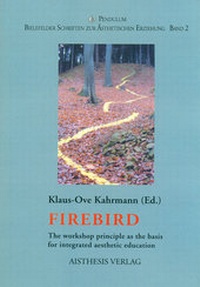
Firebird
The workshop principle as the basis for integrated aesthetic education
1st Edition
Published on 5. April 2005
Book
190 pages
978-3-89528-509-7 (ISBN)
Description
'Firebird' is a good heading for an aesthetic workshop. On one hand it gives the idea of powerful dynamics and ease, and on the other hand, the phoenix rising from the ashes is immediately present, as a symbol of the constantly renewing creative process.
In this second volume of the Pendulum series, the international workshops of the Bielefeld University Department of Art and Music will be presented. In Bielefeld, the workshop principle has been in use for years with the aim of developing new forms of creativity and self-organisation in the process of training and education. Since the German education system has come under criticism due to widespread problems and low levels of performance in comparison to other countries, there have been experiments and attempts in many places to reform the education and training system. The activities involved in the workshop principle, as conducted in Bielefeld, can be counted among these innovative models. The workshop principle is far more than a new approach in music or art teaching. Little known up till now, it represents a very effective form of learning and communication of diverse appeal, which is valid in all subjects and institutions. It embodies a behaviour and a method which appeal to the inner curiosity and exploratory urge that we all have within us. Self-organisation and self-determination are at the heart of the principle. Implementing perception, thought and action as an entity, used consistently to achieve the rapid and lasting learning not only of facts but also of structures, forms of communication and social interaction.
The portrayal of the workshop's activities in this book serves to show the workshop principle as a fundamental perspective in order to draw conclusion for aesthetic education as it unfortunately today too rarely is in schools and non-school youth education institutions. 'Firebird' seeks to encourage the taking of the route that is unusual, the route that will break through the formal restrictions of the existing system, and to take risks, to recognise experimental creativity and to make use of it.
Here, an integrated form of aesthetic education is attempted, in other words the connection of the senses and the circular comprehension of aesthetic processes. The descriptions of the workshops, which are often very precise, are an incentive to attempt the same thing in other places. So that these examples are as concrete as possible, there is a DVD to accompany the book which contains a large number of examples of pictures and films as well as musical presentations. There are however no lesson plans here; the idea is to read, watch and listen and then to put your own ideas into action and to arrive at your own independent creative actions.
In this second volume of the Pendulum series, the international workshops of the Bielefeld University Department of Art and Music will be presented. In Bielefeld, the workshop principle has been in use for years with the aim of developing new forms of creativity and self-organisation in the process of training and education. Since the German education system has come under criticism due to widespread problems and low levels of performance in comparison to other countries, there have been experiments and attempts in many places to reform the education and training system. The activities involved in the workshop principle, as conducted in Bielefeld, can be counted among these innovative models. The workshop principle is far more than a new approach in music or art teaching. Little known up till now, it represents a very effective form of learning and communication of diverse appeal, which is valid in all subjects and institutions. It embodies a behaviour and a method which appeal to the inner curiosity and exploratory urge that we all have within us. Self-organisation and self-determination are at the heart of the principle. Implementing perception, thought and action as an entity, used consistently to achieve the rapid and lasting learning not only of facts but also of structures, forms of communication and social interaction.
The portrayal of the workshop's activities in this book serves to show the workshop principle as a fundamental perspective in order to draw conclusion for aesthetic education as it unfortunately today too rarely is in schools and non-school youth education institutions. 'Firebird' seeks to encourage the taking of the route that is unusual, the route that will break through the formal restrictions of the existing system, and to take risks, to recognise experimental creativity and to make use of it.
Here, an integrated form of aesthetic education is attempted, in other words the connection of the senses and the circular comprehension of aesthetic processes. The descriptions of the workshops, which are often very precise, are an incentive to attempt the same thing in other places. So that these examples are as concrete as possible, there is a DVD to accompany the book which contains a large number of examples of pictures and films as well as musical presentations. There are however no lesson plans here; the idea is to read, watch and listen and then to put your own ideas into action and to arrive at your own independent creative actions.
More details
Persons
Content
Foreword
Klaus-Ove Kahrmann: To perceive in order to receive the reality of the world. Thoughts on aesthetic education in the information society
Wieslaw Karolak: On my experiences with the workshop principle
Heike Thienenkamp: Firebird. Like phoenix from the ashes
Klaus-Ove Kahrmann: The place as an aesthetic field of learning. St. Hedwigshaus as an example of a creative ambient
Malgorzata Bielecka: The Painting Workshop. A report
Bernd Clausen: What remains is the melody. Views from the in-between world
Shinji Ishioka: With my eyes and ears. An essay
Klaus-Ove Kahrmann: Film pedagogy as aesthetic education
Jan Leiding/Björn Sommer: Videobird
Anna Sala: The Colours of Contact. A workshop on the Gestalt therapy-influenced methods in the education process
The Authors
Klaus-Ove Kahrmann: To perceive in order to receive the reality of the world. Thoughts on aesthetic education in the information society
Wieslaw Karolak: On my experiences with the workshop principle
Heike Thienenkamp: Firebird. Like phoenix from the ashes
Klaus-Ove Kahrmann: The place as an aesthetic field of learning. St. Hedwigshaus as an example of a creative ambient
Malgorzata Bielecka: The Painting Workshop. A report
Bernd Clausen: What remains is the melody. Views from the in-between world
Shinji Ishioka: With my eyes and ears. An essay
Klaus-Ove Kahrmann: Film pedagogy as aesthetic education
Jan Leiding/Björn Sommer: Videobird
Anna Sala: The Colours of Contact. A workshop on the Gestalt therapy-influenced methods in the education process
The Authors