

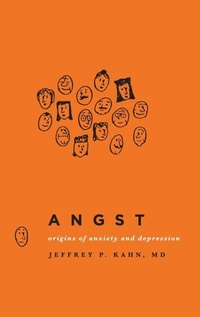
Angst
Origins of Anxiety and Depression
Published on 8. November 2012
Book
Hardback
312 pages
978-0-19-979644-1 (ISBN)
Description
Why do so many people suffer the slings and arrows of outrageous angst? Some twenty percent of us are afflicted with common Anxiety and Depressive disorders. That's not just nervous or scared or sad - that is painful dysfunction without obvious benefit. This angst comes from an evolutionary inheritance that biologically shaped us into social communities. There are just five specific diagnostic subtypes that account for most of this modern-day angst: Panic Anxiety, Social Anxiety, OCD, Atypical Depression and Melancholic Depression. Each of the five comes from primeval social instincts that told our ancestors how to improve survival of their community DNA. These instincts are also very much alive and unfettered in other species today. Their potential link to our human distress was anticipated by both Darwin and Freud.
We humans have greater instinctive consciousness than other creatures. Rational thoughts let us defy biological social instructions. One result of this uniquely human skill is that over-ridden social instincts complain to us in the painful language of emotional disorders. A few of us even tackle this pain head-on, in ways that can advance our intellectual creativity, social performance, and productivity. Our human intellectual abilities owe as much to our unique social software as to our greater brain processing power. Civilization is built upon our ability to maintain social harmony with ethics and government, and to find solace in technology, religion and beer.
This novel theoretical synthesis offers a new framework for understanding what our knowledge of psychiatric neuroscience, clinical research, diagnosis and treatment. The central theory is explained in everyday language. It is supported by clinical observation, straightforward accounts of complex science, animal research, and quotes from both ancient writings and modern humor and lyrics. This fascinating new synthesis is written for the general public, mental health professionals and academic researchers alike.
We humans have greater instinctive consciousness than other creatures. Rational thoughts let us defy biological social instructions. One result of this uniquely human skill is that over-ridden social instincts complain to us in the painful language of emotional disorders. A few of us even tackle this pain head-on, in ways that can advance our intellectual creativity, social performance, and productivity. Our human intellectual abilities owe as much to our unique social software as to our greater brain processing power. Civilization is built upon our ability to maintain social harmony with ethics and government, and to find solace in technology, religion and beer.
This novel theoretical synthesis offers a new framework for understanding what our knowledge of psychiatric neuroscience, clinical research, diagnosis and treatment. The central theory is explained in everyday language. It is supported by clinical observation, straightforward accounts of complex science, animal research, and quotes from both ancient writings and modern humor and lyrics. This fascinating new synthesis is written for the general public, mental health professionals and academic researchers alike.
Reviews / Votes
This is an interesting book by an author with a wealth of clinical and research experience. He has done a very thorough job on the research behind his theories and express them clearly and succinctly... I would recommend the book.More details
Language
English
Place of publication
New York
United States
Target group
College/higher education
Professional and scholarly
Intelligent Lay Readers, Mental Health/Medical Professionals, Academic Researchers, Mental Health Consumers, Students of Mental Health, Psychology and Evolution
Illustrations
10 illustrations
Dimensions
Height: 240 mm
Width: 161 mm
Thickness: 21 mm
Weight
634 gr
ISBN-13
978-0-19-979644-1 (9780199796441)
Copyright in bibliographic data and cover images is held by Nielsen Book Services Limited or by the publishers or by their respective licensors: all rights reserved.
Schweitzer Classification
Other editions

Person
Jeffrey P. Kahn, M.D.'s evolutionary theory of Anxiety and Depression draws on his academic work on anxiety disorders, workplace mental health, and precision diagnosis, and most especially upon observations from clinical practice. A graduate of Swarthmore College and Columbia University Medical School, he is now Clinical Associate Professor of Psychiatry at Weill-Cornell Medical College, with offices in Manhattan and Westchester County.
Content
* Table of Contents ; * One: Anxiety and Depression are the Modern Echoes of Evolved Social Instincts ; * Part I: Six Social Instincts: Five Usual Suspects and One Missing Think ; * Two: Don't Stray Far From Family, Home or Safety: Panic Anxiety ; * Three: Follow the Leader of the Pack: Social Anxiety ; * Four: A Sure and Tidy Nest (Clean, Arrange, Save and Behave): Obsessive-Compulsive Disorder ; * Five: Go Along to Get Along: Atypical Depression ; * Six: Feeling So Useless You Could Die: Melancholic Depression ; * Seven: Consciousness Lost and Instinct Run Amok: Schizophrenia and Psychosis ; * Part II: Civilization: The Rise of Reason and the Ascent of Angst ; * Eight: Happy in the Herd: Instinctive Herds and Primeval Ignorance ; * Nine: Climbing To Civilization: The Rise of Reason and the Ascent of Angst ; * Ten: Illness and Instinct: Consciousness Has Consequences ; * Eleven: Free to Choose: How to Balance Your Reason and Instinct ; * Appendix of Diagnostic Criteria ; * Annotated Bibliography ; * Cited References [Arranged by Chapters] ; * Index