

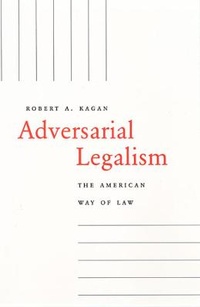
Adversarial Legalism
The American Way of Law
Published on 1. September 2003
Book
Paperback/Softback
352 pages
978-0-674-01241-7 (ISBN)
Description
American methods of policy implementation and dispute resolution are more adversarial and legalistic when compared with the systems of other economically advanced countries. Americans more often rely on legal threats and lawsuits. American laws are generally more complicated and prescriptive, adjudication more costly, and penalties more severe. In a thoughtful and cogently argued book, Robert Kagan examines the origins and consequences of this system of "adversarial legalism."
Kagan describes the roots of adversarial legalism and the deep connections it has with American political institutions and values. He investigates its social costs as well as the extent to which lawyers perpetuate it. Ranging widely across many legal fields, including criminal law, environmental regulations, tort law, and social insurance programs, he provides comparisons with the legal and regulatory systems of western Europe, Canada, and Japan that point to possible alternatives to the American methods.
Kagan notes that while adversarial legalism has many virtues, its costs and unpredictability often alienate citizens from the law and frustrate the quest for justice. This insightful study deepens our understanding of law and its relationship to politics in America and raises valuable questions about the future of the American legal system.
Kagan describes the roots of adversarial legalism and the deep connections it has with American political institutions and values. He investigates its social costs as well as the extent to which lawyers perpetuate it. Ranging widely across many legal fields, including criminal law, environmental regulations, tort law, and social insurance programs, he provides comparisons with the legal and regulatory systems of western Europe, Canada, and Japan that point to possible alternatives to the American methods.
Kagan notes that while adversarial legalism has many virtues, its costs and unpredictability often alienate citizens from the law and frustrate the quest for justice. This insightful study deepens our understanding of law and its relationship to politics in America and raises valuable questions about the future of the American legal system.
Reviews / Votes
[This] book is a tour de force. It is an elegantly written, consistently insightful analysis and critique of the American emphasis on litigation and punitive sanctions in the policy and administrative process... Adversarial Legalism is in many ways a breath of fresh air. Political elites, scholars, and college students alike may find much that is new and surprising in this book-and it is Kagan's key purpose to surprise and stimulate fresh thinking about the range of possibilities for addressing policy problems. His argument is equally critical of the Republican party's sympathy for underdog plaintiffs, and he is virtually unique among prominent legal voices in calling for more government, more bureaucratic discretion, and, at the same time, less opportunity for legal challenge to government and corporate policy. Kagan is also appropriately realistic in recognizing that his critique and reform proposals are greatly out of step with reigning cultural patterns of populist distrust of governmental and corporate power and faith in self-help legal activism, and thus that his proposals are unlikely to succeed in the near future. -- Charles R. Epp * Law and Society Review * Kagan offers an important and insightful study of American legal culture. Its chief thesis is that the American way of law is best described as 'adversarial legalism,' or the process by which policy making, implementation, and dispute resolution are dominated by lawyers and litigation. Although the thesis in this form is hardly original, Kagan's treatment of it, ranging across a wide variety of scholarly disciplines, is both comprehensive and critical. A significant advantage of Kagan's treatment is his commitment to a genuinely comparative analysis of American legalism, though one might argue that his assessment of American legal exceptionalism is overstated. Whatever the merits of Kagan's assessment, however, it is made possible by his careful attention to comparative materials and thus shows the promise of an authentic comparative legal methodology. In sum, this is an important, indeed an elegant, book. Highly recommended. -- J. E. Finn * Choice * This is a wonderful piece of work, richly detailed and beautifully written. It is the best, sanest, and most comprehensive evaluation and critique of the American way of law that I have seen. Every serious scholar concerned with justice and efficiency, and every policymaker who is serious about improving the American legal order should read this trenchant and exciting book. -- Lawrence Friedman, Stanford UniversityMore details
Language
English
Place of publication
Cambridge, Mass
United States
Target group
Professional and scholarly
US School Grade: College Graduate Student
Illustrations
2 tables
Dimensions
Height: 227 mm
Width: 146 mm
Thickness: 21 mm
Weight
499 gr
ISBN-13
978-0-674-01241-7 (9780674012417)
Copyright in bibliographic data and cover images is held by Nielsen Book Services Limited or by the publishers or by their respective licensors: all rights reserved.
Schweitzer Classification
Other editions
Additional editions
E-Book
07/2009
Harvard University Press
€30.69
Available for download
Person
Robert A. Kagan is Professor of Law and Political Science at the University of California, Berkeley.
Content
Preface I Adversarial Legalism: Contours, Consequences, Causes 1. The Concept of Adversarial Legalism 2. The Two Faces of Adversarial Legalism 3. The Political Construction of Adversarial Legalism II Criminal Justice 4. Adversarial Legalism and American Criminal Justice 5. Deciding Criminal Cases III Civil Justice 6. Adversarial Legalism and Civil Justice 7. The Tort Law System IV Public Law: Social Justice and Regulation 8. Adversarial Legalism and the Welfare State 9. Adversarial Legalism and Regulatory Style 10. Economic Development, Environmental Protection, and Adversarial Legalism Conclusion: Can the United States Tame Adversarial Legalism? Notes References Index