

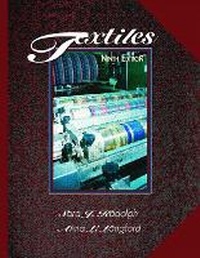
Textiles
9th Edition
Published on 15. September 2001
Book
Hardback
421 pages
978-0-13-025443-6 (ISBN)
Description
For courses in Textile Science, Textiles, Textile Fundamentals, Introduction to Textiles, Textiles for Interiors, or other courses that focus on basic textiles.
This popular text, now in its ninth edition, considers textiles as the materials used to create apparel, furnishings, and industrial products. It approaches textiles from a product analysis approach, uses terminology as professionals would, and provides examples to illustrate key concepts. Summary tables and flow charts are included to help students understand similarities and differences among textiles.
This popular text, now in its ninth edition, considers textiles as the materials used to create apparel, furnishings, and industrial products. It approaches textiles from a product analysis approach, uses terminology as professionals would, and provides examples to illustrate key concepts. Summary tables and flow charts are included to help students understand similarities and differences among textiles.
More details
Edition
9th edition
Language
English
Place of publication
United States
Publishing group
Pearson Education (US)
Target group
Professional and scholarly
Dimensions
Height: 279 mm
Width: 289 mm
Thickness: 21 mm
Weight
1127 gr
ISBN-13
978-0-13-025443-6 (9780130254436)
Copyright in bibliographic data and cover images is held by Nielsen Book Services Limited or by the publishers or by their respective licensors: all rights reserved.
Schweitzer Classification
Other editions

Content
I. INTRODUCTION TO TEXTILES.
1. Introduction.
2. Product Development from a Textile Perspective.
II. FIBERS.
3. Textile Fibers and Their Properties.
4. Natural Cellulosic Fibers.
5. Natural Protein Fibers.
6. The Fiber Manufacturing Process.
7. Manufactured Regenerated Fibers.
8. Synthetic Fibers.
9. Special-Use Fibers.
III. YARNS.
10. Yarn Processing.
11. Yarn Classification.
IV. FABRICATION.
12. Basic Weaves and Fabrics.
13. Fancy Weaves and Fabrics.
14. Knitting and Knit Fabrics.
15. Other Fabrication Methods.
V. FINISHING.
16. Finishing: An Overview.
17. Aesthetic Finishes.
18. Special-Purpose Finishes.
19. Dyeing and Printing.
VI. OTHER ISSUES RELATED TO TEXTILES.
20. Care of Textile Products.
21. Legal and Environmental Concerns.
22. Career Exploration.
Appendix A: Fiber Names in Other Languages.
Appendix B: Fibers No Longer Produced in the United States.
Appendix C: Selected Trade Names.
Glossary.
Index.
1. Introduction.
2. Product Development from a Textile Perspective.
II. FIBERS.
3. Textile Fibers and Their Properties.
4. Natural Cellulosic Fibers.
5. Natural Protein Fibers.
6. The Fiber Manufacturing Process.
7. Manufactured Regenerated Fibers.
8. Synthetic Fibers.
9. Special-Use Fibers.
III. YARNS.
10. Yarn Processing.
11. Yarn Classification.
IV. FABRICATION.
12. Basic Weaves and Fabrics.
13. Fancy Weaves and Fabrics.
14. Knitting and Knit Fabrics.
15. Other Fabrication Methods.
V. FINISHING.
16. Finishing: An Overview.
17. Aesthetic Finishes.
18. Special-Purpose Finishes.
19. Dyeing and Printing.
VI. OTHER ISSUES RELATED TO TEXTILES.
20. Care of Textile Products.
21. Legal and Environmental Concerns.
22. Career Exploration.
Appendix A: Fiber Names in Other Languages.
Appendix B: Fibers No Longer Produced in the United States.
Appendix C: Selected Trade Names.
Glossary.
Index.