

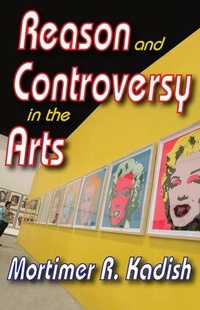
Reason and Controversy in the Arts
1st Edition
Published on 15. September 2010
Book
Paperback/Softback
296 pages
978-1-4128-1123-1 (ISBN)
Description
This study is a fresh and original attempt to liberate the theory of criticism from the limitations of connoisseurship, and the assumptions of aesthetics from the difficulties and paradoxes of aesthetic relativism. It presents a picture of what rationality in the assessment of the arts would be like if one were expected to justify one's decisions in and about the arts.
Kadish focuses upon the way in which competent and reasonable people express their differences, not upon the way they instruct novices. Among good critics, the author proposes, differences are not managed as differences concerning matters of taste, nor would anyone presume otherwise were it not for a prior and gratuitous choice of a context of consumption for considering the arts. The author examines the hypothesis that differences of opinion in artistically relevant controversy are in a fundamental sense practical, that when critics of the arts differ seriously, proposals for the proper conduct of the arts and a procedure for interpretation of the arts are what is at issue.
To understand the special logic of controversy in the arts Kadish compares that controversy with legally relevant and scientifically relevant controversies. Finally, the arts and criticism are found to be parts of a coherent enterprise the criteria of which are generated in an evolving practice, as are the criteria of law. This illuminating discourse is of continuing relevance to those interested in aesthetics.
Kadish focuses upon the way in which competent and reasonable people express their differences, not upon the way they instruct novices. Among good critics, the author proposes, differences are not managed as differences concerning matters of taste, nor would anyone presume otherwise were it not for a prior and gratuitous choice of a context of consumption for considering the arts. The author examines the hypothesis that differences of opinion in artistically relevant controversy are in a fundamental sense practical, that when critics of the arts differ seriously, proposals for the proper conduct of the arts and a procedure for interpretation of the arts are what is at issue.
To understand the special logic of controversy in the arts Kadish compares that controversy with legally relevant and scientifically relevant controversies. Finally, the arts and criticism are found to be parts of a coherent enterprise the criteria of which are generated in an evolving practice, as are the criteria of law. This illuminating discourse is of continuing relevance to those interested in aesthetics.
More details
Language
English
Place of publication
New York
United States
Publishing group
Taylor & Francis Inc
Target group
College/higher education
Dimensions
Height: 229 mm
Width: 152 mm
Weight
453 gr
ISBN-13
978-1-4128-1123-1 (9781412811231)
Copyright in bibliographic data and cover images is held by Nielsen Book Services Limited or by the publishers or by their respective licensors: all rights reserved.
Schweitzer Classification
Other editions
Additional editions
Mortimer R. Kadish
Reason and Controversy in the Arts
Book
09/2017
1st Edition
Routledge
€230.65
Shipment within 10-20 days
Mortimer R. Kadish
Reason and Controversy in the Arts
E-Book
07/2017
Routledge
€65.99
Available for download
Mortimer R. Kadish
Reason and Controversy in the Arts
E-Book
07/2017
Routledge
€65.99
Available for download
Person
Mortimer R. Kadish
Content
1: Introductory: The Gist of the Proposal; 2: The Doctrine of the Work of Art Itself; 3: Toward the Poem in Proper Relation; 4: Constructing Critical Objects: The Construction Argument; 5: The Relevance of the Created Object; 6: The Claims Question and the Dogma of Estheticism; 7: Consumer Claims and Artistically Relevant Claims; 8: Judgment and Artistic Merit; 9: The Ideal of Unicity, Judgment, and the Adjudicative Process; 10: How Artistically Relevant Controversy Is Possible: The Structure of Proper Occasions; 11: The Structure of the Evidence; 12: Reason in the Arts: A Concluding Portrait