

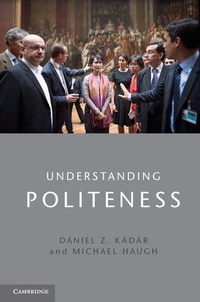
Understanding Politeness
Published on 29. August 2013
Book
Hardback
306 pages
978-1-107-03168-5 (ISBN)
Description
Politeness is key to all of our relationships and plays a fundamental part in the way we communicate with each other and the way we define ourselves. It is not limited only to conventional aspects of linguistic etiquette, but encompasses all types of interpersonal behaviour through which we explore and maintain our relationships. This groundbreaking exploration navigates the reader through this fascinating area and introduces them to a variety of new insights. The book is divided into three parts and is based on an innovative framework which relies on the concepts of social practice, time and space. In this multidisciplinary approach, the authors capture a range of user and observer understandings and provide a variety of examples from different languages and cultures. With its reader-friendly style, carefully constructed exercises and useful glossary, Understanding Politeness will be welcomed by both researchers and postgraduate students working on politeness, pragmatics and sociolinguistics more broadly.
Reviews / Votes
'Understanding Politeness provides an innovative, integrative understanding of politeness as an evaluative social practice. It is destined to become the standard paradigm for teaching students and for studying these complex phenomena.' Robert B. Arundale, Professor Emeritus of Communication, University of Alaska Fairbanks 'Understanding Politeness focuses on politeness as social practice, and sets politeness within a social, historical and evaluative context. It constitutes an excellent engagement with past and current politeness research, describes key concepts in politeness clearly, and also provides many illustrative examples from a range of different media.' Sara Mills, Research Professor in Linguistics, Sheffield Hallam University 'The authors present their innovative approach to studying interaction, focusing on (im)politeness through time and social space. Understanding Politeness can be used as a study book for students majoring in pragmatics and is a must-read for politeness researchers.' Ekaterina Rudneva, Antropologicheskij ForumMore details
Language
English
Place of publication
Cambridge
United Kingdom
Target group
College/higher education
Illustrations
Worked examples or Exercises; 4 Tables, black and white; 8 Halftones, unspecified; 17 Line drawings, unspecified
Dimensions
Height: 235 mm
Width: 157 mm
Thickness: 23 mm
Weight
656 gr
ISBN-13
978-1-107-03168-5 (9781107031685)
Copyright in bibliographic data and cover images is held by Nielsen Book Services Limited or by the publishers or by their respective licensors: all rights reserved.
Schweitzer Classification
Other editions
Additional editions
Daniel Z. Kadar | Michael Haugh
Understanding Politeness
E-Book
09/2013
1st Edition
Cambridge University Press
€32.49
Available for download
Daniel Z. Kadar | Michael Haugh
Understanding Politeness
Book
08/2013
Cambridge University Press
€63.40
Shipment within 15-20 days
Daniel Z. Kadar
Understanding Politeness
E-Book
08/2013
Cambridge University Press
€27.99
Available for download
Persons
Daniel Z. Kadar is Professor of English Language and Linguistics at the University of Huddersfield. Michael Haugh is an Associate Professor in Linguistics and International English at Griffith University.
Content
1. Introduction; Part I. Theoretical Framework: 2. The roots of politeness research; 3. Recent developments in politeness research; 4. Politeness as social practice; 5. Understandings of politeness; Part II. Politeness and Time: 6. Politeness in interaction; 7. Politeness, convention and rituality; 8. Politeness and history; Part III. Politeness and Social Space: From Mind to Society: 9. Politeness and metapragmatics; 10. Politeness, cognition and emotion; 11. Culture, identity and politeness; 12. Conclusion.