

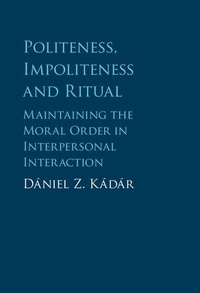
Politeness, Impoliteness and Ritual
Maintaining the Moral Order in Interpersonal Interaction
Published on 27. April 2017
Book
Hardback
284 pages
978-1-107-05218-5 (ISBN)
Description
Ritual is popularly associated with ceremonies, though in real life it plays a significantly more important role, reinforcing what people perceive as the appropriate moral order of things, or challenging what they perceive as the inappropriate flow of events. This book introduces the reader to how people use ritual in interpersonal interaction and the interface that exists between ritual and politeness and impoliteness. As rituals have a large impact on the life of people and communities, the way in which they use politeness and impoliteness in a ritual action significantly influences the way in which the given ritual is perceived. Politeness, Impoliteness and Ritual examines this complex relationship by setting up a multi-layered analytic model, with a multidisciplinary approach which will appeal to interaction scholars, politeness researchers, social psychologists and anthropologists, and moral psychologists. It fills an important knowledge gap and provides the first (im)politeness-focused interactional model of ritual.
Reviews / Votes
'This pioneering monograph brings together two foundational analytical perspectives on social interaction for the first time. Be prepared for a rewarding intellectual journey that offers a new understanding of omnipresent rituals as the substance of the moral order.' Francesca Bargiela-Chiappini, University of Warwick 'Politeness, Impoliteness and Ritual provides a solid analytic framework from both theoretical and interactional perspectives. One of the book's strengths is the wide range of datasets drawn from various human languages from the Far East to the West. This merit gives this piece of work its authenticity and reliability, making it one of the groundbreaking works in the field in recent years. Another feature that distinguishes this work is its complex and yet accessible model, which is replicable to other languages and cultures. Last but not least, the book is written in a highly accessible fashion. Therefore, this book is a must-read for scholars involved in research related to politeness and ritual, and students and educated readers who simply want to learn about a fascinating phenomenon.' Khaled Khader Oraby, FLEKS - Scandinavian Journal of Intercultural Theory and Practice '[Politeness, Impoliteness and Ritual] presents the results of a very interesting, interdisciplinary work and a stimulating framework. As a pioneering monograph that opens new research avenues, I warmly recommend it to any linguist interested in im/politeness questions.' The LINGUIST List '... this is an original and compelling book, clearly exploring the interface between politeness, impoliteness, and ritual. It serves as an excellent resource for experienced (im)politeness researchers looking to further extend their research scope, for ritual researchers exploring the oftneglected phenomenon of (im)politeness in ritual study, and for readers interested in the relationships between (im)politeness and language aggression.' International Journal of Communication 'With Politeness, Impoliteness and Ritual: Maintaining the Moral Order in Interpersonal Interaction, Daniel Kadar asserts and cements his place as the driving force behind the ritual turn in pragmatics research in general, and (im)politeness studies in particular. The preface provides an illuminating overview of the subfield, an especially valuable contribution for the uninitiated. ... The text is written in a lively, direct style, and the case studies of heckling and bystander intervention are both fun and illuminating.' Mervyn Horgan, Contemporary SociologyMore details
Language
English
Place of publication
Cambridge
United Kingdom
Target group
Professional and scholarly
Illustrations
39 Line drawings, black and white
Dimensions
Height: 235 mm
Width: 157 mm
Thickness: 20 mm
Weight
566 gr
ISBN-13
978-1-107-05218-5 (9781107052185)
Copyright in bibliographic data and cover images is held by Nielsen Book Services Limited or by the publishers or by their respective licensors: all rights reserved.
Schweitzer Classification
Other editions
Additional editions
Daniel Z. Kadar
Politeness, Impoliteness and Ritual
Maintaining the Moral Order in Interpersonal Interaction
Book
05/2019
Cambridge University Press
€49.10
Shipment within 15-20 days
Daniel Z. Kadar
Politeness, Impoliteness and Ritual
Maintaining the Moral Order in Interpersonal Interaction
E-Book
07/2017
Cambridge University Press
€29.49
Available for download
Daniel Z. Kadar
Politeness, Impoliteness and Ritual
Maintaining the Moral Order in Interpersonal Interaction
E-Book
04/2017
Cambridge University Press
€24.49
Available for download
Person
Daniel Z. Kadar is Professor of English Language and Linguistics and Director of the Centre for Intercultural Politeness Research at the University of Huddersfield. He is also Research Professor of Pragmatics at the Research Institute for Linguistics of the Hungarian Academy of Sciences. He has a long-standing interest in linguistic politeness research and ritual studies, as well as historical and intercultural pragmatics. He has published more than twenty books with Cambridge University Press and other international publishers and many papers in high-impact journals. His recent monographs include Understanding Politeness (with Michael Haugh, Cambridge, 2013) and Relational Rituals and Communication (2013). He is Editor of the Palgrave Handbook of Linguistic Politeness.
Content
Preface; 1. Introduction; Part I. Ritual and (Im)Politeness - the Basic Relationship: 2. Ritual: its definition, typology and relational role; 3. Ritual and politeness research; 4. Ritual and (im)politeness: the basic relationship; Part II. Ritual, (Im)Politeness, and Moral Aggression: 5. Rites of moral aggression in operation: countering the heckler, and bystander intervention; 6. Voicing the moral order(s) in ritual aggression: morality and/versus (im)politeness in the rite of bystander intervention; 7. De/Ratifying the maintenance/maintainer of the moral order: moral responsibility in events of heckling; 8. Conclusion.