

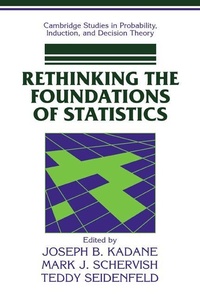
Rethinking the Foundations of Statistics
Published on 13. August 1999
Book
Hardback
400 pages
978-0-521-64011-4 (ISBN)
Description
This important collection of essays is a synthesis of foundational studies in Bayesian decision theory and statistics. An overarching topic of the collection is understanding how the norms for Bayesian decision making should apply in settings with more than one rational decision maker and then tracing out some of the consequences of this turn for Bayesian statistics. There are four principal themes to the collection: cooperative, non-sequential decisions; the representation and measurement of 'partially ordered' preferences; non-cooperative, sequential decisions; and pooling rules and Bayesian dynamics for sets of probabilities. The volume will be particularly valuable to philosophers concerned with decision theory, probability, and statistics, statisticians, mathematicians, and economists.
Reviews / Votes
"The material is well presented, and the authors themselves have made significant contributions to this area...should greatly appeal to philosophers, advanced graduate students, and researchers interested in exploring and researching the foundations of Bayesian statistics." CHOICEMore details
Series
Language
English
Place of publication
Cambridge
United Kingdom
Target group
College/higher education
Professional and scholarly
Illustrations
25 s/w Abbildungen
3 Tables, unspecified; 25 Line drawings, unspecified
Dimensions
Height: 235 mm
Width: 157 mm
Thickness: 26 mm
Weight
728 gr
ISBN-13
978-0-521-64011-4 (9780521640114)
Copyright in bibliographic data and cover images is held by Nielsen Book Services Limited or by the publishers or by their respective licensors: all rights reserved.
Schweitzer Classification
Other editions
Additional editions
Joseph B. Kadane | Mark J. Schervish | Teddy Seidenfeld
Rethinking the Foundations of Statistics
Book
08/1999
Cambridge University Press
€49.90
Shipment within 15-20 days
Persons
Content
Introduction; Part I. Decision Theory for Cooperative Decision-Making: 1. Shared preferences of two Bayesian decision makers; 2. Decisions without ordering; 3. A representation of partially ordered preferences; Part II. The Truth about Consequences: 4. Separating probability elicitation from utilities; 5. State-dependent utilities; 6. Shared preferences and state-dependent utilities; 7. A conflict between finitely additive probability and avoiding Dutch book; 8. Statistical implications of finitely additive probability; Part III. Non-Cooperative Decision Making, Inference, and Learning with Shared Evidence: 9. Subjective probability and the theory of games; 10. Equilibrium, common knowledge, and optimal sequential decisions; 11. A fair minimax theorem for 2 person (zero-sum) games involving finitely additive strategies; 12. Randomization in a Bayesian perspective; 13. Characterizations of externally Bayesian pooling operators; 14. An approach to consensus and certainty with increasing evidence; 15. Reasoning to a foregone conclusion; 16. When several Bayesians agree that there will be no reasoning to a foregone conclusion.