

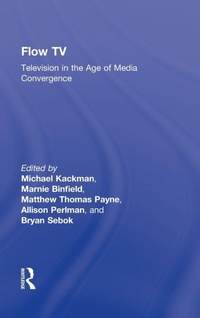
Flow TV
Television in the Age of Media Convergence
1st Edition
Published on 14. September 2010
Book
Hardback
304 pages
978-0-415-99222-0 (ISBN)
Description
From viral videos on YouTube to mobile television on smartphones and beyond, TV has overflowed its boundaries. If Raymond Williams' concept of flow challenges the idea of a discrete television text, then convergence destabilizes the notion of television as a discrete object.
Flow TV examines television in an age of technological, economic, and cultural convergence. Seeking to frame a new set of concerns for television studies in the 21st century, this collection of all new essays establishes television's continued importance in a shifting media culture. Considering television and new media not as solely technical devices, but also as social technologies, the essays in this anthology insist that we turn our attention to the social, political, and cultural practices that surround and inform those devices' use. The contributors examine television through a range of critical approaches from formal and industrial analysis to critical technology studies, reception studies, political economy, and critiques of television's transnational flows. This volume grows out of the critical community formed around the popular online journal Flow: A Critical Form on Television and Media Culture (flowtv.org). It is ideal for courses in television studies or media convergence.
Flow TV examines television in an age of technological, economic, and cultural convergence. Seeking to frame a new set of concerns for television studies in the 21st century, this collection of all new essays establishes television's continued importance in a shifting media culture. Considering television and new media not as solely technical devices, but also as social technologies, the essays in this anthology insist that we turn our attention to the social, political, and cultural practices that surround and inform those devices' use. The contributors examine television through a range of critical approaches from formal and industrial analysis to critical technology studies, reception studies, political economy, and critiques of television's transnational flows. This volume grows out of the critical community formed around the popular online journal Flow: A Critical Form on Television and Media Culture (flowtv.org). It is ideal for courses in television studies or media convergence.
Reviews / Votes
"Flow TV brings together a wide array of scholars to provocatively interrogate the sprawling and converging world of televisual media culture. Both celebrating new potentials of the digital age, and acting as a canary in the gemeinschaft, the book dramatizes why critical media studies matters now more than ever."--Matthew Jordan, Pennsylvania State University"The essays in this collection offer exciting, but level-headed analyses of television at the beginning of the 21st century. Together, they offer wonderful tributes, extensions, and complications of Raymond Williams' concept of 'flow,' analyzing television's still developing technology and cultural form without simply embracing the hype of the 'digital age'."--Brenton J. Malin, University of Pittsburgh
More details
Language
English
Place of publication
London
United Kingdom
Publishing group
Taylor & Francis Ltd
Target group
College/higher education
Postgraduate and Undergraduate
Dimensions
Height: 235 mm
Width: 157 mm
Thickness: 21 mm
Weight
594 gr
ISBN-13
978-0-415-99222-0 (9780415992220)
Copyright in bibliographic data and cover images is held by Nielsen Book Services Limited or by the publishers or by their respective licensors: all rights reserved.
Schweitzer Classification
Other editions
Additional editions
Michael Kackman | Marnie Binfield | Matthew Thomas Payne
Flow TV
Television in the Age of Media Convergence
E-Book
10/2010
Routledge
€53.99
Available for download
Michael Kackman | Marnie Binfield | Matthew Thomas Payne
Flow TV
Television in the Age of Media Convergence
E-Book
10/2010
Routledge
€53.99
Available for download
Michael Kackman | Marnie Binfield | Matthew Thomas Payne
Flow TV
Television in the Age of Media Convergence
Book
09/2010
1st Edition
Routledge
€61.70
Shipment within 15-20 days
Persons
Michael Kackman is Assistant Professor of Media Studies in the Department of Radio-Television-Film at the University of Texas at Austin. He is author of Citizen Spy: Television, Espionage, and Cold War Culture
Marnie Binfield is a doctoral student in Radio-Television-Film at the University of Texas at Austin.
Matthew Thomas Payne is a doctoral student in Radio-Televison-Film at the University of Texas at Austin. He is coeditor (with Nina B. Huntemann) of Joystick Soldiers: The Politics of Play in Military Video Games, also published by Routledge.
Allison Perlman is Assistant Professor in the Federated Department of History at the New Jersey Institute of Technology and Rutgers University-Newark.
Bryan Sebok is Assistant Professor of Media Studies at Lewis and Clark College.
Marnie Binfield is a doctoral student in Radio-Television-Film at the University of Texas at Austin.
Matthew Thomas Payne is a doctoral student in Radio-Televison-Film at the University of Texas at Austin. He is coeditor (with Nina B. Huntemann) of Joystick Soldiers: The Politics of Play in Military Video Games, also published by Routledge.
Allison Perlman is Assistant Professor in the Federated Department of History at the New Jersey Institute of Technology and Rutgers University-Newark.
Bryan Sebok is Assistant Professor of Media Studies at Lewis and Clark College.
Content
Introduction
Part I: The Convergent Experience: Viewing Practices Across Media Forms
1. Media Interfaces, Networked Media Spaces, and the Mass Customization of Everyday Space, Daniel Chamberlain
2. "It's Just Like a Mini-Mall": Textuality and Participatory Culture on YouTube, David Gurney
3. TiVoing Childhood: Time-Shifting a Generation's Concept of Television, Jason Mittell
4. Affective Convergence in Reality Television: A Case Study in Divergence Culture, Jack Bratich
5. Industry Convergence Shows: Reality TV and the Leisure Franchise, Misha Kavka
Part II: Creating Authors / Creating Audiences
6. More "Moments of Television": Online Cult Television Authorship, Derek Kompare
7. The Reviews Are In: TV Critics and the (Pre)Creation of Meaning, Jonathan Gray
8. "Word of Mouth on Steroids": Hailing the Millennial Media Fan, Louisa Ellen Stein
9. Masters of Horror: TV Auteurism and the Progressive Potential of a Disreputable Genre, Heather Hendershot
10. 49 Up: Television, "Life-Time," and the Mediated Self, John Corner
Part III: Technologies of Citizenship: Politics, Nationality, and Contemporary Television
11. Television/television, Hector Amaya
12. The Limits of the Cellular Imaginary, Eric Freedman
13. Extreme Makeover: Iraq Edition -- "TV Freedom" and Other Experiments for "Advancing" Liberal Government in Iraq, James Hay
14. Representing the Presidency: Viral Videos, Intertextuality, and Political Participation, Chuck Tryon
15. NASCAR Nation and Television: Race-ing Whiteness, L.S. Kim
Part I: The Convergent Experience: Viewing Practices Across Media Forms
1. Media Interfaces, Networked Media Spaces, and the Mass Customization of Everyday Space, Daniel Chamberlain
2. "It's Just Like a Mini-Mall": Textuality and Participatory Culture on YouTube, David Gurney
3. TiVoing Childhood: Time-Shifting a Generation's Concept of Television, Jason Mittell
4. Affective Convergence in Reality Television: A Case Study in Divergence Culture, Jack Bratich
5. Industry Convergence Shows: Reality TV and the Leisure Franchise, Misha Kavka
Part II: Creating Authors / Creating Audiences
6. More "Moments of Television": Online Cult Television Authorship, Derek Kompare
7. The Reviews Are In: TV Critics and the (Pre)Creation of Meaning, Jonathan Gray
8. "Word of Mouth on Steroids": Hailing the Millennial Media Fan, Louisa Ellen Stein
9. Masters of Horror: TV Auteurism and the Progressive Potential of a Disreputable Genre, Heather Hendershot
10. 49 Up: Television, "Life-Time," and the Mediated Self, John Corner
Part III: Technologies of Citizenship: Politics, Nationality, and Contemporary Television
11. Television/television, Hector Amaya
12. The Limits of the Cellular Imaginary, Eric Freedman
13. Extreme Makeover: Iraq Edition -- "TV Freedom" and Other Experiments for "Advancing" Liberal Government in Iraq, James Hay
14. Representing the Presidency: Viral Videos, Intertextuality, and Political Participation, Chuck Tryon
15. NASCAR Nation and Television: Race-ing Whiteness, L.S. Kim