

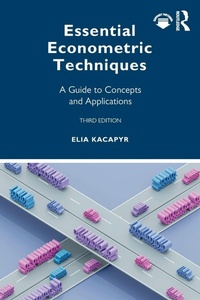
Essential Econometric Techniques
A Guide to Concepts and Applications
3rd Edition
Published on 21. March 2022
Book
Paperback/Softback
220 pages
978-1-032-10121-7 (ISBN)
Description
Now in its third edition, Essential Econometric Techniques: A Guide to Concepts and Applications is a concise, student-friendly textbook which provides an introductory grounding in econometrics, with an emphasis on the proper application and interpretation of results.
Drawing on the author's extensive teaching experience, this book offers intuitive explanations of concepts such as heteroskedasticity and serial correlation, and provides step-by-step overviews of each key topic.
This new edition contains more applications, brings in new material including a dedicated chapter on panel data techniques, and moves the theoretical proofs to appendices. After Chapter 7, students will be able to design and conduct rudimentary econometric research. The next chapters cover multicollinearity, heteroskedasticity, and autocorrelation, followed by techniques for time-series analysis and panel data.
Excel data sets for the end-of-chapter problems are available as a digital supplement. A solutions manual is also available for instructors, as well as PowerPoint slides for each chapter.
Essential Econometric Techniques shows students how economic hypotheses can be questioned and tested using real-world data, and is the ideal supplementary text for all introductory econometrics courses.
Drawing on the author's extensive teaching experience, this book offers intuitive explanations of concepts such as heteroskedasticity and serial correlation, and provides step-by-step overviews of each key topic.
This new edition contains more applications, brings in new material including a dedicated chapter on panel data techniques, and moves the theoretical proofs to appendices. After Chapter 7, students will be able to design and conduct rudimentary econometric research. The next chapters cover multicollinearity, heteroskedasticity, and autocorrelation, followed by techniques for time-series analysis and panel data.
Excel data sets for the end-of-chapter problems are available as a digital supplement. A solutions manual is also available for instructors, as well as PowerPoint slides for each chapter.
Essential Econometric Techniques shows students how economic hypotheses can be questioned and tested using real-world data, and is the ideal supplementary text for all introductory econometrics courses.
Reviews / Votes
Voices on the second edition"Professor Kacapyr's work in the field of econometrics-specifically, his work in making the subject more understandable to aspiring economics students and enthusiasts-is incredible. His style is straightforward and engaging, delivering the subject matter so effortlessly that it is a pleasure to read and immerse yourself in the text."
- Krasimir Kehayov, Ithaca College and Goldman Sachs
"Direct and to the point, Professor Kacapyr provides an effective exposition of the essentials of econometrics in both technical terms and prose. The second edition [...] is a rugged and reliable resource for instructor, learner, and practitioner. Kacapyr targets economics majors, but this book is also suited for use in courses in business, statistics, and social sciences, where the same skills are applied."
- Wade L. Thomas, SUNY Oneonta
"I really like this book as a supplement to the required text in my course. It's at the exact level that my students need, and the exercises are great practice for them."
- Cynthia Bansak, St. Lawrence University Voices on the second edition
"Professor Kacapyr's work in the field of econometrics-specifically, his work in making the subject more understandable to aspiring economics students and enthusiasts-is incredible. His style is straightforward and engaging, delivering the subject matter so effortlessly that it is a pleasure to read and immerse yourself in the text."
- Krasimir Kehayov, Goldman Sachs
"Direct and to the point, Professor Kacapyr provides an effective exposition of the essentials of econometrics in both technical terms and prose. The second edition [...] is a rugged and reliable resource for instructor, learner, and practitioner. Kacapyr targets economics majors, but this book is also suited for use in courses in business, statistics, and social sciences, where the same skills are applied."
- Wade L. Thomas, SUNY Oneonta
"I really like this book as a supplement to the required text in my course. It's at the exact level that my students need, and the exercises are great practice for them."
- Cynthia Bansak, St. Lawrence University
More details
Edition
3rd edition
Language
English
Place of publication
London
United Kingdom
Publishing group
Taylor & Francis Ltd
Target group
College/higher education
Illustrations
42 s/w Abbildungen, 42 s/w Zeichnungen, 35 s/w Tabellen
35 Tables, black and white; 42 Line drawings, black and white; 42 Illustrations, black and white
Dimensions
Height: 234 mm
Width: 156 mm
Thickness: 12 mm
Weight
354 gr
ISBN-13
978-1-032-10121-7 (9781032101217)
Copyright in bibliographic data and cover images is held by Nielsen Book Services Limited or by the publishers or by their respective licensors: all rights reserved.
Schweitzer Classification
Other editions
Additional editions
Book
03/2022
3rd Edition
Routledge
€241.70
Shipment within 10-20 days
E-Book
03/2022
3rd Edition
Routledge
€73.99
Available for download
E-Book
03/2022
3rd Edition
Routledge
€73.99
Available for download
Previous edition
Elia Kacapyr
A Guide to Basic Econometric Techniques
Book
05/2014
2nd Edition
Routledge
€75.79
Article exhausted; check for reprint
Person
Content
Chapter 1 The Nature of Econometrics Chapter 2 Simple Regression Analysis Chapter 3 Residual Statistics Chapter 4 Hypothesis Testing Chapter 5 Multivariate Regression Chapter 6 Alternate Functional Forms Chapter 7 Dichotomous Variables Chapter 8 The Classical Linear Regression Model Chapter 9 Multicollinearity Chapter 10 Heteroskedasticity Chapter 11 Serial Correlation Chapter 12 Time-Series Techniques Chapter 13 Panel Data Techniques Critical Values Tables Cited Works