

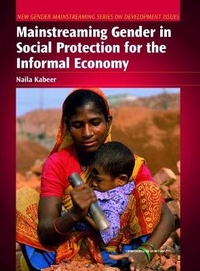
Mainstreaming Gender in Social Protection for the Informal Economy
Published on 1. January 2008
Book
Paperback/Softback
412 pages
978-0-85092-840-2 (ISBN)
Description
In Mainstreaming Gender in Social Protection for the Informal Economy Naila Kabeer explores the gendered dimensions of risk, vulnerability and insecurity and hence the need for a gender perspective in the design of social protection measures. Her emphasis is on the informal economy because that is where the majority of women, and indeed the poor, are to be found while also being where official efforts for social protection are most limited. The book will enhance understanding of the constraints and barriers that confine women to more poorly remunerated, more casual and more insecure forms of waged and self-employment, and of what this implies for women's ability to provide for their families and cope with insecurity. Kabeer develops a framework of analysis that integrates gender, life course and livelihoods perspectives in order to explore the interactions between gender inequality, household poverty and labour market forces that help to produce gender-differentiated experiences of risk and vulnerability for the working poor.
She then examines and assesses examples of social protection measures - from child allowances to pensions - in order to illustrate the necessity for a gender-analytical approach. She also stresses the importance of an organised voice for vulnerable and marginalised workers. Finally, the author synthesises the main lessons that emerge out of the discussion and identifies gaps and exclusions in the social protection agenda.
She then examines and assesses examples of social protection measures - from child allowances to pensions - in order to illustrate the necessity for a gender-analytical approach. She also stresses the importance of an organised voice for vulnerable and marginalised workers. Finally, the author synthesises the main lessons that emerge out of the discussion and identifies gaps and exclusions in the social protection agenda.
More details
Series
Language
English
Place of publication
London
United Kingdom
Target group
Professional and scholarly
Dimensions
Height: 253 mm
Width: 190 mm
ISBN-13
978-0-85092-840-2 (9780850928402)
Copyright in bibliographic data and cover images is held by Nielsen Book Services Limited or by the publishers or by their respective licensors: all rights reserved.
Schweitzer Classification
Person
Dr Naila Kabeer is a Professorial Fellow at the Institute of Development Studies at the University of Sussex, UK.
Content
Acronyms and Abbreviations Executive Summary 1. Risk, Vulnerability and Social Protection: International Perspectives Introduction What do we mean by social protection? The World Bank and the social protection agenda The ILO and the social protection agenda Social protection and structural disadvantage in the labour market: alternative perspectives 2. Gender and Trends in the Global Labour Force: New and Persisting Forms of Vulnerability 'Iceberg' economics and women's work The 'geography' of gender and patterns of economic activity The pursuit of flexible labour and the informalisation of work The changing face of the female labour force Continuities in the gender division of production and reproduction Conclusion: the rationale for a gendered approach to social protection 3. Gender, Life Course and Livelihoods: Analytical Framework and Empirical Insights Introduction Institutions and social protection: an analytical framework Gender and the structures of constraint: a three-dimensional model Gender-related constraints and labour market activity Analytical insights and policy implications: a summary Conclusion: revisiting the rationale for a gendered approach to social protection 4. Disrupting the Intergenerational Transmission of Poverty: Preventing Child Labour and Promoting Education Introduction: child labour and the intergenerational transmission of poverty Child allowances School feeding programmes Conditional cash transfer programmes Childcare support for working women Lessons from experience: gender and social protection for children 5. Alternative Approaches to Employment-based Social Protection Supply-driven and demand-led approaches to employment generation Who participates in public works programmes? Gender-related constraints and programme design Lessons from experience: gender and employment-generation programmes 6. Financial Services for Women in the Informal Economy: Protecting and Promoting Livelihoods Introduction Financial services for the poor: rationales, visions and strategies Findings on microfinance outreach Findings on the impacts of microfinance Lessons from the field 7. Pensions and Transfers: Social Protection in Old Age Gender, old age and insecurity Contributory public pension schemes Pension provision for the informal economy: examples from Latin America Social pensions and transfer schemes in South Asia Lessons from pensions and social transfers for the elderly and indigent 8. Organising for Social Protection in the Informal Economy: The Indispensability of Voice Introduction: right, codes and standards Gender and core labour standards: perspectives from the informal economy Voice, visibility and collective action in the informal economy Transnational activism Conclusion 9. Towards a 'Generative' Model of Social Protection: Making the Links to Development Policy The design of social protection: rules, norms and practice Revisiting the rationale for a gendered approach to social protection Learning from experience Social protection and development policy Financing social protection: the question of affordability Bibliography Index