

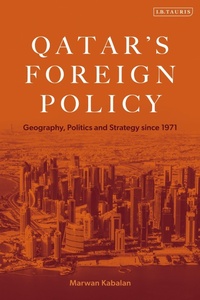
Qatar's Foreign Policy
Geography, Politics and Strategy since 1971
Will be published approx. on 25. June 2026
Book
Paperback/Softback
304 pages
978-0-7556-5519-9 (ISBN)
Description
This study offers an analysis of Qatar's foreign policy since its independence from Britain in 1971.
Locked between two vying powers, Iran and Saudi Arabia, and lacking the traditional elements of influence in the regional and international state system such as land, human capital, and advanced industry, Qatar nevertheless wields a disproportionately large amount of regional influence with an assertive foreign policy approach. Here, Marwan Kabalan highlights the strategies pursued by the ruling Qatari elite, especially during the last two decades, and delves into the methods Qatar has used to deal with the structural challenges to its foreign policy.
These strategies include financially leveraging its access to crucial resources, such as natural gas, and its manipulation of existing regional frictions. The book also addresses Qatar's soft power influence - positioning itself as an alternative cultural and intellectual hub in the Arab world, enabling it to take a leading role, particularly as a mediator, in the region. By highlighting Qatar's foreign policy strategies and outcomes, Kabalan illustrates how the Qatari case challenges key assumptions of international relations theory which assumes that wealthy small powers tend to pursue passive foreign policies, and that structural forces minimize the role of ruling elites in foreign policymaking.
Locked between two vying powers, Iran and Saudi Arabia, and lacking the traditional elements of influence in the regional and international state system such as land, human capital, and advanced industry, Qatar nevertheless wields a disproportionately large amount of regional influence with an assertive foreign policy approach. Here, Marwan Kabalan highlights the strategies pursued by the ruling Qatari elite, especially during the last two decades, and delves into the methods Qatar has used to deal with the structural challenges to its foreign policy.
These strategies include financially leveraging its access to crucial resources, such as natural gas, and its manipulation of existing regional frictions. The book also addresses Qatar's soft power influence - positioning itself as an alternative cultural and intellectual hub in the Arab world, enabling it to take a leading role, particularly as a mediator, in the region. By highlighting Qatar's foreign policy strategies and outcomes, Kabalan illustrates how the Qatari case challenges key assumptions of international relations theory which assumes that wealthy small powers tend to pursue passive foreign policies, and that structural forces minimize the role of ruling elites in foreign policymaking.
Reviews / Votes
Drawing heavily on primary sources, Kabalan has produced an authoritative primer on Qatar's influential, though often enigmatic foreign policy. Original and objective, it's well worth a space on your library shelf. * Christopher M. Davidson, author of Dubai: The Vulnerability of Success * This meticulous and highly readable account of Qatar's foreign policy is theoretically informed and empirically rigorous, and provides the most detailed explanation of how and why policymakers in Doha have been able to carve out a set of policies that far exceed the normal boundaries of small states in the international system. * Kristian Coates Ulrichsen, M.Phil PhD, Fellow for the Middle East, Rice University's Baker Institute *More details
Series
Language
English
Place of publication
United Kingdom
Publishing group
Bloomsbury Publishing PLC
Target group
Professional and scholarly
Product notice
Paperback (trade)
Unsewn / adhesive bound
Dimensions
Height: 234 mm
Width: 156 mm
Thickness: 16 mm
Weight
426 gr
ISBN-13
978-0-7556-5519-9 (9780755655199)
Copyright in bibliographic data and cover images is held by Nielsen Book Services Limited or by the publishers or by their respective licensors: all rights reserved.
Schweitzer Classification
Person
Marwan Kabalan is Director of Policy Analysis at the Arab Centre for Research and Policy Studies, Qatar. He previously served as Dean of the Faculty of International Relations and Diplomacy at Kalamoon University in Damascus, Syria. He is a co-editor of Turkey-Syria Relations: Between Enmity and Amity (2013) and Syrian Foreign Policy and the United States, From Bush to Obama (2009).
Content
List of Figures
List of Tables
Introduction
Chapter One
From Independence to Ascendancy
Chapter Two
Qatar Foreign Policy: The Theoretical Challenge
Chapter Three
Overcoming Geography
Chapter Four
Battle of the Axes
Chapter Five
Geopolitics of the Arab Spring
Chapter Six
The Unfinished Business of the Arab Spring
Chapter Seven
Relations with Washington: The Uneasy Alliance
Chapter Eight
Illusions of Strength and Decisiveness
Chapter Nine
Managing the Crisis
Chapter Ten
Challenges to Qatar's Foreign Policy
Conclusion
List of Tables
Introduction
Chapter One
From Independence to Ascendancy
Chapter Two
Qatar Foreign Policy: The Theoretical Challenge
Chapter Three
Overcoming Geography
Chapter Four
Battle of the Axes
Chapter Five
Geopolitics of the Arab Spring
Chapter Six
The Unfinished Business of the Arab Spring
Chapter Seven
Relations with Washington: The Uneasy Alliance
Chapter Eight
Illusions of Strength and Decisiveness
Chapter Nine
Managing the Crisis
Chapter Ten
Challenges to Qatar's Foreign Policy
Conclusion