

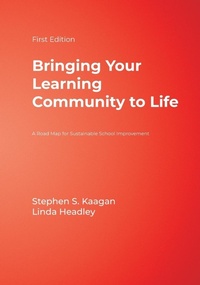
Bringing Your Learning Community to Life
A Road Map for Sustainable School Improvement
1st Edition
Published on 21. April 2010
Book
Paperback/Softback
160 pages
978-1-4129-7297-0 (ISBN)
Description
"This book is structured for the busy educator! The authors invite readers to journey toward professionalizing learning places. From the beginning of the journey (where ever you are) to the high points, low points, midpoint, and endpoints, the reader is transformed to the PLC way. A must-read for staff developers, instructional coaches, school improvement coordinators, and human relations specialists."
-Marian White-Hood, Director of Academics, SeeForever Foundation
Maya Angelou Public Charter School, Washington, DC
The do-it-yourself guide to creating and sustaining a professional learning community in your school or district!
How can you take the concept of a learning community from theory to the school building? This how-to guide walks you through the process of establishing a PLC step by step over a flexible timeline of nine to twelve months.
Leadership and organizational development specialists Stephen S. Kaagan and Linda Headley provide school and district leaders with a concrete road map and numerous tools for creating and sustaining a PLC focused on improving student learning. Readers will find everything they need to get a PLC up and running, including:
Specific tasks that help educators "learn by doing" as they create a PLC
Practice exercises for conducting productive meetings, building individual and group communication skills, and shaping the group's identity
Brief case studies of problems encountered by educators to spark discussion and support educators' growth as learners and leaders
Guidelines for appropriately pacing the chapters, tasks, and exercises with your faculty
Bringing Your Learning Community to Life is an invaluable manual for building capacity and creating an effective, sustainable PLC focused on continuous improvement.
-Marian White-Hood, Director of Academics, SeeForever Foundation
Maya Angelou Public Charter School, Washington, DC
The do-it-yourself guide to creating and sustaining a professional learning community in your school or district!
How can you take the concept of a learning community from theory to the school building? This how-to guide walks you through the process of establishing a PLC step by step over a flexible timeline of nine to twelve months.
Leadership and organizational development specialists Stephen S. Kaagan and Linda Headley provide school and district leaders with a concrete road map and numerous tools for creating and sustaining a PLC focused on improving student learning. Readers will find everything they need to get a PLC up and running, including:
Specific tasks that help educators "learn by doing" as they create a PLC
Practice exercises for conducting productive meetings, building individual and group communication skills, and shaping the group's identity
Brief case studies of problems encountered by educators to spark discussion and support educators' growth as learners and leaders
Guidelines for appropriately pacing the chapters, tasks, and exercises with your faculty
Bringing Your Learning Community to Life is an invaluable manual for building capacity and creating an effective, sustainable PLC focused on continuous improvement.
Reviews / Votes
"This book is structured for the busy educator! The authors invite readers to journey toward professionalizing learning spaces. From the beginning of the journey (wherever you are) through the high points, low points, midpoint, and endpoint, the reader is converted to the PLC way. A must-read for staff developers, instructional coaches, school improvement coordinators, and human relations specialists." -- Marian White-Hood, Director of Academics, See Forever Foundation "Excellent cases support and clarify each point, and the examples are very true to life and useful to the reader. The timeframes were also very true to life-change does not occur overnight, and the book clearly states this" -- Ginnie Drouin, PrincipalMore details
Edition
First Edition
Language
English
Place of publication
Thousand Oaks
United States
Publishing group
SAGE Publications Inc
Target group
Professional and scholarly
Dimensions
Height: 254 mm
Width: 178 mm
Thickness: 9 mm
Weight
315 gr
ISBN-13
978-1-4129-7297-0 (9781412972970)
Copyright in bibliographic data and cover images is held by Nielsen Book Services Limited or by the publishers or by their respective licensors: all rights reserved.
Schweitzer Classification
Persons
Stephen S. Kaagan is currently professor of education at Michigan State University. His teaching interests are leadership, organizational analysis, and administrative practice. He has a doctorate from Harvard University and has been honored with several awards, including membership in the Royal Society for the Encouragement of Arts, Manufactures and Commerce, London, England and Honorary Doctorates from Williams College in Massachusetts and Green Mountain College in Vermont.
Before coming to Michigan State University in 1991, Kaagan served as president of Hurricane Island Outward Bound (1989-91), commissioner of education for the State of Vermont (1982-88), and provost at Pratt Institute in New York City (1977-82).
He has written extensively on leadership, organizational development, the role of the arts in schooling, and assessment and accountability. Selected publications include Developing Teacher Leaders: How Teacher Leadership Enhances School Success (with Frank Crowther et al.), Managing Successful School Reform: the Legacy of Chris Argyris (a special edition of the International Journal of Educational Management, co-edited with Frank Crowther), Leadership Games: Experiential Learning for Organizational Development, and Leadership Lessons: From a Life of Character and Purpose in Public Affairs.
Kaagan is a charter board member of ArtServe Michigan. In the late 1980s, he served as a member of a distinguished panel on "Making the System Work Better for Poor Kids," a Carnegie Foundation-sponsored project of Harvard's John F. Kennedy School of Government.
Kaagan's experience spans an academic career; wide-ranging service as an advisor to government agencies, corporations, and educational institutions; military experience in the USMC Reserve; extensive travel throughout the world, including mountaineering expeditions in the Himalayas, Andes, and Cascades; and rugby football refereeing for the US Rugby Football Union.
Linda Headley owns and operates Headley Pratt Consulting (1993-present), which provides research, communications, and strategic planning services, primarily in the areas of education and the environment. For more than 20 years, she has been contracted by a variety of clients-including private businesses, national trade associations, nonprofits, universities, and state and local governments-to provide speaking, facilitation, focus group research, project management, and leadership training services.
A graduate of Albion College with a degree in communications, she has used her exceptional research and writing skills to help clients translate difficult topics into concepts and terms that can be understood and embraced by broad and diverse audiences. She then uses her knowledge of these topics to improve business practices and positively affect public policy.
She first joined forces with bpcUSA partner Steve Kaagan in the mid- 1990s to develop quality indicator systems for the education community and advance land-use planning initiatives in Northern Michigan. Since that time, they have worked on various projects designed to move organizations forward through strong leadership and sound strategic plans. She has written extensively on a variety of topics ranging from groundwater contamination, the recovery of end-of-life plastics, and balancing economic and environmental concerns to school choice, the changing face of education, the implications of federal legislation such as the No Child Left Behind Act, and using assessment results to positively affect curriculum and instruction.
Before coming to Michigan State University in 1991, Kaagan served as president of Hurricane Island Outward Bound (1989-91), commissioner of education for the State of Vermont (1982-88), and provost at Pratt Institute in New York City (1977-82).
He has written extensively on leadership, organizational development, the role of the arts in schooling, and assessment and accountability. Selected publications include Developing Teacher Leaders: How Teacher Leadership Enhances School Success (with Frank Crowther et al.), Managing Successful School Reform: the Legacy of Chris Argyris (a special edition of the International Journal of Educational Management, co-edited with Frank Crowther), Leadership Games: Experiential Learning for Organizational Development, and Leadership Lessons: From a Life of Character and Purpose in Public Affairs.
Kaagan is a charter board member of ArtServe Michigan. In the late 1980s, he served as a member of a distinguished panel on "Making the System Work Better for Poor Kids," a Carnegie Foundation-sponsored project of Harvard's John F. Kennedy School of Government.
Kaagan's experience spans an academic career; wide-ranging service as an advisor to government agencies, corporations, and educational institutions; military experience in the USMC Reserve; extensive travel throughout the world, including mountaineering expeditions in the Himalayas, Andes, and Cascades; and rugby football refereeing for the US Rugby Football Union.
Linda Headley owns and operates Headley Pratt Consulting (1993-present), which provides research, communications, and strategic planning services, primarily in the areas of education and the environment. For more than 20 years, she has been contracted by a variety of clients-including private businesses, national trade associations, nonprofits, universities, and state and local governments-to provide speaking, facilitation, focus group research, project management, and leadership training services.
A graduate of Albion College with a degree in communications, she has used her exceptional research and writing skills to help clients translate difficult topics into concepts and terms that can be understood and embraced by broad and diverse audiences. She then uses her knowledge of these topics to improve business practices and positively affect public policy.
She first joined forces with bpcUSA partner Steve Kaagan in the mid- 1990s to develop quality indicator systems for the education community and advance land-use planning initiatives in Northern Michigan. Since that time, they have worked on various projects designed to move organizations forward through strong leadership and sound strategic plans. She has written extensively on a variety of topics ranging from groundwater contamination, the recovery of end-of-life plastics, and balancing economic and environmental concerns to school choice, the changing face of education, the implications of federal legislation such as the No Child Left Behind Act, and using assessment results to positively affect curriculum and instruction.
Content
Acknowledgments
About the Authors
Preface
Section I. Laying the Foundation
1. Having Productive Discussions 101: Cultivating Individual Skills
Introduction
Ten Pillars of Productive Discussion
Interpreting the Pillars
Initial Self-Assessment
Practice Exercises 1-3
Conclusion
2. Having Productive Discussions 102: Cultivating Group Skills
Introduction
Practice Exercises 1-4
Self-Assessment Reprise
Future Use of the 10 Pillars
Conclusion
Section II. Putting Your New Skills to Work
3. Shaping a Group Identity
Introduction
Soul Searching via a Careful, Clean, and Crisp Culture Audit
Metaphor, the Path to the Future
Professional Learning Community Attributes
Ground Rules to Accompany the Attributes
Practice Makes Perfect
Conclusion
4. Small Moves Make a Big Difference
Introduction
Small and Different Moves Elaborated
Moving on the Small Moves
Putting It All Together
Conclusion
5. Sustaining Learning Community Growth
Introduction
Learning Strategies
The Power of Authentic Learning
Experiential Learning, a Complement to Authentic Learning
A Little Experience, a Lot of Learning Potential
Qualifying Experiences as Authentic
Making the Most of Experience for Learning
Outcome Narratives: Authentic Learning of Choice for Professional Learning Communities
Why Outcome Narratives Work
How Outcome Narratives are Developed and Used
Learning to Walk Before You Run
Conclusion
Additional Exemplary Outcome Narratives
Endnotes
Conclusion: Taking the Leap
Reproducible Resources
References
About the Authors
Preface
Section I. Laying the Foundation
1. Having Productive Discussions 101: Cultivating Individual Skills
Introduction
Ten Pillars of Productive Discussion
Interpreting the Pillars
Initial Self-Assessment
Practice Exercises 1-3
Conclusion
2. Having Productive Discussions 102: Cultivating Group Skills
Introduction
Practice Exercises 1-4
Self-Assessment Reprise
Future Use of the 10 Pillars
Conclusion
Section II. Putting Your New Skills to Work
3. Shaping a Group Identity
Introduction
Soul Searching via a Careful, Clean, and Crisp Culture Audit
Metaphor, the Path to the Future
Professional Learning Community Attributes
Ground Rules to Accompany the Attributes
Practice Makes Perfect
Conclusion
4. Small Moves Make a Big Difference
Introduction
Small and Different Moves Elaborated
Moving on the Small Moves
Putting It All Together
Conclusion
5. Sustaining Learning Community Growth
Introduction
Learning Strategies
The Power of Authentic Learning
Experiential Learning, a Complement to Authentic Learning
A Little Experience, a Lot of Learning Potential
Qualifying Experiences as Authentic
Making the Most of Experience for Learning
Outcome Narratives: Authentic Learning of Choice for Professional Learning Communities
Why Outcome Narratives Work
How Outcome Narratives are Developed and Used
Learning to Walk Before You Run
Conclusion
Additional Exemplary Outcome Narratives
Endnotes
Conclusion: Taking the Leap
Reproducible Resources
References