

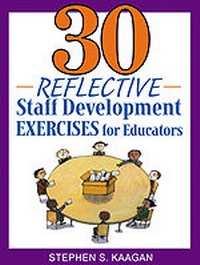
30 Reflective Staff Development Exercises for Educators
1st Edition
Published on 21. January 2004
Book
Hardback
120 pages
978-0-7619-3884-2 (ISBN)
Description
In this invaluable and unique resource, leadership and organizational development expert Stephen S Kaagan presents a unique guide for educators who enjoy challenging themselves and are eager for new ideas and a fresh perspective of staff development. It promotes individual and collective learning of all participants as they undertake formal staff development while enhancing the success and performance of the entire educational system.
The 30 reflective exercises have been designed to meet the specific needs of educators and include:
} fostering effective change
} developing leadership skills
} identifying and capitalizing on staff assets
} gaining and using new perspectives.
Each of the 30 exercises is described in rich, full detail, including detailed instructions on process, appropriate group size, and contextual cues for best use. Questions for reflection help users explore the "what," the "so what," and the "now what" of issues raised in the exercises. By incorporating reflective exercise into staff development, facilitators and participants will have the opportunity to engage deeply with new ideas and make connections between theory and practice.
The 30 reflective exercises have been designed to meet the specific needs of educators and include:
} fostering effective change
} developing leadership skills
} identifying and capitalizing on staff assets
} gaining and using new perspectives.
Each of the 30 exercises is described in rich, full detail, including detailed instructions on process, appropriate group size, and contextual cues for best use. Questions for reflection help users explore the "what," the "so what," and the "now what" of issues raised in the exercises. By incorporating reflective exercise into staff development, facilitators and participants will have the opportunity to engage deeply with new ideas and make connections between theory and practice.
Reviews / Votes
"Kaagan's book provides a growth focused tool kit that is unique in its presentation. A must-have for the professional library of the novice trainer or the experienced staff developer, it gives the 'now what' piece to enhance dialogue in school-specific learning situations, curriculum design sessions, or system-wide strategic planning." -- Marti Richardson, PresidentMore details
Language
English
Place of publication
Thousand Oaks
United States
Publishing group
SAGE Publications Inc
Target group
Professional and scholarly
Product notice
Cloth over boards
Dimensions
Height: 279 mm
Width: 216 mm
Weight
565 gr
ISBN-13
978-0-7619-3884-2 (9780761938842)
Copyright in bibliographic data and cover images is held by Nielsen Book Services Limited or by the publishers or by their respective licensors: all rights reserved.
Schweitzer Classification
Other editions
New editions
Stephen S. Kaagan
30 Reflective Staff Development Exercises for Educators
Book
08/2008
2nd Edition
Corwin Press Inc
€84.48
Article is exhausted; no reprint
Person
Stephen S. Kaagan is currently professor of education at Michigan State University. His teaching interests are leadership, organizational analysis, and administrative practice. He has a doctorate from Harvard University and has been honored with several awards, including membership in the Royal Society for the Encouragement of Arts, Manufactures and Commerce, London, England and Honorary Doctorates from Williams College in Massachusetts and Green Mountain College in Vermont.
Before coming to Michigan State University in 1991, Kaagan served as president of Hurricane Island Outward Bound (1989-91), commissioner of education for the State of Vermont (1982-88), and provost at Pratt Institute in New York City (1977-82).
He has written extensively on leadership, organizational development, the role of the arts in schooling, and assessment and accountability. Selected publications include Developing Teacher Leaders: How Teacher Leadership Enhances School Success (with Frank Crowther et al.), Managing Successful School Reform: the Legacy of Chris Argyris (a special edition of the International Journal of Educational Management, co-edited with Frank Crowther), Leadership Games: Experiential Learning for Organizational Development, and Leadership Lessons: From a Life of Character and Purpose in Public Affairs.
Kaagan is a charter board member of ArtServe Michigan. In the late 1980s, he served as a member of a distinguished panel on "Making the System Work Better for Poor Kids," a Carnegie Foundation-sponsored project of Harvard's John F. Kennedy School of Government.
Kaagan's experience spans an academic career; wide-ranging service as an advisor to government agencies, corporations, and educational institutions; military experience in the USMC Reserve; extensive travel throughout the world, including mountaineering expeditions in the Himalayas, Andes, and Cascades; and rugby football refereeing for the US Rugby Football Union.
Before coming to Michigan State University in 1991, Kaagan served as president of Hurricane Island Outward Bound (1989-91), commissioner of education for the State of Vermont (1982-88), and provost at Pratt Institute in New York City (1977-82).
He has written extensively on leadership, organizational development, the role of the arts in schooling, and assessment and accountability. Selected publications include Developing Teacher Leaders: How Teacher Leadership Enhances School Success (with Frank Crowther et al.), Managing Successful School Reform: the Legacy of Chris Argyris (a special edition of the International Journal of Educational Management, co-edited with Frank Crowther), Leadership Games: Experiential Learning for Organizational Development, and Leadership Lessons: From a Life of Character and Purpose in Public Affairs.
Kaagan is a charter board member of ArtServe Michigan. In the late 1980s, he served as a member of a distinguished panel on "Making the System Work Better for Poor Kids," a Carnegie Foundation-sponsored project of Harvard's John F. Kennedy School of Government.
Kaagan's experience spans an academic career; wide-ranging service as an advisor to government agencies, corporations, and educational institutions; military experience in the USMC Reserve; extensive travel throughout the world, including mountaineering expeditions in the Himalayas, Andes, and Cascades; and rugby football refereeing for the US Rugby Football Union.
Content
Acknowledgments
About the Author
Part I: The Power of Reflective Exercises for Staff Development
Purpose and Audience
Guiding Principles
Making the Exception the Rule
Committing to Organizational Learning Concepts
Important Caveats
Current Practice
The Contributions of Senge et al.
A Personal Approach to Teaching and Consulting
Organization of the Book
Format of the Exercises
Part II: 30 Reflective Exercises
Maps and Markers: Expanding the Mental Landscape
1. Animal Attributes
2. Ancestors
3. Pushpins
4. Surprise Me
5. E-xplore Assets
6. Instant History
7. Bringing the Outside In
8. Best, Worst
9. Don't Surprise Me
10. Leadership Then, Now, Into the Future
Multiplicity, Mutuality, and Meaning: Working Collaboratively
11. Dashing Dual Interview
12. E-xplore Perspectives
13. Snapshots
14. Rotating Pencils
15. Listening for Assumptions
16. Fruits of Silence
17. See
18. Patchwork Perspectives
19. Word by Word
20. Vision Sketch
Mission Maintenance and Momentum: Moving to Action
21. Begin, Begin, Begin
22. Modest Expectations
23. Informed Purpose
24. Beginning at the End
25. Context Map
26. The "View From Downtown"
27. E-xplore by Association
28. Unheard Voices
29. Blame Game
30. Standing Offer
Part III: Choosing Appropriate Exercises
Vignette 1: Narrowing the Generation Gap
Vignette 2: Deepening the Discourse
Vignette 3: Traversing Unfamiliar Territory
Vignette 4: Diminishing Divisiveness
Concluding Comments
Resource: Exercises Arranged by Topic and Purpose
Bibliography
About the Author
Part I: The Power of Reflective Exercises for Staff Development
Purpose and Audience
Guiding Principles
Making the Exception the Rule
Committing to Organizational Learning Concepts
Important Caveats
Current Practice
The Contributions of Senge et al.
A Personal Approach to Teaching and Consulting
Organization of the Book
Format of the Exercises
Part II: 30 Reflective Exercises
Maps and Markers: Expanding the Mental Landscape
1. Animal Attributes
2. Ancestors
3. Pushpins
4. Surprise Me
5. E-xplore Assets
6. Instant History
7. Bringing the Outside In
8. Best, Worst
9. Don't Surprise Me
10. Leadership Then, Now, Into the Future
Multiplicity, Mutuality, and Meaning: Working Collaboratively
11. Dashing Dual Interview
12. E-xplore Perspectives
13. Snapshots
14. Rotating Pencils
15. Listening for Assumptions
16. Fruits of Silence
17. See
18. Patchwork Perspectives
19. Word by Word
20. Vision Sketch
Mission Maintenance and Momentum: Moving to Action
21. Begin, Begin, Begin
22. Modest Expectations
23. Informed Purpose
24. Beginning at the End
25. Context Map
26. The "View From Downtown"
27. E-xplore by Association
28. Unheard Voices
29. Blame Game
30. Standing Offer
Part III: Choosing Appropriate Exercises
Vignette 1: Narrowing the Generation Gap
Vignette 2: Deepening the Discourse
Vignette 3: Traversing Unfamiliar Territory
Vignette 4: Diminishing Divisiveness
Concluding Comments
Resource: Exercises Arranged by Topic and Purpose
Bibliography