

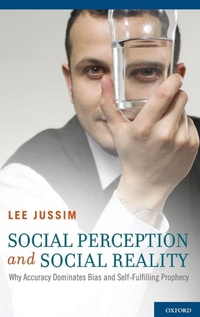
Social Perception and Social Reality
Why Accuracy Dominates Bias and Self-Fulfilling Prophecy
Published on 19. April 2012
Book
Hardback
486 pages
978-0-19-536660-0 (ISBN)
Description
Social Perception and Social Reality contests the received wisdom in the field of social psychology that suggests that social perception and judgment are generally flawed, biased, and powerfully self-fulfilling. Jussim reviews a wealth of real world, survey, and experimental data collected over the last century to show that in fact, social psychological research consistently demonstrates that biases and self-fulfilling prophecies are generally weak, fragile, and fleeting. Furthermore, research in the social sciences has shown stereotypes to be accurate.
Jussim overturns the received wisdom concerning social perception in several ways. He critically reviews studies that are highly cited darlings of the bias conclusion and shows how these studies demonstrate far more accuracy than bias, or are not replicable in subsequent research. Studies of equal or higher quality, which have been replicated consistently, are shown to demonstrate high accuracy, low bias, or both. The book is peppered with discussions suggesting that theoretical and political blinders have led to an odd state of affairs in which the flawed or misinterpreted bias studies receive a great deal of attention, while stronger and more replicable accuracy studies receive relatively little attention. In addition, the author presents both personal and real world examples (such as stock market prices, sporting events, and political elections) that routinely undermine heavy-handed emphases on error and bias, but are generally indicative of high levels of rationality and accuracy. He fully embraces scientific data, even when that data yields unpopular conclusions or contests prevailing conventions or the received wisdom in psychology, in other social sciences, and in broader society.
Jussim overturns the received wisdom concerning social perception in several ways. He critically reviews studies that are highly cited darlings of the bias conclusion and shows how these studies demonstrate far more accuracy than bias, or are not replicable in subsequent research. Studies of equal or higher quality, which have been replicated consistently, are shown to demonstrate high accuracy, low bias, or both. The book is peppered with discussions suggesting that theoretical and political blinders have led to an odd state of affairs in which the flawed or misinterpreted bias studies receive a great deal of attention, while stronger and more replicable accuracy studies receive relatively little attention. In addition, the author presents both personal and real world examples (such as stock market prices, sporting events, and political elections) that routinely undermine heavy-handed emphases on error and bias, but are generally indicative of high levels of rationality and accuracy. He fully embraces scientific data, even when that data yields unpopular conclusions or contests prevailing conventions or the received wisdom in psychology, in other social sciences, and in broader society.
Reviews / Votes
This book is well organized and clearly written. It is a book that scholars in these areas will want to read... Students also could learn a great deal about the importance of attending to the details of classic and current studies from reading this book. * PsycCritiques *More details
Language
English
Place of publication
New York
United States
Target group
College/higher education
Professional and scholarly
Social psychologists, graduate and advanced undergraduate students in psychology
Illustrations
10 B/W
Dimensions
Height: 240 mm
Width: 161 mm
Thickness: 31 mm
Weight
889 gr
ISBN-13
978-0-19-536660-0 (9780195366600)
Copyright in bibliographic data and cover images is held by Nielsen Book Services Limited or by the publishers or by their respective licensors: all rights reserved.
Schweitzer Classification
Other editions
Additional editions
Lee Jussim
Social Perception and Social Reality
Why Accuracy Dominates Bias and Self-Fulfilling Prophecy
E-Book
04/2012
1st Edition
OUP eBook
€76.49
Available for download
Person
Lee Jussim is Professor and Chair of the Psychology Department at Rutgers University. He has published extensively on stereotypes, prejudice, and discrimination, self-fulfilling prophecies and expectancy-confirming biases, and accuracy in social perception. He fully embraces scientific data, even when that data yields unpopular or politically incorrect conclusions (many of which can be found in this book).
Content
Section I - Introduction: This Book, Basic Ideas, and the Early Research ; Chapter 1 - Introduction: How Might Social Beliefs Relate to Social Reality? ; Chapter 2 - Social Reality is Not Always What it Appears To Be: The Scientific Roots of Research on Interpersonal Expectancies ; Chapter 3 - The Once Raging and Still Smoldering Pygmalion Controversy ; Section II - The Awesome Power of Expectations to Create Reality and Distort Perceptions ; Chapter 4 - The Extraordinary Power of Self-Fulfilling Prophecies ; Chapter 5 - The Extraordinary Power of Expectancies to Bias Perception, Memory, and Information-Seeking ; Section III - The Less Than Awesome Power of Expectations to Create Reality and Distort Perceptions ; Chapter 6 - The Less Than Extraordinary Power of Self-Fulfilling Prophecies: Considerations Based on Common Sense, Daily Life, and a Critical Evaluation of the Early Classic Experiments ; Chapter 7 - You Better Change Your Expectations Because I Will Not Change (Much) to Fit Your Expectations: Self-Verification as a Limit to Self-Fulfilling Prophecies ; Chapter 8 - The Less Than Awesome Power of Expectations to Distort Information-Seeking ; Chapter 9 - The Less Than Awesome Power of Expectations to Bias Perception, Memory and Judgment ; Section IV - Accuracy: Controversies, Criticisms, Criteria, Components, and Cognitive Processes ; Chapter 10 - Accuracy: Historical, Political, and Conceptual Objections ; Chapter 11 - Accuracy: Criteria ; Chapter 12 - Accuracy: Components and Processes ; Section V - The Quest for the Powerful Self-Fulfilling Prophecy ; Chapter 13 - Teacher Expectations: Accuracy and the Quest for the Powerful Self-Fulfilling Prophecy ; Chapter 14 - Do Self-Fulfilling Prophecies Accumulate or Dissipate? ; Section VI - Stereotypes ; Chapter 15 - On the Pervasiveness and Logical Incoherence of Defining Stereotypes as Inaccurate ; Chapter 16 - What Constitutes Evidence of Stereotype Accuracy? ; Chapter 17 - Pervasive Stereotype Accuracy ; Chapter 18 - Stereotypes and Person Perception: Can Judging Individuals on the Basis of Stereotypes Ever Increase Accuracy? ; Chapter 19 - Stereotypes Have Been Stereotyped! ; Section VII - Conclusion ; Chapter 20 - Important, Interesting and Controversial Work on Accuracy, Bias, and Self-Fulfilling Prophecies that Did Not Fit Elsewhere ; Chapter 21 - The 90% Full Glass Contests the Scholarly Bias for Bias