

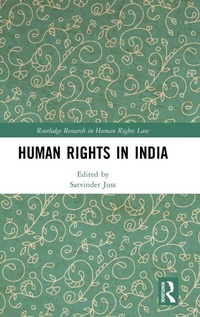
Human Rights in India
1st Edition
Published on 14. October 2019
Book
Hardback
306 pages
978-0-367-17859-8 (ISBN)
Description
This volume presents an integrated collection of essays around the theme of India's failure to grapple with the big questions of human rights protections affecting marginalized minority groups in the country's recent rush to modernization. The book traverses a broad range of rights violations from: gender equality to sexual orientation, from judicial review of national security law to national security concerns, from water rights to forest rights of those in need, and from the persecution of Muslims in Gulberg to India's parallel legal system of Lok Adalats to resolve disputes. It calls into question India's claim to be a contemporary liberal democracy. The thesis is given added strength by the authors' diverse perspectives which ultimately create a synergy that stimulates the thinking of the entire field of human rights, but in the context of a non-western country, thereby prompting many specialists in human rights to think in new ways about their research and the direction of the field, both in India and beyond.
In an area that has been under-researched, the work will provide valuable guidance for new research ideas, experimental designs and analyses in key cutting-edge issues covered in this work, such as acid attacks or the right to protest against the 'nuclear' state in India.
In an area that has been under-researched, the work will provide valuable guidance for new research ideas, experimental designs and analyses in key cutting-edge issues covered in this work, such as acid attacks or the right to protest against the 'nuclear' state in India.
Reviews / Votes
'India's Courts have developed an enviable human rights jurisprudence admired throughout the world. At the same time, it has a questionable human rights record on ground realities. This is not a dichotomy but, like so many nations, India has a bi-focal ability, to perceive the ground realities as a state of 'being' and its normative jurisprudence as a state of 'becoming.' This anthology does not seek to expose but remind us of this mighty dissonance. Perhaps, some but, not all courts, were more vigilant in their concerns to evolve a masterly jurisprudence despite the compromises inherent in India's Constitution. Even so cruel human rights absurdities persist. These essays take us to national security massively trumping rights, the parallel 'legal' system of khap panchayats (caste communities) severely punishing people, the legal mimicry of the Gujarat and other riots, the increasing lawlessness, acid attacks, forest rights, the wayward law on death penalty, the water crisis and the shadow of the World Bank on India's economy. I put this book down with a sadness that I had reached the end, but spirited by the hope that more books like this will be written.'- Dr Rajeev Dhavan, supreme court lawyer, New Delhi
More details
Series
Language
English
Place of publication
London
United Kingdom
Publishing group
Taylor & Francis Ltd
Target group
College/higher education
Illustrations
16 s/w Photographien bzw. Rasterbilder, 1 s/w Zeichnung, 2 s/w Tabellen
2 Tables, black and white; 1 Line drawings, black and white; 16 Halftones, black and white
Dimensions
Height: 240 mm
Width: 161 mm
Thickness: 22 mm
Weight
646 gr
ISBN-13
978-0-367-17859-8 (9780367178598)
Copyright in bibliographic data and cover images is held by Nielsen Book Services Limited or by the publishers or by their respective licensors: all rights reserved.
Schweitzer Classification
Other editions
Additional editions
Satvinder Juss
Human Rights in India
Book
06/2021
1st Edition
Routledge
€66.20
Shipment within 10-20 days
Person
Satvinder Juss is a Professor of Law at King's College London and a Barrister.
Content
Part One
Arudra Burra - Civil liberties in the early constitution: the CrossRoads and Organiser cases
Rajgopal Saikumar - The constitutional politics of judicial review and the Supreme Court's human rights discourse
Surabhi Chopra - Securing rights, protecting the nation?: national security and the Indian Supreme Court
Siddharth Peter de Souza - India's parallel justice systems: engaging with Lok Adalats, Gram Nyayalayas, Nari Adalats and Khap Panchayats through human rights
Part Two
Satvinder Juss - Unconstitutionalising India's death penalty
Oishik Sircar - Gujarat 2002: refracted memories, inadequate images
Robert Wintemute - Lesbian, gay, bisexual and transgender human rights in India: from Naz Foundation to Navtej Singh Johar and beyond
Sital Kalantry and Jocelyn Getgen Kestenbaum - Acid attacks in India: the case for state and corporate cccountability for gender-based crimes
Part Three
Raminder Kaur - The right for rights: the lawful and the lawless in India
Rajshree Chandra - India's Forest Rights Act: righting indigeneity, subverting property
Philipe Cullet - The human right to water: a testing ground for neoliberal policies
Bhumika Modh and Uma Mahesh Sathyanarayan - Realising human rights obligations of the World Bank in India: a human rights critique of the World Bank Country Partnership Strategy for India (2013-17)
Arudra Burra - Civil liberties in the early constitution: the CrossRoads and Organiser cases
Rajgopal Saikumar - The constitutional politics of judicial review and the Supreme Court's human rights discourse
Surabhi Chopra - Securing rights, protecting the nation?: national security and the Indian Supreme Court
Siddharth Peter de Souza - India's parallel justice systems: engaging with Lok Adalats, Gram Nyayalayas, Nari Adalats and Khap Panchayats through human rights
Part Two
Satvinder Juss - Unconstitutionalising India's death penalty
Oishik Sircar - Gujarat 2002: refracted memories, inadequate images
Robert Wintemute - Lesbian, gay, bisexual and transgender human rights in India: from Naz Foundation to Navtej Singh Johar and beyond
Sital Kalantry and Jocelyn Getgen Kestenbaum - Acid attacks in India: the case for state and corporate cccountability for gender-based crimes
Part Three
Raminder Kaur - The right for rights: the lawful and the lawless in India
Rajshree Chandra - India's Forest Rights Act: righting indigeneity, subverting property
Philipe Cullet - The human right to water: a testing ground for neoliberal policies
Bhumika Modh and Uma Mahesh Sathyanarayan - Realising human rights obligations of the World Bank in India: a human rights critique of the World Bank Country Partnership Strategy for India (2013-17)