

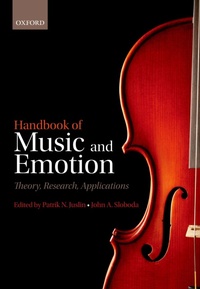
Handbook of Music and Emotion
Theory, Research, Applications
1st Edition
Published on 17. March 2011
Book
Paperback/Softback
992 pages
978-0-19-960496-8 (ISBN)
Description
Music's ability to express and arouse emotions is a mystery that has fascinated both experts and laymen at least since ancient Greece. The predecessor to this book 'Music and Emotion' (OUP, 2001) was critically and commercially successful and stimulated much further work in this area. In the years since publication of that book, empirical research in this area has blossomed, and the successor to 'Music and Emotion' reflects the considerable activity in this area.
The Handbook of Music and Emotion offers an 'up-to-date' account of this vibrant domain. It provides comprehensive coverage of the many approaches that may be said to define the field of music and emotion, in all its breadth and depth.
The first section offers multi-disciplinary perspectives on musical emotions from philosophy, musicology, psychology, neurobiology, anthropology, and sociology. The second section features methodologically-oriented chapters on the measurement of emotions via different channels (e.g., self report, psychophysiology, neuroimaging). Sections three and four address how emotion enters into different aspects of musical behavior, both the making of music and its consumption. Section five covers developmental, personality, and social factors. Section six describes the most important applications involving the relationship between music and emotion. In a final commentary, the editors comment on the history of the field, summarize the current state of affairs, as well as propose future directions for the field.
The only book of its kind, The Handbook of Music and Emotion will fascinate music psychologists, musicologists, music educators, philosophers, and others with an interest in music and emotion (e.g., in marketing, health, engineering, film, and the game industry). It will be a valuable resource for established researchers in the field, a developmental aid for early-career researchers and postgraduate research students, and a compendium to assist students at various levels. In addition, as with its predecessor, it will also attract interest from practising musicians and lay readers fascinated by music and emotion.
The Handbook of Music and Emotion offers an 'up-to-date' account of this vibrant domain. It provides comprehensive coverage of the many approaches that may be said to define the field of music and emotion, in all its breadth and depth.
The first section offers multi-disciplinary perspectives on musical emotions from philosophy, musicology, psychology, neurobiology, anthropology, and sociology. The second section features methodologically-oriented chapters on the measurement of emotions via different channels (e.g., self report, psychophysiology, neuroimaging). Sections three and four address how emotion enters into different aspects of musical behavior, both the making of music and its consumption. Section five covers developmental, personality, and social factors. Section six describes the most important applications involving the relationship between music and emotion. In a final commentary, the editors comment on the history of the field, summarize the current state of affairs, as well as propose future directions for the field.
The only book of its kind, The Handbook of Music and Emotion will fascinate music psychologists, musicologists, music educators, philosophers, and others with an interest in music and emotion (e.g., in marketing, health, engineering, film, and the game industry). It will be a valuable resource for established researchers in the field, a developmental aid for early-career researchers and postgraduate research students, and a compendium to assist students at various levels. In addition, as with its predecessor, it will also attract interest from practising musicians and lay readers fascinated by music and emotion.
Reviews / Votes
Handbook of Music and Emotion, by Patrik N. Juslin and John A. Sloboda, is an excellent book. It is comprehensive and up-to-date, well organized, well written, and stimulating. * Music Perception *More details
Language
English
Place of publication
Oxford
United Kingdom
Target group
College/higher education
Professional and scholarly
Students and researchers in emotion and the affective sciences; music psychologists and music educators; philosophers of mind and aesthetics; neuroscientists
Dimensions
Height: 246 mm
Width: 169 mm
Thickness: 50 mm
Weight
1669 gr
ISBN-13
978-0-19-960496-8 (9780199604968)
Copyright in bibliographic data and cover images is held by Nielsen Book Services Limited or by the publishers or by their respective licensors: all rights reserved.
Schweitzer Classification
Other editions
Additional editions
E-Book
03/2011
OUP eBook
€38.49
Available for download
E-Book
03/2011
1st Edition
OUP eBook
€38.49
Available for download
Book
12/2009
Oxford University Press
€73.67
Article exhausted; check different version
Persons
Patrik N. Juslin is associate professor of Psychology at Uppsala University, Sweden, where he teaches courses on music, emotion, perception, and research methodology. He completed his PhD in 1998 and became associate professor in 2004. Juslin has published numerous articles in the areas of expression in music performance, emotional responses to music, music education, and emotion in speech. In 2001, he edited the volume Music and Emotion: Theory and Research together with John Sloboda. Juslin is associate editor of the journals Music Perception and Musicae Scientiae. He is a member of the International Society for Research on Emotions and received ESCOM's 'Young Researcher Award' in 1996. Alongside his work as a researcher, he has also worked professionally as a guitar player.
John Sloboda is Emeritus Professor at Keele, and honorary Professor of Music at Royal Holloway University, London. He has been a member of the School of Psychology at Keele since 1974 and was Director of its Unit for
the Study of Musical Skill and Development founded in 1991. John Sloboda is internationally known for his work on the psychology of music. He is a Fellow of the British Psychological Society, and has been President of both the Psychology and General Sections of the British Association for the Advancement of Science, as well as President of the European Society for the Cognitive Sciences of Music, where he serves on
the editorial board of it's journal Musicae Scientiae. He was recipient of the 1998 British Psychological Society's Presidents Award for Distinguished Contributions to Psychological Knowledge, and in 2004 was
elected to Fellowship of the British Academy. He is author of over 150 publications in the field of music psychology.
John Sloboda is Emeritus Professor at Keele, and honorary Professor of Music at Royal Holloway University, London. He has been a member of the School of Psychology at Keele since 1974 and was Director of its Unit for
the Study of Musical Skill and Development founded in 1991. John Sloboda is internationally known for his work on the psychology of music. He is a Fellow of the British Psychological Society, and has been President of both the Psychology and General Sections of the British Association for the Advancement of Science, as well as President of the European Society for the Cognitive Sciences of Music, where he serves on
the editorial board of it's journal Musicae Scientiae. He was recipient of the 1998 British Psychological Society's Presidents Award for Distinguished Contributions to Psychological Knowledge, and in 2004 was
elected to Fellowship of the British Academy. He is author of over 150 publications in the field of music psychology.
Content
PART I: OVERTURE; PART II: MULTIDISCIPLINARY PERSPECTIVES; PART III: MEASUREMENT; PART IV: MUSIC MAKING; PART V: MUSIC LISTENING; PART VI: DEVELOPMENT, PERSONALITY AND SOCIAL FACTORS; PART VII: APPLICATIONS; PART VIII: ENCORE