

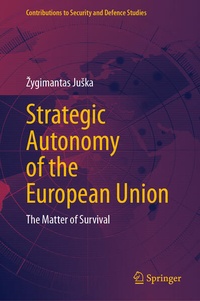
Strategic Autonomy of the European Union
Description
This book emphasizes the pressing necessity for the European Union (EU) to reduce its reliance on external actors and develop the ability to act independently in critical areas such as defense, energy, advanced technology, and raw materials. Building on the author's previous work on the EU's soft power, this book contends that strategic autonomy is no longer a theoretical ambition. It is a matter of the EU's survival. This urgency arises amid the collapse of the international rules-based order, the resurgence of authoritarian regimes, and the United States' departure from its traditional role as a global champion of democracy.
Drawing on unique insights gained from diplomatic experience in Kosovo, Ukraine, and Rwanda, the author blends practical analysis with geopolitical insight to evaluate the EU's gaps in strategic autonomy and explore its untapped potential. The author's real-life accounts, from seeking shelter during wartime in Kyiv to navigating global economic competition, highlight that strategic autonomy has tangible, impactful consequences. In short, the book emphasizes that the geopolitical message to the EU is clear: adapt or become irrelevant.
More details
Person
Zygimantas Juska is a European Union diplomat with over seven years of experience, including diplomatic postings in Rwanda, Ukraine, and Kosovo. He holds a PhD in EU competition law from Leiden University in the Netherlands. Zygimantas is also the author of the book 'Soft Power of the European Union: Mastering the Language of Power Politics' (Springer, 2024).
Dr. Juska has built a strong profile as an EU competition lawyer, with experience spanning the European Commission, private sector, and academia. His legal expertise also extends to international criminal justice, having worked on high-profile cases at the International Criminal Tribunal for the former Yugoslavia and represented Lithuania at the International Criminal Court.
An accomplished academic, he has published eight peer-reviewed articles on EU competition law and refugee policy, and served as a Visiting Lecturer at the University of Rwanda. Zygimantas was also the first Lithuanian to receive the EU Fulbright-Schuman scholarship.
Content
Chapter 1. Introduction.- Chapter 2. A Geopolitical Shift: The European Union's Strategic Wake-Up Call.- Chapter 3. The Architecture of Strategic Autonomy.- Chapter 4. The EU's Strategic Assets - The Foundations of Strategic Autonomy.- Chapter 5. Strategic Vulnerabilities of the European Union.- Chapter 6. Strategic Autonomy as Survival: Building Resilient Architecture.- Chapter 7. Conclusion.