

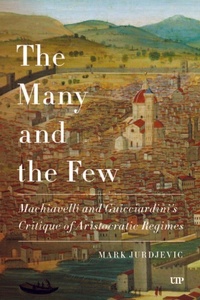
The Many and the Few
Machiavelli and Guicciardini's Critique of Aristocratic Regimes
Will be published approx. on 20. January 2026
Book
Hardback
256 pages
978-1-4875-6686-9 (ISBN)
Description
The Many and the Few reconstructs a pattern of recurring populist themes in the writings of Francesco Guicciardini and Niccolo Machiavelli. These two pioneering thinkers of the late Renaissance are almost always presented in terms of dramatic contrasts - while Machiavelli's violent populism and scorn for aristocratic culture is well established, many consider Guicciardini the most influential Renaissance advocate of narrow, elitist regimes. In The Many and the Few, Mark Jurdjevic challenges these pre-existing beliefs and argues that Guicciardini was a vastly more complex thinker who subjected his own aristocratic ideals to devastating scrutiny.
From his very first to very last texts, Guicciardini consistently embedded an alternate narrative in which he thoroughly embraced, and arguably exceeded, Machiavelli's view of the innately positive qualities of the people and destructive qualities of the elites. Subsequent "republican" writers, such as Jean-Jacques Rousseau and James Madison, all claimed Guicciardini as one of the chief Renaissance exemplars of a longstanding tradition of aristocratic, senatorial politics, but The Many and the Few demonstrates that Guicciardini's contribution was a Trojan horse: it appeared to confirm this tradition even while affirming every aspect of Machiavelli's critique.
From his very first to very last texts, Guicciardini consistently embedded an alternate narrative in which he thoroughly embraced, and arguably exceeded, Machiavelli's view of the innately positive qualities of the people and destructive qualities of the elites. Subsequent "republican" writers, such as Jean-Jacques Rousseau and James Madison, all claimed Guicciardini as one of the chief Renaissance exemplars of a longstanding tradition of aristocratic, senatorial politics, but The Many and the Few demonstrates that Guicciardini's contribution was a Trojan horse: it appeared to confirm this tradition even while affirming every aspect of Machiavelli's critique.
More details
Series
Language
English
Place of publication
Toronto
Canada
Target group
College/higher education
Professional and scholarly
Dimensions
Height: 236 mm
Width: 163 mm
Thickness: 24 mm
Weight
550 gr
ISBN-13
978-1-4875-6686-9 (9781487566869)
Copyright in bibliographic data and cover images is held by Nielsen Book Services Limited or by the publishers or by their respective licensors: all rights reserved.
Schweitzer Classification
Person
Mark Jurdjevic is professor of history at York University and studies early modern Europe.
Content
Introduction: The Politics of the Few and the Many in the Political Thought of Machiavelli and Guicciardini
1. Machiavelli and Guicciardini: Background and Relationship
2. Populist Perspectives in Guicciardini's On the Method of Electing Offices in the Great Council
3. Radical Virtu in The Prince and Ricordi
4. Deconstructing Regimes of the Few in Guicciardini's Dialogue on the Government of Florence
5. Cognitive Dissonance in Guicciardini's Considerations on the Discourses of Machiavelli
6. Machiavelli and Guicciardini on Cesare Borgia's "Good Government": Chapter 7 of The Prince Revisited
Conclusion
Works Cited
1. Machiavelli and Guicciardini: Background and Relationship
2. Populist Perspectives in Guicciardini's On the Method of Electing Offices in the Great Council
3. Radical Virtu in The Prince and Ricordi
4. Deconstructing Regimes of the Few in Guicciardini's Dialogue on the Government of Florence
5. Cognitive Dissonance in Guicciardini's Considerations on the Discourses of Machiavelli
6. Machiavelli and Guicciardini on Cesare Borgia's "Good Government": Chapter 7 of The Prince Revisited
Conclusion
Works Cited