

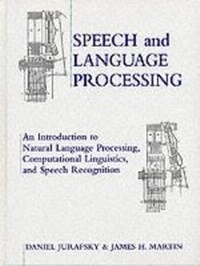
Speech and Language Processing
An Introduction to Natural Language Processing, Computational Linguistics and Speech Recognition: Internationa
Published on 9. February 2000
Book
Paperback/Softback
934 pages
978-0-13-122798-9 (ISBN)
Description
For undergraduate or advanced undergraduate courses in Classical Natural Language Processing, Statistical Natural Language Processing, Speech Recognition, Computational Linguistics, and Human Language Processing.
This book takes an empirical approach to language processing, based on applying statistical and other machine-learning algorithms to large corporations.
Author Website with Resources: http://www.cs.colorado.edu/~martin/slp.html
This book takes an empirical approach to language processing, based on applying statistical and other machine-learning algorithms to large corporations.
Author Website with Resources: http://www.cs.colorado.edu/~martin/slp.html
More details
Language
English
Place of publication
United States
Publishing group
Pearson Education (US)
Target group
Professional and scholarly
Dimensions
Height: 234 mm
Width: 179 mm
Thickness: 35 mm
Weight
1312 gr
ISBN-13
978-0-13-122798-9 (9780131227989)
Copyright in bibliographic data and cover images is held by Nielsen Book Services Limited or by the publishers or by their respective licensors: all rights reserved.
Schweitzer Classification
Other editions
New editions
Book
08/2008
2nd Edition
Pearson
€181.35
Article exhausted; check for reprint
Previous edition
Daniel Jurafsky | James H. Martin
Speech and Language Processing
An Introduction to Natural Language Processing, Computational Linguistics and Speech Recognition: United State
Book
02/2000
Pearson
€58.17
Article exhausted; check for reprint
Content
1. Introduction.
I. WORDS.
2. Regular Expressions and Automata.
3. Morphology and Finite-State Transducers.
4. Computational Phonology and Text-to-Speech.
5. Probabilistic Models of Pronunciation and Spelling.
6. N-grams.
7. HMMs and Speech Recognition.
II. SYNTAX.
8. Word Classes and Part-of-Speech Tagging.
9. Context-Free Grammars for English.
10. Parsing with Context-Free Grammars.
11. Features and Unification.
12. Lexicalized and Probabilistsic Parsing.
13. Language and Complexity.
III. SEMANTICS.
14. Representing Meaning.
15. Semantic Analysis.
16. Lexical Semantics.
17. Word Sense Disambiguation and Information Retrieval.
IV. PRAGMATICS.
18. Discourse.
19. Dialogue and Conversational Agents.
20. Natural Language Generation.
21. Machine Translation.
APPENDICES.
A. Regular Expression Operators.
B. The Porter Stemming Algorithm.
C. C5 and C7 tagsets.
D. Training HMMs: The Forward-Backward Algorithm.
Bibliography.
Index.
I. WORDS.
2. Regular Expressions and Automata.
3. Morphology and Finite-State Transducers.
4. Computational Phonology and Text-to-Speech.
5. Probabilistic Models of Pronunciation and Spelling.
6. N-grams.
7. HMMs and Speech Recognition.
II. SYNTAX.
8. Word Classes and Part-of-Speech Tagging.
9. Context-Free Grammars for English.
10. Parsing with Context-Free Grammars.
11. Features and Unification.
12. Lexicalized and Probabilistsic Parsing.
13. Language and Complexity.
III. SEMANTICS.
14. Representing Meaning.
15. Semantic Analysis.
16. Lexical Semantics.
17. Word Sense Disambiguation and Information Retrieval.
IV. PRAGMATICS.
18. Discourse.
19. Dialogue and Conversational Agents.
20. Natural Language Generation.
21. Machine Translation.
APPENDICES.
A. Regular Expression Operators.
B. The Porter Stemming Algorithm.
C. C5 and C7 tagsets.
D. Training HMMs: The Forward-Backward Algorithm.
Bibliography.
Index.