

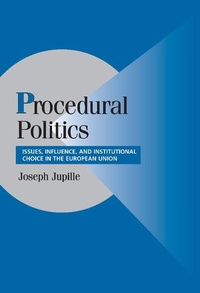
Procedural Politics
Issues, Influence, and Institutional Choice in the European Union
Published on 30. August 2004
Book
Hardback
296 pages
978-0-521-83253-3 (ISBN)
Description
This book was first published in 2004. Under what conditions, in what ways, and with what effects do actors engage in politics with respect to, rather than merely within, political institutions? Using multiple methods and original data, Procedural Politics develops a theory of everyday politics with respect to rules - procedural politics - and applies it to European Union integration and politics. Assuming that actors influence maximizers, it argues and demonstrates that the jurisdiction ambiguity of issues provides opportunities for procedural politics and that influence-differences among institutional alternatives provide the incentives. It also argues and demonstrates that procedural politics occurs by predictable means (most notably, involving procedural coalition formation and strategic issue-definition) and exerts predictable effects on policymaking efficiency and outcomes and long-run institutional change. Beyond illuminating previously under-appreciated aspects of EU rule governance, these findings generalize to all rule-governed political systems and form the basis of fuller accounts of the role of institutions in political life.
Reviews / Votes
'This book offers answers to one of the trickiest questions in EU politics: how and why are every-day decision-making rules designed? Jupille develops a highly original and sophisticated theory to answer this question, and tests his theory with an impressive dataset and detailed case-studies. As a result, this is a model piece of contemporary political science research and is sure to be a landmark text in the study of the EU.' Simon Hix, London School of Economics 'Joseph Jupille's Procedural Politics is a first-rate work of institutional analysis, combining the theoretical elegance and methodological sophistication of the very best rational-choice work on US Congressional institutions with a rigorous quantitative and qualitative study of the politics of the European Union. Jupille's hypotheses about the conditions under which, and the ways in which, EU actors engage in procedural disputes are clearly articulated and tested with rigor, and the implications of the book extend beyond the EU to any political system - and there are many - in which actors might be tempted to manipulate legislative procedure for their own purposes.' Mark Pollack, University of WisconsinMore details
Series
Language
English
Place of publication
Cambridge
United Kingdom
Target group
Professional and scholarly
Dimensions
Height: 235 mm
Width: 157 mm
Thickness: 22 mm
Weight
634 gr
ISBN-13
978-0-521-83253-3 (9780521832533)
Copyright in bibliographic data and cover images is held by Nielsen Book Services Limited or by the publishers or by their respective licensors: all rights reserved.
Schweitzer Classification
Other editions
Additional editions
Book
07/2012
Cambridge University Press
€49.20
Shipment within 15-20 days
E-Book
07/2006
1st Edition
Cambridge University Press
€29.49
Available for download
Person
Joseph Jupille received his Ph.D. in Political Science from the University of Washington in 2000. He is Assistant Professor of Political Science at Florida International University and Associate Director of the Miami European Union Center. His published work has appeared in among others, Annual Review of Political Science, Comparative Political Studies, and International Organization. He has been EU-US Fulbright Fellow, and SSRC International Dissertation Fellow. Having been awarded a Jean Monnet Fellowship, he spent the 2003-2004 academic year in the Transatlantic Programme of the Robert Schuman Centre for Advanced Studies at the European University Institute in Fiesole, Italy.
Content
List of figures; List of tables; Preface and acknowledgments; List of acronyms used in the text; 1. Introduction: choice, constraint, and European Union institutions; 2. Theorizing procedural politics: issues, interests, and institutional choice; 3. The EU as a procedural system: rules, preferences, and strategic interaction; 4. Patterns: determinants and effects of EU procedural politics; 5. Greening the market? Procedural politics and EU environmental policy; 6. Mad cows and Englishmen: procedural politics and EU agricultural policy; 7. Conclusion: procedural politics and rule governance in the EU and beyond; Bibliography; Index.