

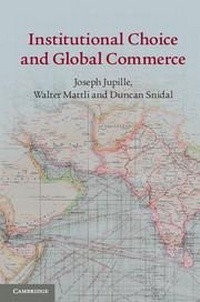
Institutional Choice and Global Commerce
Published on 29. August 2013
Book
Paperback/Softback
265 pages
978-1-107-64592-9 (ISBN)
Description
Why do institutions emerge, operate, evolve and persist? Institutional Choice and Global Commerce elaborates a theory of boundedly rational institutional choice that explains when states USE available institutions, SELECT among alternative forums, CHANGE existing rules, or CREATE new arrangements (USCC). The authors reveal the striking staying power of the institutional status quo and test their innovative theory against evidence on institutional choice in global commerce from the nineteenth through the twenty-first centuries. Cases range from the establishment in 1876 of the first truly international system of commercial dispute resolution, the Mixed Courts of Egypt, to the founding and operation of the General Agreement on Tariffs and Trade, the World Trade Organization, and the International Accounting Standards Board. Analysts of institutional choice henceforth must take seriously not only the distinct demands of specific cooperation dilemmas, but also the wide array of available institutional choices.
Reviews / Votes
'Jupille, Mattli, and Snidal have written a pathbreaking book on the politics of institutional choice relating to global commerce. Developing a novel approach grounded in bounded rationality, the authors demonstrate why the process of institutional change is often piece-meal, disjointed, and inefficient judged by standards of global efficiency.' James Caporaso, Director of the European Union Center for Excellence, University of Washington, Seattle 'Jupille, Mattli and Snidal provide us with one of the most cogent and comprehensive accounts of institutional choice and change to date. Melding together historical institutionalism with more rationalist accounts of politics, the book explains why institutional reform is difficult and should not be expected under 'normal' conditions. This is critical reading for all scholars of international relations.' Judith Goldstein, Janet Peck Professor of International Communication and Professor of Political Science, Stanford University 'The authors provide a novel theoretical approach to a world of proliferating international institutions that frequently underperform. They illuminate institutional creation, persistence, and change in the face of a constantly evolving global agenda.' Miles Kahler, University of California, San Diego 'In this interesting and rich new book, Jupille, Mattli and Snidal stake out a theoretically-principled approach to international institutions between pure rational design and pure path-dependency. In their theory, actors are boundedly rational and usually rely on existing institutions or modify them slightly, even when the institutions are suboptimal. But, as the authors show, there are specific, predictable circumstances when they will try to craft new institutions to meet new problems. This clear, readable analysis weaves together theory and empirical tests to shed new light on why institutions persist, why new ones are built, and how states select and use international institutions.' Charles Lipson, Peter B. Ritzma Professor in Political Science, University of ChicagoMore details
Language
English
Place of publication
Cambridge
United Kingdom
Target group
Professional and scholarly
Product notice
Paperback (trade)
Illustrations
8 Tables, black and white; 10 Line drawings, black and white
Dimensions
Height: 226 mm
Width: 152 mm
Thickness: 13 mm
Weight
435 gr
ISBN-13
978-1-107-64592-9 (9781107645929)
Copyright in bibliographic data and cover images is held by Nielsen Book Services Limited or by the publishers or by their respective licensors: all rights reserved.
Schweitzer Classification
Other editions
Additional editions
Joseph Jupille | Walter Mattli | Duncan Snidal
Institutional Choice and Global Commerce
E-Book
08/2013
1st Edition
Cambridge University Press
€17.49
Available for download
Joseph Jupille | Walter Mattli | Duncan Snidal
Institutional Choice and Global Commerce
Book
08/2013
Cambridge University Press
€85.56
Article not available at the moment
Persons
Joseph Jupille is Associate Professor of Political Science at the University of Colorado, Boulder. Walter Mattli is Professor of International Political Economy in the Department of Politics and International Relations, Oxford University and a Fellow of St John's College, Oxford. Duncan Snidal is Professor of International Relations in the Department of Politics and International Relations, Oxford University and a Fellow of Nuffield College, Oxford.
Content
Part I: 1. Introduction: institutional choice and global commerce; 2. International institutional choice: cooperation, alternatives, and strategies; 3. Building Theseus' ship: why the ITO failed, the GATT succeeded, and the WTO emerged; Part II: 4. Creating the first international court of commercial dispute resolution: the Mixed Courts of Egypt; 5. Commercial complexity and institutional choice in the GATT era; 6. Institutional choice in global accounting governance; Part III: 7. Conclusion: overview and institutional theories compared.