

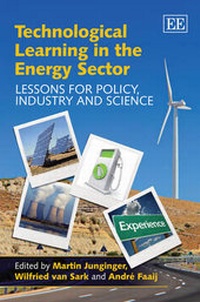
Technological Learning in the Energy Sector
Lessons for Policy, Industry and Science
Will be published approx. on 30. September 2010
Book
Hardback
352 pages
978-1-84844-834-6 (ISBN)
Description
Technological learning is a key driver behind the improvement of energy technologies and subsequent reduction of production costs. Understanding how and why production costs for energy technologies decline, and whether they will continue to do so in the future, is of crucial importance for policy makers, industrial stakeholders and scientists alike. This timely and informative book therefore provides a comprehensive review of technological development and cost reductions for renewable energy, clean fossil fuel and energy-efficient demand-side technologies.
It responds to the need for a quality-controlled data set of experience curves, including assessment of measurement methodology, technological knowledge and associated cost. The expert contributors present a thorough overview and discussion of the pitfalls of applying the experience curve approach, including aspects such as geographical system boundaries, whether the slope of the experience curves is constant or not, statistical error and sensitivity analysis of experience curves, and whether the experience curve approach can be utilized to quantify improvements in energy efficiency. A clear set of recommendations for the use of the experience curve approach is also prescribed.
Providing a significant contribution to the current literature on energy and climate models, scenario analysis, and methodological lessons on experience curves, this book will strongly appeal to academics and students in the areas focusing on energy and public sector economics. Policy makers in these fields will also find the book to be of great interest.
It responds to the need for a quality-controlled data set of experience curves, including assessment of measurement methodology, technological knowledge and associated cost. The expert contributors present a thorough overview and discussion of the pitfalls of applying the experience curve approach, including aspects such as geographical system boundaries, whether the slope of the experience curves is constant or not, statistical error and sensitivity analysis of experience curves, and whether the experience curve approach can be utilized to quantify improvements in energy efficiency. A clear set of recommendations for the use of the experience curve approach is also prescribed.
Providing a significant contribution to the current literature on energy and climate models, scenario analysis, and methodological lessons on experience curves, this book will strongly appeal to academics and students in the areas focusing on energy and public sector economics. Policy makers in these fields will also find the book to be of great interest.
Reviews / Votes
'This expert analysis provides an important contribution to understanding the technicalities of energy technology cost dynamics. Given the urgent need for delivery of low-cost renewable energy technologies in particular, it is vital to understand how to accelerate this process of technological learning.' -- Miguel Mendonca, World Future Council, Germany '"Experience curves" are an important instrument for policy makers. This book has a thorough discussion of such "curves" for a large number of energy technologies and will therefore be very useful around the world.' -- Jose Goldemberg, University of Sao Paulo, BrazilMore details
Language
English
Place of publication
Cheltenham
United Kingdom
Target group
Professional and scholarly
Dimensions
Height: 234 mm
Width: 156 mm
ISBN-13
978-1-84844-834-6 (9781848448346)
Copyright in bibliographic data and cover images is held by Nielsen Book Services Limited or by the publishers or by their respective licensors: all rights reserved.
Schweitzer Classification
Persons
Edited by Martin Junginger, Assistant Professor, Wilfried van Sark, Assistant Professor and Andre Faaij, Professor, Copernicus Institute, Utrecht University, The Netherlands
Content
Contents:
Foreword
Clas-Otto Wene
1. Introduction
Martin Junginger, Wilfried van Sark and Andre Faaij
PART I: THE USE OF EXPERIENCE CURVES FOR ENERGY TECHNOLOGIES: AN INTRODUCTION
2. The Experience Curve Approach: History, Methodological Aspects and Applications
Martin Junginger, Wilfried van Sark, Sondes Kahouli-Brahmi and Gerrit Jan Schaeffer
3. General Aspects and Caveats of Experience Curve Analysis
Wilfried van Sark, Gregory Nemet, Sondes Kahouli-Brahmi, Lena Neij and Clas-Otto Wene
4. Putting Experience Curves in Context: Links to and between Technology Development, Market Diffusion, Learning Mechanisms and Systems Innovation Theory
Martin Junginger, Roald Suurs, Geert Verbong and Gerrit Jan Schaeffer
5. The Use of Experience Curves in Energy Models
Sander Lensink, Sondes Kahouli-Brahmi and Wilfried van Sark
PART II: CASE STUDIES
6. Onshore Wind Energy
Martin Junginger, Paul Lako, Lena Neij, Wouter Engels and David Milborrow
7. Offshore Wind Energy
Paul Lako, Martin Junginger, Lena Neij, Wouter Engels and Sander Lensink
8. Photovoltaic Solar Energy
Wilfried van Sark, Gregory Nemet, Gerrit Jan Schaeffer and Erik Alsema
9. Concentrating Solar Thermal Electricity Technology
Wilfried van Sark and Paul Lako
10. Bioenergy
Andre Faaij and Martin Junginger
11. Combined Cycle Gas Turbine (CCGT) Plants
Ric Hoefnagels, Anna Bergek and Paul Lako
12. Pulverized Coal-fired Power Plants
Paul Lako, Sonia Yeh and Machteld van den Broek
13. Carbon Dioxide Capture and Storage (CCS) Technologies
Machteld van den Broek, Sonia Yeh, Ric Hoefnagels, Martin Junginger, Edward Rubin and Andre Faaij
14. Nuclear Power
Paul Lako, Aliki van Heek and Geoffrey Rothwell
15. Household Appliances
Martin Weiss, Larry Dale and Michael McNeil
16. Lighting Technologies
Martin Weiss, Philippine de T'Serclaes and Willy Taelman
17. Space Heating and Cooling
Martin Weiss, Reinhard Madlener and Martin Jakob
18. The Chemical Sector
Martin Patel, Martin Weiss, Tristan Simon and Andrea Ramirez Ramirez
PART III: SYNTHESIS AND RECOMMENDATIONS
19. Overview and Comparison of Experience Curves for Energy Technologies
Martin Junginger, Martin Weiss, Wilfried van Sark and Andre Faaij
20. Methodological Lessons and Recommendations for Scientists and Modellers
Wilfried van Sark, Martin Junginger and Andre Faaij
21. Lessons on Technological Learning for Policy Makers and Industry
Andre Faaij, Martin Junginger and Wilfried van Sark
References
Index
Foreword
Clas-Otto Wene
1. Introduction
Martin Junginger, Wilfried van Sark and Andre Faaij
PART I: THE USE OF EXPERIENCE CURVES FOR ENERGY TECHNOLOGIES: AN INTRODUCTION
2. The Experience Curve Approach: History, Methodological Aspects and Applications
Martin Junginger, Wilfried van Sark, Sondes Kahouli-Brahmi and Gerrit Jan Schaeffer
3. General Aspects and Caveats of Experience Curve Analysis
Wilfried van Sark, Gregory Nemet, Sondes Kahouli-Brahmi, Lena Neij and Clas-Otto Wene
4. Putting Experience Curves in Context: Links to and between Technology Development, Market Diffusion, Learning Mechanisms and Systems Innovation Theory
Martin Junginger, Roald Suurs, Geert Verbong and Gerrit Jan Schaeffer
5. The Use of Experience Curves in Energy Models
Sander Lensink, Sondes Kahouli-Brahmi and Wilfried van Sark
PART II: CASE STUDIES
6. Onshore Wind Energy
Martin Junginger, Paul Lako, Lena Neij, Wouter Engels and David Milborrow
7. Offshore Wind Energy
Paul Lako, Martin Junginger, Lena Neij, Wouter Engels and Sander Lensink
8. Photovoltaic Solar Energy
Wilfried van Sark, Gregory Nemet, Gerrit Jan Schaeffer and Erik Alsema
9. Concentrating Solar Thermal Electricity Technology
Wilfried van Sark and Paul Lako
10. Bioenergy
Andre Faaij and Martin Junginger
11. Combined Cycle Gas Turbine (CCGT) Plants
Ric Hoefnagels, Anna Bergek and Paul Lako
12. Pulverized Coal-fired Power Plants
Paul Lako, Sonia Yeh and Machteld van den Broek
13. Carbon Dioxide Capture and Storage (CCS) Technologies
Machteld van den Broek, Sonia Yeh, Ric Hoefnagels, Martin Junginger, Edward Rubin and Andre Faaij
14. Nuclear Power
Paul Lako, Aliki van Heek and Geoffrey Rothwell
15. Household Appliances
Martin Weiss, Larry Dale and Michael McNeil
16. Lighting Technologies
Martin Weiss, Philippine de T'Serclaes and Willy Taelman
17. Space Heating and Cooling
Martin Weiss, Reinhard Madlener and Martin Jakob
18. The Chemical Sector
Martin Patel, Martin Weiss, Tristan Simon and Andrea Ramirez Ramirez
PART III: SYNTHESIS AND RECOMMENDATIONS
19. Overview and Comparison of Experience Curves for Energy Technologies
Martin Junginger, Martin Weiss, Wilfried van Sark and Andre Faaij
20. Methodological Lessons and Recommendations for Scientists and Modellers
Wilfried van Sark, Martin Junginger and Andre Faaij
21. Lessons on Technological Learning for Policy Makers and Industry
Andre Faaij, Martin Junginger and Wilfried van Sark
References
Index