

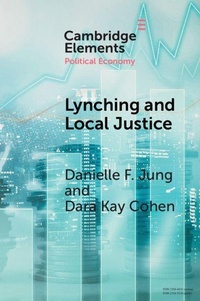
Lynching and Local Justice
Legitimacy and Accountability in Weak States
Published on 17. September 2020
Book
Paperback/Softback
104 pages
978-1-108-79447-3 (ISBN)
Description
What are the social and political consequences of poor state governance and low state legitimacy? Under what conditions does lynching - lethal, extralegal group violence to punish offenses to the community - become an acceptable practice? We argue lynching emerges when neither the state nor its challengers have a monopoly over legitimate authority. When authority is contested or ambiguous, mass punishment for transgressions can emerge that is public, brutal, and requires broad participation. Using new cross-national data, we demonstrate lynching is a persistent problem in dozens of countries over the last four decades. Drawing on original survey and interview data from Haiti and South Africa, we show how lynching emerges and becomes accepted. Specifically, support for lynching most likely occurs in one of three conditions: when states fail to provide governance, when non-state actors provide social services, or when neighbors must rely on self-help.
More details
Series
Language
English
Place of publication
Cambridge
United Kingdom
Target group
Professional and scholarly
Product notice
Paperback (trade)
Illustrations
Worked examples or Exercises; 11 Line drawings, black and white
Dimensions
Height: 229 mm
Width: 152 mm
Thickness: 6 mm
Weight
150 gr
ISBN-13
978-1-108-79447-3 (9781108794473)
Copyright in bibliographic data and cover images is held by Nielsen Book Services Limited or by the publishers or by their respective licensors: all rights reserved.
Schweitzer Classification
Other editions
Additional editions
E-Book
09/2020
Cambridge University Press
€14.49
Available for download
Danielle F. Jung | Dara Kay Cohen
Lynching and Local Justice
Legitimacy and Accountability in Weak States
E-Book
09/2020
Cambridge University Press
€20.99
Available for download
Persons
Content
1. Introduction. Lynching in global comparative perspective; 2. Toward a theory of legitimacy and lynching; 3. Lynching around the world: cross-national evidence; 4. Local governance, legitimacy and lynching in Port-au-Prince; 5. Conclusion. Implications for theory and policy.