

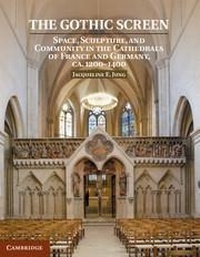
The Gothic Screen
Space, Sculpture, and Community in the Cathedrals of France and Germany, ca.1200-1400
Published on 28. December 2012
Book
Hardback
328 pages
978-1-107-02295-9 (ISBN)
Description
At the heart of Gothic cathedrals, the threshold between nave and sanctuary was marked by the choir screen, a partitioning structure of special complexity, grandeur, and beauty. At once a canopy for altars, a stage for performance, a pedestal for crucifixes and reliquaries, and a ground for spectacular arrays of narrative and iconic sculptures, the choir screen profoundly shaped the spaces of liturgy and social interaction for the diverse communities, both clerical and lay, who shared the church interior. For the first time, this book draws together the most important examples - some fully extant, others known through fragments and graphic sources - from thirteenth- and fourteenth-century France and Germany. Through analyses of both their architectural and sculptural components, Jacqueline E. Jung reveals how these furnishings, far from being barricades or hindrances, were vital vehicles of communication and shapers of a community centered on Christian rituals and stories.
Reviews / Votes
"Recommended."Choice "This book has been long awaited and it does not disappoint in the breadth and richness of its exposition ... [U]ndoubtedly it will become a standard reference for studies of both the built environment and iconography of the Middle Ages."
The Medieval Review "The Gothic Screen makes stimulating reading for students and scholars, pointing the way for further studies of screens of all kinds throughout medieval Europe. Never again could we wish away the Gothic screen, nor would we want to."
Tom Nickson, The Medieval Journal "... one can only be grateful for Jung's insights and keen observations. She has put the discussion of choir screens where it really belongs: within the vast realm of lay religiosity."
Dorothy Gillerman, Speculum "At the turn of this century, Jacqueline Jung published an influential article on choir screens in Gothic great churches. She has been regarded as the leading Anglo-American specialist on these furnishings ever since, a status maintained through publication of subsequent essays. Now, at last, her monograph on the topic has arrived in the form of an authoritative statement of the role of screens as space-co-ordinating, performative, psychology-conditioning objects."
Julian Luxford, The Burlington Magazine
More details
Language
English
Place of publication
Cambridge
United Kingdom
Target group
Professional and scholarly
Product notice
sewn/stitched
Cloth over boards
Illustrations
30 Plates, color; 171 Halftones, unspecified; 171 Halftones, black and white; 9 Line drawings, black and white
Dimensions
Height: 287 mm
Width: 220 mm
Thickness: 30 mm
Weight
1180 gr
ISBN-13
978-1-107-02295-9 (9781107022959)
Copyright in bibliographic data and cover images is held by Nielsen Book Services Limited or by the publishers or by their respective licensors: all rights reserved.
Schweitzer Classification
Other editions
Additional editions
Jacqueline E. Jung
The Gothic Screen
Space, Sculpture, and Community in the Cathedrals of France and Germany, ca.1200-1400
Book
07/2017
Cambridge University Press
€47.50
Article not available at the moment
Jacqueline E. Jung
Gothic Screen
Space, Sculpture, and Community in the Cathedrals of France and Germany, ca.1200-1400
E-Book
12/2012
Cambridge University Press
€30.49
Available for download
Jacqueline E. Jung
The Gothic Screen
Space, Sculpture, and Community in the Cathedrals of France and Germany, ca.1200-1400
E-Book
11/2012
1st Edition
Cambridge University Press
€36.99
Available for download
Person
Jacqueline E. Jung is Assistant Professor of Medieval Art and Architecture in the Department of History of Art at Yale University, Connecticut. She is the author of articles in The Art Bulletin, Gesta, and numerous anthologies and catalogs both in the United States and Germany, as well as the translator of several seminal art historical writings, most notably Alois Riegl's Historical Grammar of the Visual Arts (2004).
Content
Introduction; Part I. The Screen as Sculpture: 1. The choir screen as partition; 2. The choir screen as bridge; 3. The choir screen as frame; Part II. The Sculpture on the Screen: 4. Women, men, and the social order; 5. Jews, Christians, and the question of the individual; 6. Nobles, peasants, and the vernacular mode; Epilogue.