

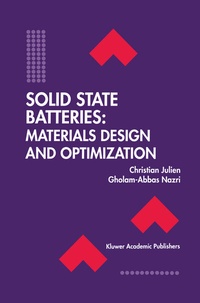
Solid State Batteries: Materials Design and Optimization
Published on 23. February 2014
Book
Paperback/Softback
XIII, 629 pages
978-1-4613-6164-0 (ISBN)
Description
The field of solid state ionics is multidisciplinary in nature. Chemists, physicists, electrochimists, and engineers all are involved in the research and development of materials, techniques, and theoretical approaches. This science is one of the great triumphs of the second part of the 20th century. For nearly a century, development of materials for solid-state ionic technology has been restricted. During the last two decades there have been remarkable advances: more materials were discovered, modem technologies were used for characterization and optimization of ionic conduction in solids, trial and error approaches were deserted for defined predictions. During the same period fundamental theories for ion conduction in solids appeared. The large explosion of solid-state ionic material science may be considered to be due to two other influences. The first aspect is related to economy and connected with energy production, storage, and utilization. There are basic problems in industrialized countries from the economical, environmental, political, and technological points of view. The possibility of storing a large amount of utilizable energy in a comparatively small volume would make a number of non-conventional intermittent energy sources of practical convenience and cost. The second aspect is related to huge increase in international relationships between researchers and exchanges of results make considerable progress between scientists; one find many institutes joined in common search programs such as the material science networks organized by EEC in the European countries.
More details
Series
Edition
Softcover reprint of the original 1st ed. 1994
Language
English
Place of publication
New York
United States
Target group
Professional and scholarly
Research
Illustrations
XIII, 629 p.
Dimensions
Height: 235 mm
Width: 155 mm
Thickness: 35 mm
Weight
961 gr
ISBN-13
978-1-4613-6164-0 (9781461361640)
DOI
10.1007/978-1-4615-2704-6
Schweitzer Classification
Other editions
Additional editions
Christian Julien | Gholam-Abbas Nazri
Solid State Batteries: Materials Design and Optimization
Materials Design and Optimization
Book
05/1994
Kluwer Academic Publishers
€353.09
Shipment within 15-20 days
Persons
Dr. Christian M. Julien received his engineer degree in Physics from Conservatoire des Arts et Métiers, Paris and obtained his PhD in materials science from Université Pierre et Marie Curie, Paris. He has 45 years of research experience in the field of solid state ionics and materials for energy storage and conversion, and, has developed lithium micro-batteries. He is especially well known for his contributions on vibrational spectroscopy of lithium intercalation compounds. He was director of NATO Advanced Study Institutes on intercalation compounds and materials for batteries. He is investigating cathode and anode materials for supercapacitors, lithium-ion, lithium-metal and lithium-sulfur batteries. Dr. Julien has served The Electrochemical Society as coorganiser of technical symposia and he is editorial board member of Ionics, Material Science Engineering B, Green Chemical Technology, academic editor of Nanomaterials, Materials and Inorganics and editor-in-chief of Nanoarchitectonics. He is an author or co-author of over 900 research articles.
Dr. Alain Mauger attended the University of Paris where he graduated in solid state physics, obtained the PhD degree in 1974, and Doctorat d'État in 1980. His work focussed on the theory of impurities in semi-metals, electronic structure of solids, and magnetic semiconductors. He left Paris to spend a year at the University of California, Irvine where he continued his work on magnetic semiconductors and optical properties of liquid crystals in collaboration with Professor D.L. Mills and shared his time between the University of Paris and the University of California up to 1985. He went on to do research at the University of Paris 07 on spin glasses and statistical physics. Since 1992, he has been at University Paris 06, leading different groups on solid state and complex matter physics, before joining IMPMC in 2007 to work on the materials science for Li-ion batteries.
Content
1. Design and optimization of solid-state batteries.- 1. Description of relations in battery operation.- 2. Quality criteria for thin-film materials.- References for chapter 1.- 2. Materials for electrolyte: Crystalline compounds.- 1. Mechanisms of transport in solid electrolytes.- 2. Anionic conductors.- 3. Cationic conductors.- 4. Composite electrolytes.- References for chapter 2.- 3. Materials for electrolyte: Fast-ion-conducting glasses.- 1. Fast-ion-conducting glasses.- 2. Conduction mechanisms in glasses.- 3. Silver-ion-conducting glasses.- 4. Sodium-ion-conducting glasses.- 5. Lithium-ion-conducting glasses.- 6. Glasses with mobile anions.- 7. Structure and optical properties of lithium-borate glasses.- 8. ac conductivity of lithium-borate glasses.- References for chapter 3.- 4. Materials for electrolyte: Thin films.- 1. Synthesis of thin-films of ionic conductors.- 2. Growth and properties of lithium-borate thin-films.- References for chapter 4.- 5. Polymer electrolytes.- 1. Structure and chemistry of polymers.- 2. Electrochemistry of polymers.- References for chapter 5.- 6. Materials for electrodes: Crystalline compounds.- 1. Introduction.- 2. Carbon-based electrodes.- 3. Inorganic chalcogenides.- 4. Inorganic oxides.- 5. Composite electrodes.- References for chapter 6.- 7. Materials for electrodes: Amorphous and thin-films.- 1. Amorphous cathodic materials.- 2. Thin-film cathodes.- References for chapter 7.- 8. Applications of solid-state ionic materials.- 1. Applications of solid-state ionics to batteries.- 2. Lithium metal-free rechargeable batteries.- 3. Microbatteries.- References for chapter 8.