

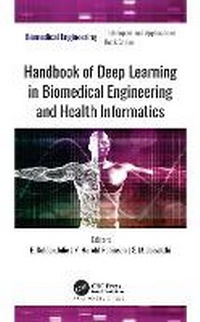
Handbook of Deep Learning in Biomedical Engineering and Health Informatics
Biomedical Engineering: Techniques and Applications
1st Edition
Published on 25. September 2023
Book
Paperback/Softback
318 pages
978-1-77463-817-0 (ISBN)
Description
This new volume discusses state-of-the-art deep learning techniques and approaches that can be applied in biomedical systems and health informatics. Deep learning in the biomedical field is an effective method of collecting and analyzing data that can be used for the accurate diagnosis of disease.
This volume delves into a variety of applications, techniques, algorithms, platforms, and tools used in this area, such as image segmentation, classification, registration, and computer-aided analysis. The editors proceed on the principle that accurate diagnosis of disease depends on image acquisition and interpretation. There are many methods to get high resolution radiological images, but we are still lacking in automated image interpretation. Currently deep learning techniques are providing a feasible solution for automatic diagnosis of disease with good accuracy. Analyzing clinical data using deep learning techniques enables clinicians to diagnose diseases at an early stage and treat patients more effectively.
Chapters explore such approaches as deep learning algorithms, convolutional neural networks and recurrent neural network architecture, image stitching techniques, deep RNN architectures, and more. This volume also depicts how deep learning techniques can be applied for medical diagnostics of several specific health scenarios, such as cancer, COVID-19, acute neurocutaneous syndrome, cardiovascular and neuro diseases, skin lesions and skin cancer, etc.
Key features:
Introduces important recent technological advancements in the field
Describes the various techniques, platforms, and tools used in biomedical deep learning systems
Includes informative case studies that help to explain the new technologies
Handbook of Deep Learning in Biomedical Engineering and Health Informatics provides a thorough exploration of biomedical systems applied with deep learning techniques and will provide valuable information for researchers, medical and industry practitioners, academicians, and students.
This volume delves into a variety of applications, techniques, algorithms, platforms, and tools used in this area, such as image segmentation, classification, registration, and computer-aided analysis. The editors proceed on the principle that accurate diagnosis of disease depends on image acquisition and interpretation. There are many methods to get high resolution radiological images, but we are still lacking in automated image interpretation. Currently deep learning techniques are providing a feasible solution for automatic diagnosis of disease with good accuracy. Analyzing clinical data using deep learning techniques enables clinicians to diagnose diseases at an early stage and treat patients more effectively.
Chapters explore such approaches as deep learning algorithms, convolutional neural networks and recurrent neural network architecture, image stitching techniques, deep RNN architectures, and more. This volume also depicts how deep learning techniques can be applied for medical diagnostics of several specific health scenarios, such as cancer, COVID-19, acute neurocutaneous syndrome, cardiovascular and neuro diseases, skin lesions and skin cancer, etc.
Key features:
Introduces important recent technological advancements in the field
Describes the various techniques, platforms, and tools used in biomedical deep learning systems
Includes informative case studies that help to explain the new technologies
Handbook of Deep Learning in Biomedical Engineering and Health Informatics provides a thorough exploration of biomedical systems applied with deep learning techniques and will provide valuable information for researchers, medical and industry practitioners, academicians, and students.
More details
Language
English
Place of publication
Oakville
Canada
Target group
College/higher education
Professional and scholarly
Academic and Postgraduate
Illustrations
14 s/w Tabellen, 10 farbige Abbildungen, 59 s/w Photographien bzw. Rasterbilder, 60 s/w Zeichnungen, 119 s/w Abbildungen, 10 farbige Zeichnungen
14 Tables, black and white; 10 Line drawings, color; 60 Line drawings, black and white; 59 Halftones, black and white; 10 Illustrations, color; 119 Illustrations, black and white
Dimensions
Height: 234 mm
Width: 156 mm
Weight
640 gr
ISBN-13
978-1-77463-817-0 (9781774638170)
Copyright in bibliographic data and cover images is held by Nielsen Book Services Limited or by the publishers or by their respective licensors: all rights reserved.
Schweitzer Classification
Other editions
Additional editions
E. Golden Julie | Y. Harold Robinson | S. M. Jaisakthi
Handbook of Deep Learning in Biomedical Engineering and Health Informatics
Biomedical Engineering: Techniques and Applications
Book
09/2021
1st Edition
Apple Academic Press Inc.
€164.50
Shipment within 3-4 weeks
E. Golden Julie | Y. Harold Robinson | S. M. Jaisakthi
Handbook of Deep Learning in Biomedical Engineering and Health Informatics
E-Book
09/2021
1st Edition
Apple Academic Press Inc.
€173.99
Available for download
E. Golden Julie | Y. Harold Robinson | S. M. Jaisakthi
Handbook of Deep Learning in Biomedical Engineering and Health Informatics
E-Book
09/2021
1st Edition
Apple Academic Press Inc.
€173.99
Available for download
Persons
E. Golden Julie, PhD, is a Senior Assistant Professor in the Department of Computer Science and Engineering at Anna University, Regional Campus, Tirunelveli, India. With more than? 12 ?years? of? experience ?in ?teaching, she has? published? and presented many papers at national and international conferences. She ?has? written? ten book chapters and is co-editor of the books Successful Implementation and Deployment of IoT Projects in Smart Cities and Handbook of Research on Blockchain Technology: Trend and Technologies. She also acts as a reviewer for many journals on computers and electrical engineering.
Y. Harold Robinson, PhD, is currently working at the School of Information Technology and Engineering, Vellore Institute of Technology, Vellore, India. He? has? more? than ?15 ?years? of? experience ?in ?teaching, has published? many papers in international? journals and presented ?at? both ?national ?and ?international? conferences.? Along with Dr. Julie, Dr. Robinson is co-editor of the books Successful Implementation and Deployment of IoT Projects in Smart Cities and Handbook of Research on Blockchain Technology: Trend and Technologies. He ?is ?a reviewer? of? many journals.
S. M. Jaisakthi, PhD, is an Associate Professor at the School of Computer Science and Engineering at the Vellore Institute of Technology, Vellore, India. Dr. Jaisakthi has extensive research experience in machine learning in image processing, medical image analysis and in building deep learning models. She has published many research publications in refereed international journals and in proceedings of international conferences. Currently she is investigating a project funded by the Science and Engineering Research Board (SERB).
Y. Harold Robinson, PhD, is currently working at the School of Information Technology and Engineering, Vellore Institute of Technology, Vellore, India. He? has? more? than ?15 ?years? of? experience ?in ?teaching, has published? many papers in international? journals and presented ?at? both ?national ?and ?international? conferences.? Along with Dr. Julie, Dr. Robinson is co-editor of the books Successful Implementation and Deployment of IoT Projects in Smart Cities and Handbook of Research on Blockchain Technology: Trend and Technologies. He ?is ?a reviewer? of? many journals.
S. M. Jaisakthi, PhD, is an Associate Professor at the School of Computer Science and Engineering at the Vellore Institute of Technology, Vellore, India. Dr. Jaisakthi has extensive research experience in machine learning in image processing, medical image analysis and in building deep learning models. She has published many research publications in refereed international journals and in proceedings of international conferences. Currently she is investigating a project funded by the Science and Engineering Research Board (SERB).
Content
1. Review of Existing Systems in Biomedical Using Deep Learning Algorithms 2. An Overview of Convolutional Neural Network Architecture and Its Variants in Medical Diagnostics of Cancer and COVID-19 3. Technical Assessment of Various Image Stitching Techniques: A Deep Learning Approach 4. CCNN: A Deep Learning Approach for an Acute Neurocutaneous Syndrome via Cloud-Based MRI Images 5. Critical Investigation and Prototype Study on Deep Brain Stimulations: An Application of Biomedical Engineering in Healthcare 6. Insight into Various Algorithms for Medical Image Analyzes Using Convolutional Neural Networks (Deep Learning) 7. Exploration of Deep RNN Architectures: LSTM and GRU in Medical Diagnostics of Cardiovascular and Neuro Diseases 8. Medical Image Classification and Manifold Disease Identification Through Convolutional Neural Networks: A Research Perspective 9. Melanoma Detection on Skin Lesion Images Using K-Means Algorithm and SVM Classifier 10. Role of Deep Learning Techniques in Detecting Skin Cancer: A Review 11. Deep Learning and Its Applications in Biomedical Image Processing