

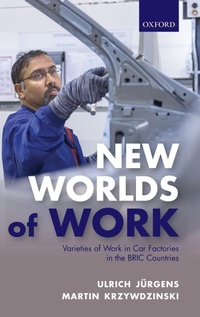
New Worlds of Work
Varieties of Work in Car Factories in the BRIC Countries
Published on 17. March 2016
Book
Hardback
364 pages
978-0-19-872267-0 (ISBN)
Description
New industrial centres are emerging in the so-called BRIC countries (Brazil, Russia, India, and China), where large numbers of plants have been constructed in recent years, creating many manufacturing jobs. But what does industrial work look like in these locations? Up until now, much of the interest in developing country industrialization has concentrated on the poor working conditions that characterize some export-oriented sectors in emerging economies, most notoriously in the garment industry. In contrast, the concern of this book is with the modern facilities of multinational or local manufacturers that reflect aspirations for a process of industrial upgrading that might foreshadow the future for these countries.
The book provides an analysis of work, its context, and the situation of employees in plants in the BRICs focussing on three main questions:
What differences and common features can be ascertained in a comparison both of countries and firms in terms of workplace HR management and production systems? What evidence is there for either a 'high road' or 'low road' developmental path in the BRICs? How are corporate standards implemented in these local contexts?
The book addresses an academic audience as well as managers and trade unionists. For the former, it offers a systematic comparison of the four countries and the companies under study. For the latter, it offers a vivid account of challenges the companies face in the BRIC countries as well as the solutions adopted by the companies.
The book provides an analysis of work, its context, and the situation of employees in plants in the BRICs focussing on three main questions:
What differences and common features can be ascertained in a comparison both of countries and firms in terms of workplace HR management and production systems? What evidence is there for either a 'high road' or 'low road' developmental path in the BRICs? How are corporate standards implemented in these local contexts?
The book addresses an academic audience as well as managers and trade unionists. For the former, it offers a systematic comparison of the four countries and the companies under study. For the latter, it offers a vivid account of challenges the companies face in the BRIC countries as well as the solutions adopted by the companies.
Reviews / Votes
Overall, this is a particularly useful book for teachers of comparative employment relations, especially given the scarcity of empirical investigations of ER in companies and plants from the BRIC countries. I will certainly use chapters from this book in the teaching of my comparative ER courses. * Sarosh Kuruvilla, Cornell University, Work, Employment and Society * Overall, this book represents a major contribution to the study of work in these emerging and transitional economies. * Tom Barnes, Australian Catholic University, Work, Employment and Society * The book is a must read for anyone interested in multiple, cross-national case-study research and ought to stand as a model for this form of rich workplace-based analysis of work and employment. * Chris Smith, Royal Holloway, University of London, Work, Employment and Society *More details
Other editions
Additional editions
Ulrich Jürgens | Martin Krzywdzinski
New Worlds of Work
Varieties of Work in Car Factories in the BRIC Countries
E-Book
04/2016
1st Edition
OUP eBook
€80.49
Available for download
Persons
Ulrich Juergens is researcher at the Berlin Social Science Center (WZB) and adjunct professor at Institute of Political Science at the Free University Berlin. Until his retirement, he was head of the Research Group "Knowledge, Production Systems, and Work" at the WZB. He has been carrying out extensive international comparative research in the fields of industrial relations, work organisation and personnel policy, systems of innovation, and industrial policy. He is a member of the Euro-Asia Management Studies Association (EAMSA), and of the Steering Committee of the GERPISA International Network of the Automobile.
Martin Krzywdzinski heads the project group "Globalization, Work, and Production" at the Berlin Social Science Center (WZB). He studied political science at the Free University of Berlin and at the Universite Paris VIII (1996-2002), completing his doctorate at the Free University of Berlin (2007). He is a member of the steering committee of the international automobile research network GERPISA. His field of interest is the sociology of work, covering such areas as production systems, work organization, and employment relations, as well as the development of multinational corporations and global value chains.
Martin Krzywdzinski heads the project group "Globalization, Work, and Production" at the Berlin Social Science Center (WZB). He studied political science at the Free University of Berlin and at the Universite Paris VIII (1996-2002), completing his doctorate at the Free University of Berlin (2007). He is a member of the steering committee of the international automobile research network GERPISA. His field of interest is the sociology of work, covering such areas as production systems, work organization, and employment relations, as well as the development of multinational corporations and global value chains.