

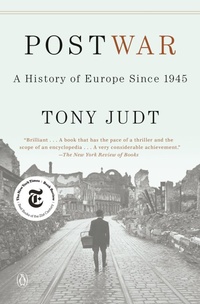
Postwar
A History of Europe Since 1945
Published on 5. September 2006
Book
Paperback/Softback
960 pages
978-0-14-303775-0 (ISBN)
Description
Finalist for the Pulitzer Prize * Winner of the Council on Foreign Relations Arthur Ross Book Award * One of the New York Times's 100 Best Books of the 21st Century
"Impressive . . . Mr. Judt writes with enormous authority." -The Wall Street Journal
"Magisterial . . . It is, without a doubt, the most comprehensive, authoritative, and yes, readable postwar history." -The Boston Globe
Almost a decade in the making, this much-anticipated grand history of postwar Europe from one of the world's most esteemed historians and intellectuals is a singular achievement. Postwar is the first modern history that covers all of Europe, both east and west, drawing on research in six languages to sweep readers through thirty-four nations and sixty years of political and cultural change-all in one integrated, enthralling narrative. Both intellectually ambitious and compelling to read, thrilling in its scope and delightful in its small details, Postwar is a rare joy.
"Impressive . . . Mr. Judt writes with enormous authority." -The Wall Street Journal
"Magisterial . . . It is, without a doubt, the most comprehensive, authoritative, and yes, readable postwar history." -The Boston Globe
Almost a decade in the making, this much-anticipated grand history of postwar Europe from one of the world's most esteemed historians and intellectuals is a singular achievement. Postwar is the first modern history that covers all of Europe, both east and west, drawing on research in six languages to sweep readers through thirty-four nations and sixty years of political and cultural change-all in one integrated, enthralling narrative. Both intellectually ambitious and compelling to read, thrilling in its scope and delightful in its small details, Postwar is a rare joy.
Reviews / Votes
"Judt's massive, learned, brilliantly detailed account of Europe's recovery from the wreckage of World War II presents a whole continent in panorama even as it sets off detonations on almost every page." -The New York Times Book Review"Remarkable . . . The writing is vivid; the coverage-of little countries as well as of great ones-is virtually superhuman; and above all, the book is smart. Every page contains unexpected data, or a fresh observation, or a familar observation freshly turned." -Louis Menand, The New Yorker
"Impressive . . . Mr. Judt writes with enormous authority." -The Wall Street Journal
"Magisterial . . . It is, without a doubt, the most comprehensive, authoritative, and yes, readable postwar history." -The Boston Globe
"Brave and remakable." -The Washington Post
"Brilliant . . . A book that has the pace of a thriller and the scope of an encyclopedia . . . A very considerable achievement." -The New York Review of Books
"Not likely to be surpassed for many years. . . . This is history writing at its best." -Publishers Weekly (starred review)
More details
Edition
Trade Paperback
Language
English
Place of publication
New York, NY
United States
Publishing group
Penguin Putnam Inc
Product notice
Paperback (trade)
Dimensions
Height: 230 mm
Width: 153 mm
Thickness: 44 mm
Weight
956 gr
ISBN-13
978-0-14-303775-0 (9780143037750)
Copyright in bibliographic data and cover images is held by Nielsen Book Services Limited or by the publishers or by their respective licensors: all rights reserved.
Schweitzer Classification
Other editions
Additional editions

Book
10/2005
The Penguin Press
€56.75
Article exhausted; check different version
Person
Tony Judt was the Erich Maria Remarque Professor of European Studies at New York University, as well as the founder and director of the Remarque Institute, dedicated to creating an ongoing conversation between Europe and the United States. He was educated at King's College, Cambridge, and the Ecole Normale Superieure, Paris, and also taught at Cambridge, Oxford, and Berkeley. Professor Judt was a frequent contributor to The New York Review of Books, The Times Literary Supplement, The New Republic, The New York Times, and many journals across Europe and the United States. He is the author or editor of fifteen books, including Thinking the Twentieth Century, The Memory Chalet, Ill Fares the Land, Reappraisals: Reflections on the Forgotten Twentieth Century, and Postwar: A History of Europe Since 1945, which was one of The New York Times Book Review's Ten Best Books of 2005, the winner of the Council on Foreign Relations Arthur Ross Book Award, and a finalist for the Pulitzer Prize. He died in August 2010 at the age of sixty-two.
Content
Preface & Acknowledgements
Introduction
Part One: Post-War: 1945-1953
I. The Legacy of War
II. Retribution
III. The Rehabilitation of Europe
IV. The Impossible Settlement
V. The Coming of the Cold War
VI. Into the Whirlwind
VII. Culture Wars
Coda. The End of Old Europe
Part Two: Prosperity and Its Discontents: 1953-1971
VIII. The Politics of Stability
IX. Lost Illusions
X. The Age of Affluence
XI. The Social Democratic Hour
XII. The Spectre of Revolution
XIII. The End of the Affair
Part Three: Recessional: 1971-1989
XIV. Diminished Expectations
XV. Politics in a New Key
XVI. A Time of Transition
XVII. The New Realism
XVIII. The Power of the Powerless
XIX. The End of the Old Order
Part Four: After the Fall: 1989-2005
XX. A Fissile Continent
XXI. The Reckoning
XXII. The Old Europe-:and the New
XXIII. The Varieties of Europe
XXIV. Europe as a Way of Life
Epilogue
From the House of the Dead: An Essay on Modern European Memory
Index
Introduction
Part One: Post-War: 1945-1953
I. The Legacy of War
II. Retribution
III. The Rehabilitation of Europe
IV. The Impossible Settlement
V. The Coming of the Cold War
VI. Into the Whirlwind
VII. Culture Wars
Coda. The End of Old Europe
Part Two: Prosperity and Its Discontents: 1953-1971
VIII. The Politics of Stability
IX. Lost Illusions
X. The Age of Affluence
XI. The Social Democratic Hour
XII. The Spectre of Revolution
XIII. The End of the Affair
Part Three: Recessional: 1971-1989
XIV. Diminished Expectations
XV. Politics in a New Key
XVI. A Time of Transition
XVII. The New Realism
XVIII. The Power of the Powerless
XIX. The End of the Old Order
Part Four: After the Fall: 1989-2005
XX. A Fissile Continent
XXI. The Reckoning
XXII. The Old Europe-:and the New
XXIII. The Varieties of Europe
XXIV. Europe as a Way of Life
Epilogue
From the House of the Dead: An Essay on Modern European Memory
Index