

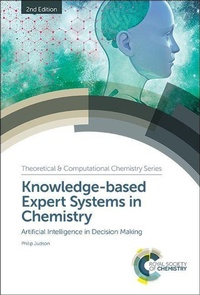
Knowledge-based Expert Systems in Chemistry
Artificial Intelligence in Decision Making
2nd Edition
Published on 15. February 2019
Book
Hardback
284 pages
978-1-78801-471-7 (ISBN)
Description
There have been significant developments in the use of knowledge-based expert systems in chemistry since the first edition of this book was published in 2009. This new edition has been thoroughly revised and updated to reflect the advances.
The underlying theme of the book is still the need for computer systems that work with uncertain or qualitative data to support decision-making based on reasoned judgements. With the continuing evolution of regulations for the assessment of chemical hazards, and changes in thinking about how scientific decisions should be made, that need is ever greater. Knowledge-based expert systems are well established in chemistry, especially in relation to toxicology, and they are used routinely to support regulatory submissions. The effectiveness and continued acceptance of computer prediction depends on our ability to assess the trustworthiness of predictions and the validity of the models on which they are based.
Written by a pioneer in the field, this book provides an essential reference for anyone interested in the uses of artificial intelligence for decision making in chemistry.
The underlying theme of the book is still the need for computer systems that work with uncertain or qualitative data to support decision-making based on reasoned judgements. With the continuing evolution of regulations for the assessment of chemical hazards, and changes in thinking about how scientific decisions should be made, that need is ever greater. Knowledge-based expert systems are well established in chemistry, especially in relation to toxicology, and they are used routinely to support regulatory submissions. The effectiveness and continued acceptance of computer prediction depends on our ability to assess the trustworthiness of predictions and the validity of the models on which they are based.
Written by a pioneer in the field, this book provides an essential reference for anyone interested in the uses of artificial intelligence for decision making in chemistry.
More details
Series
Edition
2nd edition
Language
English
Place of publication
Cambridge
United Kingdom
Target group
College/higher education
Professional and scholarly
Product notice
Unsewn / adhesive bound
Dimensions
Height: 236 mm
Width: 163 mm
Thickness: 15 mm
Weight
590 gr
ISBN-13
978-1-78801-471-7 (9781788014717)
DOI
10.1039/9781788016186
Copyright in bibliographic data and cover images is held by Nielsen Book Services Limited or by the publishers or by their respective licensors: all rights reserved.
Schweitzer Classification
Other editions
New editions
E-Book
02/2019
2nd Edition
Royal Society of Chemistry
€201.99
Available for download
Additional editions
E-Book
02/2019
2nd Edition
Royal Society of Chemistry
€201.99
Available for download
E-Book
02/2019
2nd Edition
Royal Society of Chemistry
€201.99
Available for download
Previous edition
Book
09/2009
Royal Society of Chemistry
€157.50
Shipment within 3-4 weeks
Person
The author studied chemistry at the University of Manchester before working on the synthesis of novel herbicides and fungicides for Fisons Ltd at Chesterford Park Research Station near Saffron Walden. His PhD at the University of Surrey was on chemical synthesis. He took an interest in knowledge-based computer systems and became Head of Chemical Information and Computing for Schering Agrochemicals Ltd. He was one of the founders of Lhasa Limited, a not-for-profit company specialising in knowledge-based expert systems in chemistry including the widely-used Derek, Meteor, and Zeneth systems for predicting chemical toxicity, metabolism, and chemical degradation. Although semi-retired, he continues to contribute to research and development work at Lhasa Limited in his role as Scientific Advisor and is working in a project on synthetic accessibility led by scientists at the US Niational Institutes of Health. He developed and maintains software for chemical hazard classification and chemical safety data sheet management, Harmoneus and Prometheus, which are supplied by Hibiscus plc. He has published over eighty scientfic papers, posters and book chapters. His hobbies include climbing and caving and he has published articles about international caving expeditions that he has taken part in.
Content
Artificial Intelligence - Making Use of Reasoning;
Synthesis Planning by Computer;Other Programs to Support Chemical Synthesis Planning;
International Repercussions of the Harvard LHASA Project;
Current Interest in Synthesis Planning by Computer;
Structure Representation;
Structure, Substructure and Superstructure Searching;
Protons That Come and Go;
Aromaticity and Stereochemistry;
DEREK - Predicting Toxicity;
Other Alert-based Toxicity Prediction Systems;
Rule Discovery;
The 2D-3D Debate;
Making Use of Reasoning: Derek for Windows;
Predicting Metabolism;
Relative Reasoning;
Predicting Biodegradation;
Other Applications and Potential Applications of Knowledge-based Prediction in Chemistry;
Combining Predictions;
The Adverse Outcome Pathways Approach;
Evaluation of Knowledge-based Systems;
Validation of Computer Predictions;
Artificial Intelligence Developments in Other Fields;
A Subjective View of the Future
Synthesis Planning by Computer;Other Programs to Support Chemical Synthesis Planning;
International Repercussions of the Harvard LHASA Project;
Current Interest in Synthesis Planning by Computer;
Structure Representation;
Structure, Substructure and Superstructure Searching;
Protons That Come and Go;
Aromaticity and Stereochemistry;
DEREK - Predicting Toxicity;
Other Alert-based Toxicity Prediction Systems;
Rule Discovery;
The 2D-3D Debate;
Making Use of Reasoning: Derek for Windows;
Predicting Metabolism;
Relative Reasoning;
Predicting Biodegradation;
Other Applications and Potential Applications of Knowledge-based Prediction in Chemistry;
Combining Predictions;
The Adverse Outcome Pathways Approach;
Evaluation of Knowledge-based Systems;
Validation of Computer Predictions;
Artificial Intelligence Developments in Other Fields;
A Subjective View of the Future