

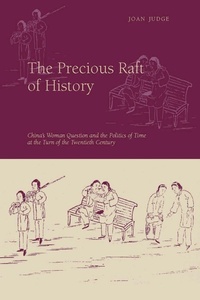
The Precious Raft of History
The Past, the West, and the Woman Question in China
Published on 22. April 2010
Book
Paperback/Softback
416 pages
978-0-8047-7326-3 (ISBN)
Description
This book reveals and interprets the rich diversity of turn-of-the-twentieth-century Chinese approaches to their own past and the modern West through the lens of the woman question. Writers and activists who engaged in debates over this question variously appropriated biographies of women-a genre with a 2,000-year history in China and a new political salience in the early twentieth century. Judge maps the ways these individuals used historical Chinese and modern Western women's biographies to promote competing visions of female virtue, talent, and heroism, and, ultimately, to advance competing evaluations of China's ritual teachings, cultural heritage, and national future. She concludes by applying the hermeneutics of historical change she develops for the turn of the twentieth century to the turn of the twenty-first century, as women's issues continue to foreground Chinese conceptions of the past, the West, and the nation.
Reviews / Votes
"In this broadly researched, ambitiously structured book, Judge presents a cross-section of the writings appearing at the turn of the 20th century that addressed the so-called 'women's question' in China. Rather than using such jaded terms as "tradition" and "modern," she ingeniously divides these writings into what she calls 'four chronotypes'...These chronotypes, which bridge history with literary theory, have enable Judge to demonstrate a complex and multifarious scene of sociocultural change at a critical juncture in Chinese history." - CHOICE "Judge's study of the 'woman question' does justice to its dynamism, complexity and transitional character. She has established a new benchmark in historical studies of the very late Qing." - Antonia Finnane (China Quarterly) "Joan Judge's The Precious Raft of History does exactly what a raft is supposed to do. It rescues history, in this case the history of Chinese women in the late Qing dynasty, from the dismissive condescension of revolutionaries and scholars alike. With impressive erudition, Judge gives us genuinely new material and themes to think about. This is original, careful, exciting work." - Gail Hershatter (University of California, Santa Cruz) "This fascinating new book strips away scholarly illusions about ruptures in China's nineteenth and early-twentieth century history, and reveals how new roles for women have deep roots in a dense textual and cultural past. The illustrations are nothing short of fabulous." - Susan Mann, University of California (Davis)More details
Edition
New edition
Language
English
Place of publication
Palo Alto
United States
Target group
College/higher education
Professional and scholarly
Edition type
New edition
Product notice
Paperback (trade)
Illustrations
51 illustrations
Dimensions
Height: 222 mm
Width: 149 mm
Thickness: 29 mm
Weight
547 gr
ISBN-13
978-0-8047-7326-3 (9780804773263)
Copyright in bibliographic data and cover images is held by Nielsen Book Services Limited or by the publishers or by their respective licensors: all rights reserved.
Schweitzer Classification
Person
Joan Judge is Associate Professor of Humanities and Women's Studies at York University in Toronto. She is the author of Print and Politics: 'Shibao' and the Culture of Reform in Late Qing China (Stanford, 1996) and of numerous articles on China at the turn of the twentieth century.
Content
Contents List of Illustrations xxx Acknowledgments xxx Introduction: Women and Temporality 1 Part One The Regime of Feminine Virtue 000 1. Chaste Women: Sacred, Praiseworthy, or Misguided 000 2. Public Women: Licentious or Evolved 000 Part Two History, Nation, and Female Talent 000 3. Women of Talent: Valorized and Repudiated 000 4. Wise Mothers and Mothers of Citizens 000 Part Three New Global Hierarchies of Female Heroism 000 5. The Chinese Woman Warrior and the Western Heroine 000 6. The New-Style Heroine and the Paradoxes of Feminine Time 000 Conclusion: From the Turn of the Twentieth Century to the Turn of the Twenty-First 000 Glossary and Character List 000 Abbreviations 000 Notes 000 Bibliography 000