

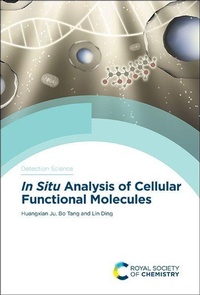
In Situ Analysis of Cellular Functional Molecules
Published on 28. January 2020
Book
Hardback
272 pages
978-1-78801-722-0 (ISBN)
Description
In recent years, in situ analysis of cellular functional molecules has attracted considerable interest as it can provide spatially or temporally resolved information of these essential molecules on/within living cells in a non-invasive way. In Situ Analysis of Cellular Functional Molecules introduces the tailor-made design of detection probes as well as schemes from a top-down perspective according to the unique characteristics of cellular functional molecules. The latest methodological developments, including enhancement of detection sensitivity and specificity, precision localization, implementation of dynamic tracking, and acquirement of quantitative functional information for various important functional molecules is discussed in detail. Written by leaders in the field, this book will provide a comprehensive overview to scientists in academia and professionals in industry working on different aspects of cellular analysis and cell biology.
More details
Series
Language
English
Place of publication
Cambridge
United Kingdom
Target group
College/higher education
Professional and scholarly
Product notice
Unsewn / adhesive bound
Dimensions
Height: 231 mm
Width: 160 mm
Thickness: 13 mm
Weight
544 gr
ISBN-13
978-1-78801-722-0 (9781788017220)
DOI
10.1039/9781839160455
Copyright in bibliographic data and cover images is held by Nielsen Book Services Limited or by the publishers or by their respective licensors: all rights reserved.
Schweitzer Classification
Other editions
Additional editions
Huangxian Ju | Bo Tang | Lin Ding
In Situ Analysis of Cellular Functional Molecules
E-Book
01/2020
1st Edition
Royal Society of Chemistry
€216.99
Available for download
Persons
Prof. Huangxian Ju received his B.S., M.S. and Ph.D from Nanjing University in 1986, 1989 and 1992, and became lecturer, associate professor and professor in 1992, 1993 and 1999, respectively. He is currently the director of State Key Laboratory of Analytical Chemistry for Life Science. He won the National Funds for National Distinguished Young Scholars in 2003, and was selected as Changjiang Professor by Education Ministry of China and a National Key Talent in The New Century in 2007 by China government, a chief scientist of National Basic Research Program of China by MSTC in 2009, Fellows of the International Society of Electrochemistry and the Royal Society of Chemistry in 2015. His research interests include analytical biochemistry and nanobiosensing. He has published 569 papers in SCI journals (329 in journals with IF over 5), and authored 3 English books, 7 Chinese books, 17 chapters, and 6 editorial, preface or book reviews. His research works have 25584 citations in SCI journals with an h-index of 84 (Google Scholar h-index 93 with 30450 citations) up to Aug. 10, 2018, and won 3 first-class S&T prizes from Jiangsu Province Government, 3 first-class prizes in natural science from Education Ministry of China, and 3 first-class S&T prizes from Chinese Association for Instrumental Analysis.
Prof. Bo Tang received his Ph.D. degree from Nankai University in 1994. He currently works in Shandong Normal University as professor, president of Shandong Normal University. He is also the adjunct professor of Nankai University and Shandong University. Prof. Tang won National Fund for Outstanding Young Scientists in 2007, Chief-scientist for National key basic research development plan (973 Program) in 2012. He is director of Research Center of the Key Laboratory of Molecular and Nano Probes Ministry of Education in Shandong Normal University. Prof. Tang currently is Honorary Advisors of Analytical Chemistry and serves on the Editorial Board of Scientific Reports. His research interest is focused on the synthesis of molecular and nanoprobes and its application in biological imaging, synthesis of fluorescent material, solar chemical conversion and storage. Up to now, Prof. Tang has published over 400 papers in the journals of Nat. Commun., J. Am. Chem. Soc., Angew. Chem. Int. Ed., Chem. Sci., Biomaterials, and so on. His work has been cited over 12,000 times not counting self-citations and his current H-index is 58.
Prof. Lin Ding, graduated from Prof. Ju's group with Ph.D degree in 2009, is now a professor of chemistry in Nanjing University. She is also the holder of Excellent Young Scientist Award from NSFC. Her research interests center on the in situ detection of cellular functional molecules, with 60 papers in SCI journals.
Prof. Bo Tang received his Ph.D. degree from Nankai University in 1994. He currently works in Shandong Normal University as professor, president of Shandong Normal University. He is also the adjunct professor of Nankai University and Shandong University. Prof. Tang won National Fund for Outstanding Young Scientists in 2007, Chief-scientist for National key basic research development plan (973 Program) in 2012. He is director of Research Center of the Key Laboratory of Molecular and Nano Probes Ministry of Education in Shandong Normal University. Prof. Tang currently is Honorary Advisors of Analytical Chemistry and serves on the Editorial Board of Scientific Reports. His research interest is focused on the synthesis of molecular and nanoprobes and its application in biological imaging, synthesis of fluorescent material, solar chemical conversion and storage. Up to now, Prof. Tang has published over 400 papers in the journals of Nat. Commun., J. Am. Chem. Soc., Angew. Chem. Int. Ed., Chem. Sci., Biomaterials, and so on. His work has been cited over 12,000 times not counting self-citations and his current H-index is 58.
Prof. Lin Ding, graduated from Prof. Ju's group with Ph.D degree in 2009, is now a professor of chemistry in Nanjing University. She is also the holder of Excellent Young Scientist Award from NSFC. Her research interests center on the in situ detection of cellular functional molecules, with 60 papers in SCI journals.
Content
Design of In Situ Cytosensing Strategies;
In Situ Detection of Cell-surface Glycans;
In Situ Detection of Intracellular Messenger RNA and MicroRNA;
In Situ Analysis of Intracellular Telomerase Activity;
In Situ Analysis of the Intracellular Caspase Family;
Visualization of Intracellular Glycosylation;
Real-time Monitoring of Intracellular Reactive Oxygen Species;
Imaging of Intracellular Reactive Nitrogen Species and Reactive Sulfur Species;
Imaging of the Tumour Microenvironment;
Visualization of Dynamic Intermolecular Interactions in Living Cells
In Situ Detection of Cell-surface Glycans;
In Situ Detection of Intracellular Messenger RNA and MicroRNA;
In Situ Analysis of Intracellular Telomerase Activity;
In Situ Analysis of the Intracellular Caspase Family;
Visualization of Intracellular Glycosylation;
Real-time Monitoring of Intracellular Reactive Oxygen Species;
Imaging of Intracellular Reactive Nitrogen Species and Reactive Sulfur Species;
Imaging of the Tumour Microenvironment;
Visualization of Dynamic Intermolecular Interactions in Living Cells