

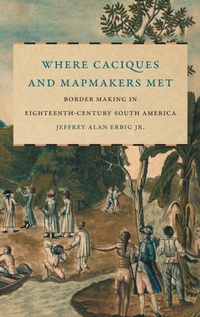
Where Caciques and Mapmakers Met
Border Making in Eighteenth-Century South America
Published on 30. April 2020
Book
Hardback
288 pages
978-1-4696-5503-1 (ISBN)
Description
During the late eighteenth century, Portugal and Spain sent joint mapping expeditions to draw a nearly 10,000-mile border between Brazil and Spanish South America. These boundary commissions were the largest ever sent to the Americas and coincided with broader imperial reforms enacted throughout the hemisphere. Where Caciques and Mapmakers Met considers what these efforts meant to Indigenous peoples whose lands the border crossed. Moving beyond common frameworks that assess mapped borders strictly via colonial law or Native sovereignty, it examines the interplay between imperial and Indigenous spatial imaginaries. What results is an intricate spatial history of border making in southeastern South America (present-day Argentina, Brazil, and Uruguay) with global implications.
Drawing upon manuscripts from over two dozen archives in seven countries, Jeffrey Alan Erbig Jr. traces on-the-ground interactions between Ibero-American colonists, Jesuit and Guarani mission-dwellers, and autonomous Indigenous peoples as they responded to ever-changing notions of territorial possession. It reveals that Native agents shaped when and where the border was drawn, and fused it to their own territorial claims. While mapmakers' assertions of Indigenous disappearance or subjugation shaped historiographical imaginations thereafter, Erbig reveals that the formation of a border was contingent upon Native engagement and authority.
Drawing upon manuscripts from over two dozen archives in seven countries, Jeffrey Alan Erbig Jr. traces on-the-ground interactions between Ibero-American colonists, Jesuit and Guarani mission-dwellers, and autonomous Indigenous peoples as they responded to ever-changing notions of territorial possession. It reveals that Native agents shaped when and where the border was drawn, and fused it to their own territorial claims. While mapmakers' assertions of Indigenous disappearance or subjugation shaped historiographical imaginations thereafter, Erbig reveals that the formation of a border was contingent upon Native engagement and authority.
More details
Series
Language
English
Place of publication
Chapel Hill
United States
Target group
Professional and scholarly
Product notice
Cloth
Illustrations
24 halftones, 13 maps, 6 tables
Dimensions
Height: 240 mm
Width: 161 mm
Thickness: 21 mm
Weight
638 gr
ISBN-13
978-1-4696-5503-1 (9781469655031)
Copyright in bibliographic data and cover images is held by Nielsen Book Services Limited or by the publishers or by their respective licensors: all rights reserved.
Schweitzer Classification
Person
Jeffrey Alan Erbig Jr. is assistant professor of Latin American and Latino studies at the University of California, Santa Cruz.