

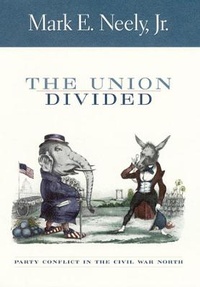
The Union Divided
Party Conflict in the Civil War North
Published on 1. February 2005
Book
Paperback/Softback
272 pages
978-0-674-01610-1 (ISBN)
Description
In 1863, Union soldiers from Illinois threatened to march from the battlefield to their state capital. Springfield had not been seized by the Rebels--but the state government was in danger of being captured by the Democrats.
In The Union Divided, Pulitzer Prize-winning historian Mark E. Neely, Jr., vividly recounts the surprising story of political conflict in the North during the Civil War. Examining party conflict as viewed through the lens of the developing war, the excesses of party patronage, the impact of wartime elections, the highly partisan press, and the role of the loyal opposition, Neely deftly dismantles the argument long established in Civil War scholarship that the survival of the party system in the North contributed to its victory.
The many positive effects attributed to the party system were in fact the result of the fundamental operation of the Constitution, in particular a four-year president who was commander in chief. In several ways, the party system actually undermined the Northern war effort; Americans uneasy about normal party operations in the abnormal circumstances of civil war saw near-treason in the loyal opposition.
Engagingly written and brilliantly argued, The Union Divided is an insightful and original contribution to Civil War studies and American political history.
In The Union Divided, Pulitzer Prize-winning historian Mark E. Neely, Jr., vividly recounts the surprising story of political conflict in the North during the Civil War. Examining party conflict as viewed through the lens of the developing war, the excesses of party patronage, the impact of wartime elections, the highly partisan press, and the role of the loyal opposition, Neely deftly dismantles the argument long established in Civil War scholarship that the survival of the party system in the North contributed to its victory.
The many positive effects attributed to the party system were in fact the result of the fundamental operation of the Constitution, in particular a four-year president who was commander in chief. In several ways, the party system actually undermined the Northern war effort; Americans uneasy about normal party operations in the abnormal circumstances of civil war saw near-treason in the loyal opposition.
Engagingly written and brilliantly argued, The Union Divided is an insightful and original contribution to Civil War studies and American political history.
Reviews / Votes
Mark Neely's The Union Divided is an important book on a badly neglected topic. In a series of vigorously argued chapters, Neely challenges the long-accepted view that the North's two party system played a vital role in sustaining the Union war effort by moderating public opinion and checking political extremism. Instead, he demonstrates how the partisan press, by seriously distorting events and badly misinterpreting the military situation, overtly stimulated the extremism of the period. This is a bold and provocative book that reveals how fragile the American democratic system really was when confronted with the strains of civil war. -- William Gienapp, Harvard University Like most of Mark Neely's work, The Union Divided is marvelously contrarian and thought-provoking. It makes an important contribution to our understanding of Civil War politics and the political history of the United States in the nineteenth century. Especially in Civil War studies, there are too many books that fill in the paradigm. This does the opposite; clearly written, logically argued, it is a terrific work. -- Jean H. Baker, Goucher College Historians of the American Civil War have long argued that the two-party political system functioning in the North during the war provided it with a powerful, if not decisive, advantage over the South...[T]he Pulitzer Prize-winning author of The Fate of Liberty: Abraham Lincoln and Civil Liberties, questions this long-held assumption and argues that the system often stirred up rather than controlled conflict. This thought-provoking volume is structured chronologically, tracing the functioning of the system throughout the war and examining topics from the wartime elections to the political functions of newspapers of the day. Utilizing many primary sources, he also provides excellent historiographical context for the topic. Concise, well reasoned, and well written, it will excite much discussion and future scholarship and is recommended. -- Theresa McDevitt * Library Journal * Though his book is designed to be "tentative and suggestive"--in other words, to replace the accepted wisdom with thoughtful queries and to provoke debate--Neely provides a bold and informed reappraisal of Northern party and factional discord and its impact on the conduct and outcome of the Civil War. * Publishers Weekly *More details
Language
English
Place of publication
Cambridge, Mass
United States
Target group
Professional and scholarly
US School Grade: College Graduate Student
Illustrations
1 table
Dimensions
Height: 202 mm
Width: 130 mm
Thickness: 19 mm
ISBN-13
978-0-674-01610-1 (9780674016101)
Copyright in bibliographic data and cover images is held by Nielsen Book Services Limited or by the publishers or by their respective licensors: all rights reserved.
Schweitzer Classification
Other editions
Additional editions
E-Book
07/2009
Harvard University Press
€26.49
Available for download
Person
Mark E. Neely, Jr., is McCabe-Greer Professor of the History of the Civil War Era at Pennsylvania State University and the author of the Pulitzer Prize-winning The Fate of Liberty: Abraham Lincoln and Civil Liberties.
Content
Preface Introduction 1. "No party now but all for our country" Political Parties and the Public Safety 2. "Blustering treason in every assembly" The Revolt against Politics in 1863 3. "He must be entrenching" Political Parties and the Death of Strategy 4. "Odious to honourable men" The Press and Its Freedom in the Civil War 5. "Times of corruption and demoralization" The Futility of a Loyal Opposition 6. "Paroxysms of rage and fear" The Republican Part at War 7. "The Civil War and the Two-Party System" A Reconsideration Notes Index