

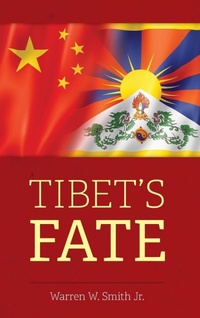
Tibet's Fate
Published on 15. March 2023
Book
Hardback
402 pages
978-1-5381-7398-5 (ISBN)
Description
Tibet's Fate examines the issue of the political fate of Tibet. It is told by Tibetans themselves as well as by the author from his own experiences. The title is not meant to imply that the current fate of Tibet is an ultimate destiny, or even that Tibet's fate is already decided. It is only meant in the sense that if Tibet's fate is now determined, it has been determined not by the Tibetan people but by those of China. If it is to be determined by China, then Tibet's fate is indeed to be an integral part of China. However, if Tibet's fate were to be decided by the Tibetan people, if they were allowed their right to national self-determination, then it would definitely be different.
Given all the criteria for independent statehood-territory, culture, language, religion and government-Tibet surely should be an independent state. Tibetan territory, defined by altitude, was the very nearly exclusively habitation of people who identified themselves as Tibetans. Those people share a distinct culture, language and religion. They had a central government that directly administered the territory of Central Tibet and indirectly that of Kham and Amdo. Had Tibetans been allowed to determine for themselves their political status; that is, if they had the right to self-determination as specified in the most fundamental documents of international law, there is no doubt that they would have chosen independence. Whatever the flaws of the Tibetan social and political systems, Tibet should have had the right to determine its own fate, and could have done so, until deprived of that right by China.
The book also examines the sensitive question of the nature of the Tibetan political system and its role in the fate that has befallen Tibet. The author concludes that the Tibetan political system of Chosi Shungdrel, or the unity of religion and politics, is implicated in the failure of Tibet to maintain its independence.
Given all the criteria for independent statehood-territory, culture, language, religion and government-Tibet surely should be an independent state. Tibetan territory, defined by altitude, was the very nearly exclusively habitation of people who identified themselves as Tibetans. Those people share a distinct culture, language and religion. They had a central government that directly administered the territory of Central Tibet and indirectly that of Kham and Amdo. Had Tibetans been allowed to determine for themselves their political status; that is, if they had the right to self-determination as specified in the most fundamental documents of international law, there is no doubt that they would have chosen independence. Whatever the flaws of the Tibetan social and political systems, Tibet should have had the right to determine its own fate, and could have done so, until deprived of that right by China.
The book also examines the sensitive question of the nature of the Tibetan political system and its role in the fate that has befallen Tibet. The author concludes that the Tibetan political system of Chosi Shungdrel, or the unity of religion and politics, is implicated in the failure of Tibet to maintain its independence.
Reviews / Votes
Insightful and inspirational, this book captures the author's lifetime support of the Tibetan cause, telling not only of his experiences during the independence movement but also the testimonies of Tibetans and how their lives were impacted. A must read for the younger generation of Tibetans, Tibetan activists and anyone who is interested in the Tibetan diaspora. -- Jianglin Li, Author of Tibet in Agony: Lhasa 1959 Erudite and uncompromised. Tibet's Fate is part memoir and part history - a unique, realist tour of contemporary Tibet. -- Carole McGranahan, University of Colorado, Boulder For some four decades, Warren Smith has been a deeply engaged participant in the cause of Tibetan freedom, serving for almost a quarter century as the only non-Tibetan member of the Tibetan branch of Radio Free Asia. In Tibet's Fate, drawing on the experiences of Tibetans in exile and his personal memoirs, Smith offers a unique perspective on the movement with which he has been so intimately engaged. This is an essential work on contemporary Tibetan affairs. -- Matthew Kapstein, Professor emeritus, Ecole Pratique des Hautes Etudes, Sorbonne, Paris In a time when our hearts are lifted by the heroic resistance of the men and women of Ukraine against Putin's vicious neo-imperialist invasion of their lives and lands, it seems compellingly patriotic as a citizen of the earth to be spellbound by Warren' Smith's searing account of the century-long outrage of the Chinese communist party's ongoing, completely unwarranted, criminal genocide of the people of Tibet and despoliation of its land and the headwaters of every single one of Asia's major rivers. In telling his fascinating story, he gives voice to a Solzhenytsin-like Tibetan collective of witnesses of the inhumanly murderous atrocities and rapacious robberies committed by Chinese individuals, military and civilian ideological fanatics, against the free men, women, children, animals, trees, plants, lands and waters of a Tibet that we can see vanishing before our eyes. At the same time, Smith himself describes in vivid prose his personal adventure and life-long exploration of the Land of Snow Peaks, and so takes us along with him to see the majesty and beauty of the vast plateau-big as the whole of the U.S. west of the Mississippi-and moves our hearts to compassionate amazement at the astounding endurance of its colorful, kind, intelligent, spiritual and yet earthy Tibetan people. Smith's deeply informed, heartfelt, and historically realistic grim conclusion about the fate of Tibet and its all-too-unacknowledged human nation of real people stirs us to open our hearts to them, to stand with them in whatever ways we can, great or small. Smith's riveting Tibet's Fate takes on a gripping journey and leaves us with an existential question: when will it be on our planet that an ongoing genocide is one too many? That can admit of no one's rationalizations for letting it happen? -- Robert A.F Thurman, Jey Tsong Khapa Professor Emeritus, Columbia University Tibet's Fate is a tour de force that expertly weaves together Tibetan accounts, autobiography, history, and policy analysis into a highly engaging treatment of what is an increasingly marginalized topic: Tibet's situation. Warren Smith has displayed, yet again, his acumen as a writer, analyst, and Tibet-watcher. -- Tsering Topgyal, University of BirminghamMore details
Language
English
Place of publication
United States
Publishing group
Bloomsbury Publishing Plc
Illustrations
13 b/w photos
Dimensions
Height: 235 mm
Width: 157 mm
Thickness: 28 mm
Weight
801 gr
ISBN-13
978-1-5381-7398-5 (9781538173985)
Copyright in bibliographic data and cover images is held by Nielsen Book Services Limited or by the publishers or by their respective licensors: all rights reserved.
Schweitzer Classification
Other editions
Additional editions
Warren W. Smith Jr.
Tibet's Fate
E-Book
03/2023
1st Edition
Bloomsbury eBooks US
€32.99
Available for download
Warren W. Smith Jr.
Tibet's Fate
E-Book
03/2023
1st Edition
Rowman & Littlefield Publishers
€32.99
Available for download
Person
Warren W. Smith Jr. is a research historian with Radio Free Asia, Tibetan Service, Washington, D.C..