

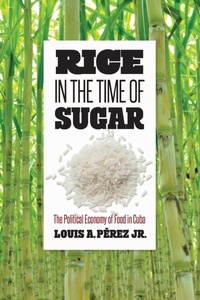
Rice in the Time of Sugar
The Political Economy of Food in Cuba
Published on 30. May 2019
Book
Paperback/Softback
264 pages
978-1-4696-5142-2 (ISBN)
Description
In this history of Cuba, Louis A. Perez proposes a new Cuban counterpoint: rice, a staple central to the island's cuisine, and sugar, which dominated an export economy 150 years in the making. Perez shows how the logic of the sugar trade resulted in the development of an agriculture for consumers abroad at the expense of consumers at home. In the process, dependency on food imports, a signal feature of the Cuban economy, was set in place.
Efforts to diversify the economy through expanded rice production were met with keen resistance by U.S. rice producers, who were as reliant on the Cuban market as Cubans were on the U.S. market. U.S. growers prepared to retaliate by cutting the sugar quota in a struggle to control Cuban rice markets. Perez's chronicle culminates in the 1950s, a period of deepening revolutionary tensions on the island, as U.S. rice producers and their allies in Congress clashed with Cuban producers supported by the government of Fulgencio Batista. U.S. interests prevailed-a success, Perez argues, that contributed to undermining Batista's capacity to govern. Cuba's inability to develop self-sufficiency in rice production persists long after the triumph of the Cuban revolution. Cuba continues to import rice, but, in the face of the U.S. embargo, mainly from Asia. U.S. rice growers wait impatiently to recover the Cuban market.
Efforts to diversify the economy through expanded rice production were met with keen resistance by U.S. rice producers, who were as reliant on the Cuban market as Cubans were on the U.S. market. U.S. growers prepared to retaliate by cutting the sugar quota in a struggle to control Cuban rice markets. Perez's chronicle culminates in the 1950s, a period of deepening revolutionary tensions on the island, as U.S. rice producers and their allies in Congress clashed with Cuban producers supported by the government of Fulgencio Batista. U.S. interests prevailed-a success, Perez argues, that contributed to undermining Batista's capacity to govern. Cuba's inability to develop self-sufficiency in rice production persists long after the triumph of the Cuban revolution. Cuba continues to import rice, but, in the face of the U.S. embargo, mainly from Asia. U.S. rice growers wait impatiently to recover the Cuban market.
More details
Language
English
Place of publication
Chapel Hill
United States
Target group
Professional and scholarly
Illustrations
14 halftones, 15 tables
Dimensions
Height: 234 mm
Width: 156 mm
Thickness: 16 mm
Weight
455 gr
ISBN-13
978-1-4696-5142-2 (9781469651422)
Copyright in bibliographic data and cover images is held by Nielsen Book Services Limited or by the publishers or by their respective licensors: all rights reserved.
Schweitzer Classification
Other editions
Additional editions
E-Book
03/2019
The University of North Carolina Press
€22.49
Available for download
Person
Louis A. Perez Jr is J. Carlyle Sitterson Professor of History at the University of North Carolina at Chapel Hill. A fellow of the American Academy of Arts and Sciences as well as the Academia de la Historia de Cuba, Perez is author of numerous books on Cuban history and culture, including On Becoming Cuban: Identity, Nationality, and Culture and The Structure of Cuban History: Meanings and Purpose of the Past.