

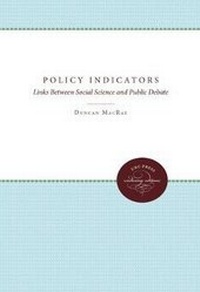
Policy Indicators
Links Between Social Science and Public Debate
Published on 17. May 1985
Book
Hardback
432 pages
978-0-8078-1628-8 (ISBN)
Description
Duncan MacRae analyzes the ways in which experts can aid a political community in choosing public statistics for citizens to use in making policy judgments. In contrast to the study of social indicators, which has emphasized descriptions and models of social change, he stresses that the relevant measures should be selected in view of their potential applications.
The usefulness of a public statistical series depends on the goals it represents and on our knowledge of how to act collectively to achieve those ends. The measures chosen, MacRae notes, can include gauges of social objectives, such as health and education improvements or crime reduction, and administrative inputs that promote them. He recommends, however, that the measures should be organized around general ends such as net economic benefit, subjective well-being, and equity. Knowledge about how to further collective aims, MacRae contends, requires strenthening of ""technical communities"" of researchers who study the means to the ends that policy indicators measure.
Policy Indicators provides a critical review of the field of social indicators, stressing the uses of statistics in policy debate. For applied social scientists and policy analysts, it presents broad proposals for the roles of their fields in a democracy.
Originally published in 1985.
A UNC Press Enduring Edition -- UNC Press Enduring Editions use the latest in digital technology to make available again books from our distinguished backlist that were previously out of print. These editions are published unaltered from the original, and are presented in affordable paperback formats, bringing readers both historical and cultural value.
The usefulness of a public statistical series depends on the goals it represents and on our knowledge of how to act collectively to achieve those ends. The measures chosen, MacRae notes, can include gauges of social objectives, such as health and education improvements or crime reduction, and administrative inputs that promote them. He recommends, however, that the measures should be organized around general ends such as net economic benefit, subjective well-being, and equity. Knowledge about how to further collective aims, MacRae contends, requires strenthening of ""technical communities"" of researchers who study the means to the ends that policy indicators measure.
Policy Indicators provides a critical review of the field of social indicators, stressing the uses of statistics in policy debate. For applied social scientists and policy analysts, it presents broad proposals for the roles of their fields in a democracy.
Originally published in 1985.
A UNC Press Enduring Edition -- UNC Press Enduring Editions use the latest in digital technology to make available again books from our distinguished backlist that were previously out of print. These editions are published unaltered from the original, and are presented in affordable paperback formats, bringing readers both historical and cultural value.
More details
Series
Language
English
Place of publication
Chapel Hill
United States
Target group
College/higher education
Dimensions
Height: 229 mm
Width: 152 mm
ISBN-13
978-0-8078-1628-8 (9780807816288)
Copyright in bibliographic data and cover images is held by Nielsen Book Services Limited or by the publishers or by their respective licensors: all rights reserved.
Schweitzer Classification
Person
Duncan MacRae, Jr.'s books include Policy Analysis for Public Decisions, The Social Function of Social Science, and Parliament, Parties, and Society in France, 1946-1958.