

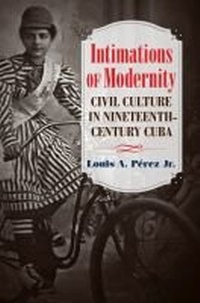
Intimations of Modernity
Civil Culture in Nineteenth-Century Cuba
Will be published approx. on 28. February 2017
Book
Hardback
288 pages
978-1-4696-3130-1 (ISBN)
Description
Louis A. Perez Jr.'s new history of nineteenth-century Cuba chronicles in fascinating detail the emergence of an urban middle class that was imbued with new knowledge and moral systems. Fostering innovative skills and technologies, these Cubans became deeply implicated in an expanding market culture during the boom in sugar production and prior to independence. Contributing to the cultural history of capitalism in Latin America, Perez argues that such creoles were cosmopolitans with powerful transnational affinities and an abiding identification with modernity. This period of Cuban history is usually viewed through a political lens, but Perez, here emphasizing the character of everyday life within the increasingly fraught colonial system, shows how moral, social, and cultural change that resulted from market forces also contributed to conditions leading to the collapse of the Spanish colonial administration.
Perez highlights women's centrality in this process, showing how criollas adapted to new modes of self-representation as a means of self-fulfillment. Increasing opportunities for middle-class women's public presence and social participation was both cause and consequence of expanding consumerism and of women's challenges to prevailing gender hierarchies. Seemingly simple actions--riding a bicycle, for example, or deploying the abanico, the fan, in different ways--exposed how traditional systems of power and privilege clashed with norms of modernity and progress.
Perez highlights women's centrality in this process, showing how criollas adapted to new modes of self-representation as a means of self-fulfillment. Increasing opportunities for middle-class women's public presence and social participation was both cause and consequence of expanding consumerism and of women's challenges to prevailing gender hierarchies. Seemingly simple actions--riding a bicycle, for example, or deploying the abanico, the fan, in different ways--exposed how traditional systems of power and privilege clashed with norms of modernity and progress.
More details
Series
Language
English
Place of publication
Chapel Hill
United States
Target group
Professional and scholarly
Illustrations
24 halftones, 1 tables
Dimensions
Height: 235 mm
Width: 155 mm
Thickness: 25 mm
Weight
540 gr
ISBN-13
978-1-4696-3130-1 (9781469631301)
Copyright in bibliographic data and cover images is held by Nielsen Book Services Limited or by the publishers or by their respective licensors: all rights reserved.
Schweitzer Classification
Other editions
Additional editions
E-Book
01/2017
The University of North Carolina Press
€29.49
Available for download
Person
Louis A. Perez Jr is J. Carlyle Sitterson Professor of History at the University of North Carolina at Chapel Hill. A fellow of the American Academy of Arts and Sciences as well as the Academia de la Historia de Cuba, Perez is author, most recently, of The Structure of Cuban History: Meanings and Purpose of the Past.