

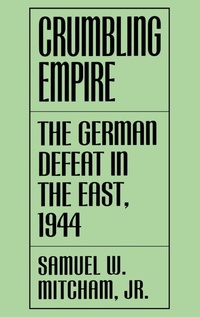
Crumbling Empire
The German Defeat in the East, 1944
Published on 30. June 2001
Book
Hardback
336 pages
978-0-275-96856-4 (ISBN)
Description
The last place a German soldier wanted to be in 1944 was the Russian front. That summer, Stalin hurled into battle more than six million men and 9,000 tanks, supported by 16,000 fighters and bombers and more than 12,800 guns and rocket launchers. Despite this massive effort and the resulting decimation of German forces, events on the Eastern Front are largely neglected by historians who focus instead on German defeats in Normandy and the Ardennes. This account details the massive battles on the Eastern Front from the summer of 1944 until the fall of Budapest in early 1945, a period when Hitler lost the majority of his conquered Eastern territories and many of his best remaining divisions.
To destroy the Third Reich, the Allies needed to defeat the German Wehrmacht militarily, and the decisive victories of this period occurred on the Russian Front. More German soldiers were lost in White Russia than at Stalingrad; more troops were lost in Rumania in a brief ten days than in the entire Normandy campaign; and German losses in Hungary were greater than the Battle of the Bulge. The most mobile army in the world in 1940, the German Army was the least mobile by 1944, and Hitler's stand fast and fortified place policies imposed a paralysis that neither senior German generals nor the High Command of the Army were able to overcome. Outnumbered 3 to 1 in men, 5 to 1 in tanks, and 20 to 1 in airplanes, the German Army was slaughtered, as casualties mounted and the empire crumbled.
To destroy the Third Reich, the Allies needed to defeat the German Wehrmacht militarily, and the decisive victories of this period occurred on the Russian Front. More German soldiers were lost in White Russia than at Stalingrad; more troops were lost in Rumania in a brief ten days than in the entire Normandy campaign; and German losses in Hungary were greater than the Battle of the Bulge. The most mobile army in the world in 1940, the German Army was the least mobile by 1944, and Hitler's stand fast and fortified place policies imposed a paralysis that neither senior German generals nor the High Command of the Army were able to overcome. Outnumbered 3 to 1 in men, 5 to 1 in tanks, and 20 to 1 in airplanes, the German Army was slaughtered, as casualties mounted and the empire crumbled.
More details
Language
English
Place of publication
United States
Publishing group
Bloomsbury Publishing Plc
Target group
College/higher education
Professional and scholarly
Interest Age: From 7 to 17 years
Dimensions
Height: 240 mm
Width: 161 mm
Thickness: 23 mm
Weight
666 gr
ISBN-13
978-0-275-96856-4 (9780275968564)
Copyright in bibliographic data and cover images is held by Nielsen Book Services Limited or by the publishers or by their respective licensors: all rights reserved.
Schweitzer Classification
Person
SAMUEL W. MITCHAM, JR. is an internationally recognized authority on Nazi Germany and the Second World War and is the author of more than 15 books on the subject, including this title's companion volume, Retreat to the Reich (Praeger, 2000), Why Hitler? (Praeger, 1996), and The Desert Fox in Normandy (Praeger, 1997), as well as several dozen articles. A former army helicopter pilot and company commander, he is a graduate of the U.S. Army's Command and General Staff College. He has been a professor of geography and military history since 1984. He lives in rural Louisiana.
Content
The Cannae of Army Group Center
The Loss of the Ukraine
Stabilizing the Front
Intro the Courland Pocket
Rumania
The Retreat from the Balkans
The Battle for Hungry
Bibliography
Appendices
The Loss of the Ukraine
Stabilizing the Front
Intro the Courland Pocket
Rumania
The Retreat from the Balkans
The Battle for Hungry
Bibliography
Appendices