

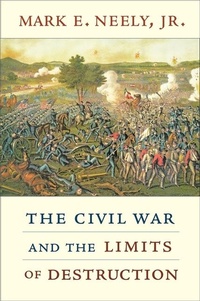
The Civil War and the Limits of Destruction
Published on 10. May 2010
Book
Paperback/Softback
288 pages
978-0-674-04595-8 (ISBN)
Description
The Civil War is often portrayed as the most brutal war in America's history, a premonition of twentieth-century slaughter and carnage. In challenging this view, Mark E. Neely, Jr., considers the war's destructiveness in a comparative context, revealing the sense of limits that guided the conduct of American soldiers and statesmen.
Neely begins by contrasting Civil War behavior with U.S. soldiers' experiences in the Mexican War of 1846. He examines Price's Raid in Missouri for evidence of deterioration in the restraints imposed by the customs of war; and in a brilliant analysis of Philip Sheridan's Shenandoah Valley campaign, he shows that the actions of U.S. cavalrymen were selective and controlled. The Mexican war of the 1860s between French imperial forces and republicans provided a new yardstick for brutality: Emperor Maximilian's infamous Black Decree threatened captured enemies with execution. Civil War battles, however, paled in comparison with the unrestrained warfare waged against the Plains Indians. Racial beliefs, Neely shows, were a major determinant of wartime behavior.
Destructive rhetoric was rampant in the congressional debate over the resolution to avenge the treatment of Union captives at Andersonville by deliberately starving and freezing to death Confederate prisoners of war. Nevertheless, to gauge the events of the war by the ferocity of its language of political hatred is a mistake, Neely argues. The modern overemphasis on violence in Civil War literature has led many scholars to go too far in drawing close analogies with the twentieth century's "total war" and the grim guerrilla struggles of Vietnam.
Neely begins by contrasting Civil War behavior with U.S. soldiers' experiences in the Mexican War of 1846. He examines Price's Raid in Missouri for evidence of deterioration in the restraints imposed by the customs of war; and in a brilliant analysis of Philip Sheridan's Shenandoah Valley campaign, he shows that the actions of U.S. cavalrymen were selective and controlled. The Mexican war of the 1860s between French imperial forces and republicans provided a new yardstick for brutality: Emperor Maximilian's infamous Black Decree threatened captured enemies with execution. Civil War battles, however, paled in comparison with the unrestrained warfare waged against the Plains Indians. Racial beliefs, Neely shows, were a major determinant of wartime behavior.
Destructive rhetoric was rampant in the congressional debate over the resolution to avenge the treatment of Union captives at Andersonville by deliberately starving and freezing to death Confederate prisoners of war. Nevertheless, to gauge the events of the war by the ferocity of its language of political hatred is a mistake, Neely argues. The modern overemphasis on violence in Civil War literature has led many scholars to go too far in drawing close analogies with the twentieth century's "total war" and the grim guerrilla struggles of Vietnam.
Reviews / Votes
In a perceptive and rigorously argued call to resist the temptation to describe the Civil War as an unusually destructive or brutal war, Mark Neely finds new ways to examine old questions and to challenge prevailing interpretations. This is another first-rate work from one of the best and most imaginative scholars working in the field of Civil War history. -- Gary W. Gallagher, author of <i>The Confederate War</i> Neely tackles a fascinating and important topic: were terror and brutality a key part of the Civil War? He makes a compelling case that the combat was more controlled than we now often accept. His account is original--in some cases clearly pathbreaking--and his tone passionate and gripping. This is a major contribution that will capture a wide readership. -- Ari Kelman, author of <i>A River and Its City</i> An intriguing new book...Neely argues forcefully and thoughtfully for a more realistic, less gory understanding of the great war...Whatever you think of Neely's arguments, you cannot reject them as poorly conceived or loosely defended. He is a thoughtful expert who delivers a book that you cannot read without transforming your view of the Civil War and its place in American history. -- Cameron McWhirter * Atlanta Journal-Constitution * Impressive and lively. -- David Waldstreicher * Boston Globe * A seminal work on a big issue, The Civil War and the Limits of Destruction should stir up much productive discussion. -- John Cimprich * Civil War Book Review * Using comparisons to other wars in other nations in the 19th and 20th centuries, Neely finds that the U.S. Civil War was not nearly as bloody as conventional wisdom (and much scholarly wisdom) has held. -- R. G. Lowe * Choice *More details
Language
English
Place of publication
Cambridge, Mass
United States
Target group
Professional and scholarly
US School Grade: College Graduate Student
Product notice
Paperback (trade)
Unsewn / adhesive bound
Illustrations
12 halftones
Dimensions
Height: 207 mm
Width: 134 mm
Thickness: 20 mm
Weight
322 gr
ISBN-13
978-0-674-04595-8 (9780674045958)
Copyright in bibliographic data and cover images is held by Nielsen Book Services Limited or by the publishers or by their respective licensors: all rights reserved.
Schweitzer Classification
Person
Mark E. Neely, Jr., is McCabe-Greer Professor of the History of the Civil War Era at Pennsylvania State University and the author of the Pulitzer Prize-winning The Fate of Liberty: Abraham Lincoln and Civil Liberties.
Content
Introduction: Destructiveness in the Civil War 1. The Mexican-American War: Republicanism and the Ethos of War 2. Price's Raid: Limited War in Missouri 3. Emperor Maximilian's Black Decree: War in the Tropics 4. The Shenandoah Valley: Sheridan and Scorched Earth 5. The Sand Creek Massacre: The Grand Burning of the Prairie 6. Avenging Andersonville: Retaliation and the Political Uses of Hatred Conclusion: The Cult of Violence in Civil War History Notes Selected Bibliography Acknowledgments Illustration Sources Index